
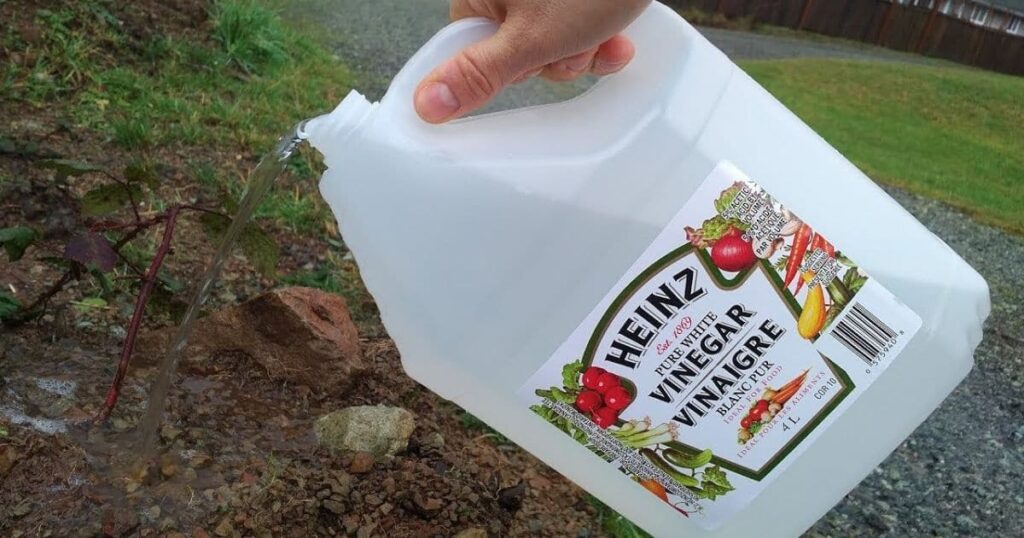
White vinegar is inexpensive, easy to find, and incredibly useful around the home. So it’s no surprise that gardeners have found plenty of ways to use it outdoors too.
But there’s an important catch.
Many viral gardening tips present vinegar as a natural fertilizer, pesticide, fungicide, soil acidifier, and weed killer all at once. While vinegar can be genuinely useful for certain garden tasks, some of these claims are exaggerated—and using it incorrectly can actually damage your plants.
White vinegar contains acetic acid, which is exactly why it can remove mineral deposits and damage young weeds. Unfortunately, that same acidity can also injure leaves, stems, roots, and some outdoor surfaces.
So rather than pouring vinegar everywhere, use it strategically.
Here are 10 smart ways to use white vinegar in and around the garden, plus several popular vinegar tricks you should think twice about. 🌱
🧪 First: What Is White Vinegar?
Household white vinegar is primarily water and acetic acid, commonly at a concentration of around 5%.
Its acidity makes it useful for:
✔ dissolving some mineral deposits
✔ removing certain residues
✔ household cleaning
✔ controlling odors in some situations
✔ damaging the foliage of some young weeds
But remember:
⚠️ Vinegar does not know the difference between a weed and your favorite flower.
If enough vinegar lands on desirable foliage, it can damage that plant too.
Higher-strength horticultural vinegar is considerably more hazardous than ordinary kitchen vinegar and requires special care. Don’t assume that a stronger concentration is simply a better garden remedy.
🪰 1. Make a Simple Trap for Small Fruit Flies
Apple cider vinegar is particularly attractive to certain small fruit flies because its fermented aroma draws them toward the liquid.
This makes vinegar useful in a trap.
It doesn’t mean vinegar repels fruit flies from your entire garden.
🍎 Simple vinegar trap
You’ll need:
- a small jar or container
- apple cider vinegar
- a drop of dish soap
Pour a small amount of apple cider vinegar into the container and add a tiny drop of dish soap.
Place the trap where small fruit flies are causing problems.
The vinegar acts as an attractant, while the soap reduces the liquid’s surface tension.
⚠️ Important distinction
Not every insect commonly called a “fruit fly” is the same pest.
A homemade vinegar trap shouldn’t be presented as universal protection for fruit trees or crops.
If fruit is being damaged directly on trees or plants, identify the pest before deciding on treatment.
🛠️ 2. Remove Mineral Deposits From Garden Tools
Garden tools can develop soil residue and mineral buildup after repeated use.
White vinegar can help loosen certain deposits.
How to use it
For suitable metal tools:
- Remove loose soil.
- Apply diluted vinegar to stubborn mineral deposits.
- Scrub with a brush or cloth.
- Rinse thoroughly.
- Dry the tool immediately.
For more stubborn rust, a longer treatment may sometimes help, but don’t leave every type of metal soaking indefinitely.
⚠️ Vinegar can react with or damage certain metals and finishes, so check the material and test first.
🌿 Important
Cleaning isn’t necessarily the same thing as disinfecting.
If you’re trying to prevent transmission of a known plant disease between pruning cuts or plants, use a sanitation method appropriate for that pathogen and tool.
🪴 3. Remove White Mineral Deposits From Terracotta Pots
Have you noticed a white crust forming on old terracotta pots?
These deposits can come from minerals in irrigation water and fertilizer salts.
Vinegar’s acidity can help dissolve some of this buildup.
🧽 How to clean an empty pot
First remove all soil and loose debris.
Then use diluted white vinegar to scrub the mineral deposits with a brush or sponge.
Rinse the pot very thoroughly with clean water before using it again.
Allow it to dry.
✨ This is one of the most practical garden uses for vinegar—and it can produce a satisfying before-and-after result.
🏷️ 4. Clean Reusable Plant Labels
Plant labels and markers can become covered in:
🌱 soil
💧 mineral residue
🟢 algae
🪴 general grime
Rather than throwing them away every season, clean and reuse them.
For compatible plastic or other acid-resistant labels, wipe them with diluted vinegar, scrub if necessary, rinse, and allow them to dry.
♻️ It’s a simple way to reduce garden waste.
💐 5. Help Keep Cut Flowers Fresh
Vinegar is sometimes included in homemade cut-flower solutions because lowering the pH of vase water can be useful under certain conditions.
However, vinegar alone isn’t a magic flower preservative.
Commercial flower food is designed to provide a more balanced solution.
🌸 For longer-lasting flowers, focus on the basics
✔ Start with a clean vase.
✔ Use fresh water.
✔ Remove leaves that would sit below the waterline.
✔ Recut stems when appropriate.
✔ Change the water regularly.
✔ Use commercial flower food according to its directions when available.
A carefully measured amount of vinegar may be part of some homemade flower-food recipes, but more vinegar isn’t better.
Too much acidity can damage plant tissue.
🌿 6. Target Very Young Weeds With Caution
This is probably the most famous outdoor use for vinegar.
Acetic acid can damage plant foliage, particularly the tender leaves of young weeds.
But calling ordinary vinegar a complete weed killer is misleading.
Why?
Household vinegar primarily damages the above-ground foliage it contacts.
Established perennial weeds may survive and regrow from their roots.
⚠️ Vinegar is non-selective
If it lands on:
🌹 roses
🥬 vegetables
🌱 seedlings
🌸 flowers
🌿 desirable plants
…it may damage those plants too.
Where targeted use makes more sense
If you choose to use household vinegar on young weeds, reserve it for locations where accidental contact with desirable plants can be avoided.
Never assume that because vinegar comes from the kitchen, it is harmless to vegetation.
💡 In vegetable and flower beds, hand pulling, hoeing and mulching are often better long-term approaches.
🧹 7. Clean Compatible Outdoor Garden Surfaces
Potting benches, hard plastic garden furniture, and other washable garden surfaces can accumulate dirt and mineral residue.
Diluted vinegar may be useful on certain acid-resistant surfaces.
Simple method
- Remove loose dirt.
- Apply diluted vinegar to a cloth or sponge.
- Wipe or gently scrub.
- Rinse thoroughly.
- Allow the surface to dry.
⚠️ Test first
Vinegar is not suitable for every outdoor surface.
Be particularly cautious around:
❌ marble
❌ limestone
❌ travertine
❌ other acid-sensitive natural stone
❌ some metals
❌ delicate finishes
Acid can permanently etch certain materials.
🪣 8. Remove Hard-Water Residue From Empty Containers
Watering cans, empty plant saucers, buckets and other gardening containers can gradually develop hard-water deposits.
White vinegar can help dissolve some calcium-based mineral buildup.
How to use it
For compatible materials:
- Empty the container.
- Apply diluted vinegar to the mineral deposits.
- Allow brief contact if needed.
- Scrub.
- Rinse thoroughly with clean water.
Never leave vinegar residue in containers that will immediately hold water for sensitive plants or animals.
🧼 9. Clean Empty Vases and Propagation Containers
Glass jars and vases used for cut flowers or plant propagation can develop cloudy mineral deposits along the waterline.
White vinegar is particularly useful here.
Add diluted vinegar to the empty container, allow it to contact the deposits, then scrub or wipe.
Rinse thoroughly before adding fresh water and plants.
✨ This is a much safer use of vinegar than spraying it directly onto living leaves.
🧤 10. Clean Up Around Your Potting Area
Garden workspaces become messy quickly.
Dried water spots, soil residue and mineral deposits can build up around potting areas.
On acid-resistant washable surfaces, diluted vinegar can make a useful occasional cleaner.
Just remember the golden rule:
👉 Keep cleaning vinegar away from nearby plant foliage and exposed roots.
Apply it to the cleaning cloth rather than spraying indiscriminately around plants.
🚫 6 Popular Vinegar Garden Hacks You Should Avoid
Some of the most popular vinegar tricks are actually the ones requiring the most caution.
Let’s separate useful garden advice from viral myths.
🌺 Myth #1: Regularly Water Acid-Loving Plants With Vinegar
You’ve probably seen recipes recommending vinegar water for:
🫐 blueberries
🌺 azaleas
🌿 rhododendrons
🌸 hydrangeas
The reasoning seems straightforward:
Vinegar is acidic → these plants prefer acidic soil → vinegar must be good for them.
But soil chemistry isn’t that simple.
Vinegar can temporarily affect acidity, but routinely pouring homemade vinegar solutions around roots isn’t a precise or reliable way to manage soil pH.
✅ Better approach
If you suspect your soil is too alkaline:
- Test the soil.
- Determine its actual pH.
- Check the requirements of your plant.
- Use an appropriate horticultural amendment if correction is necessary.
Long-term soil management is much more important than temporarily making irrigation water acidic.
🐛 Myth #2: Spray Vinegar on Aphids
This one can easily backfire.
Vinegar solutions may harm insects under direct exposure—but acetic acid can also damage plant foliage.
The difference between a mixture that does little and one that burns leaves can be problematic for homemade recipes.
🐞 Better aphid options
For minor infestations:
✔ remove aphids manually
✔ spray sturdy plants with water
✔ remove heavily infested shoots when appropriate
✔ encourage beneficial insects
When more control is necessary, use an appropriate insecticidal product according to its label.
Don’t turn your plant into the casualty while trying to kill the aphids.
🍄 Myth #3: Vinegar Is a Universal Natural Fungicide
Another popular claim is that spraying diluted vinegar onto plants prevents or cures fungal diseases.
That’s far too broad.
Plant diseases differ enormously, and a vinegar solution capable of affecting a pathogen may also cause phytotoxicity, meaning injury to the plant itself.
If you see:
🍂 leaf spots
⚪ white powder
🟤 lesions
🌿 unusual discoloration
identify the problem first.
Proper spacing, airflow, sanitation and watering practices may be more useful than spraying an unidentified homemade treatment.
🐌 Myth #4: Spray Vinegar Around the Garden to Kill Slugs
Direct contact with an acidic solution can harm slugs and snails.
But spraying vinegar around garden beds isn’t a good general strategy.
You risk exposing:
🌱 seedlings
🌿 foliage
🪱 soil organisms
🌸 ornamentals
to unnecessary acid.
🐌 Better options
Try:
✔ hand-picking during evening or damp conditions
✔ removing hiding places
✔ reducing unnecessary damp shelters
✔ using appropriate barriers or registered controls when necessary
The goal should be controlling the pest without damaging the garden around it.
🐈 Myth #5: Vinegar Is a Guaranteed Animal Repellent
Some cats and other animals dislike strong vinegar odors.
Vinegar-soaked cloths placed away from plants may therefore discourage some individual animals temporarily.
But this isn’t guaranteed.
Animals can become accustomed to smells, rain dilutes the vinegar, and responses vary.
Never pour large amounts of vinegar onto soil or plants just to deter an animal.
For persistent problems, physical barriers are generally more predictable.
🌸 Myth #6: Vinegar Makes Hydrangeas Change Color
This is another oversimplification.
Some hydrangeas can change flower color depending partly on soil pH and aluminum availability.
Simply pouring vinegar into the soil isn’t a precise way to control that chemistry.
If you’re deliberately trying to influence hydrangea color, first identify the hydrangea type and test the soil.
Then use amendments designed for horticultural soil management.
⚠️ 5 Places You Should NEVER Casually Spray Vinegar
❌ 1. On desirable plant leaves
Acetic acid can burn foliage.
❌ 2. Around exposed plant roots
Vinegar isn’t fertilizer and can injure plant tissue.
❌ 3. On lawns you want to keep
Grass is vegetation too. Vinegar isn’t selective.
❌ 4. On natural stone
Marble, limestone and other calcium-containing stone can be etched by acids.
❌ 5. As a universal pest spray
Different pests require different solutions.
🧪 What About Strong Horticultural Vinegar?
This is important.
Household vinegar and concentrated horticultural vinegar are not interchangeable.
Higher-concentration acetic acid products can cause much more serious:
⚠️ eye injury
⚠️ skin irritation or burns
⚠️ plant damage
Don’t increase the strength of a homemade weed treatment under the assumption that “natural” means safe.
If using a horticultural product, follow its label exactly and use the specified protective equipment.
🌱 Vinegar vs. Proper Soil Amendments
If you’re trying to change soil pH, don’t guess.
Different situations may call for different horticultural amendments.
The correct approach is:
Test → identify the problem → amend appropriately → retest when necessary.
This is especially important for long-lived plants such as blueberries, hydrangeas and rhododendrons.
A soil test gives you much more useful information than pouring kitchen ingredients around roots and hoping for the best.
🌿 Better Natural Alternatives for Common Garden Problems
Vinegar isn’t necessary for every garden problem.
🌱 For weeds
Try mulch, hand pulling or hoeing.
🐛 For aphids
Start with water and physical removal.
🐌 For slugs
Reduce hiding places and use physical or appropriately selected control methods.
🍄 For fungal problems
Identify the disease, improve airflow and adjust watering practices before reaching for a spray.
🌺 For soil pH
Test the soil and choose a suitable horticultural amendment.
♻️ For healthier soil
Use mature compost and appropriate organic matter rather than vinegar.
🌿 White Vinegar vs. Apple Cider Vinegar in the Garden
They’re sometimes used interchangeably online, but their most sensible garden uses differ.
White vinegar is generally the more practical option for cleaning tools, pots, containers and compatible outdoor surfaces.
Apple cider vinegar is particularly useful as an attractant in certain small fruit-fly traps.
Neither should be treated as a general-purpose plant fertilizer.
❓ FAQ – Using Vinegar in the Garden
Is white vinegar safe for plants?
Not necessarily. Acetic acid can damage plant tissue, especially when it contacts leaves and tender growth.
Can I pour vinegar directly onto soil?
Routine application isn’t recommended. If your goal is to alter soil pH, test the soil and use an appropriate amendment.
Does vinegar kill weeds permanently?
It may damage young weed foliage, but established perennial weeds can regrow from surviving roots.
Does vinegar kill aphids?
Direct exposure may harm some insects, but vinegar can also injure the plant. It isn’t my first recommendation for aphid control.
Can vinegar help with fruit flies?
Apple cider vinegar can attract certain small fruit flies and therefore works well as an ingredient in simple traps. A trap shouldn’t be confused with a universal garden repellent.
Can I use vinegar on hydrangeas?
Don’t routinely pour vinegar around hydrangeas to change their color or soil pH. Test the soil and use appropriate horticultural amendments instead.
Is vinegar good for garden tools?
It can be useful for removing certain mineral deposits and light rust from compatible tools. Rinse and dry metal tools thoroughly afterward.
Can vinegar clean terracotta pots?
Yes, diluted vinegar can help dissolve mineral deposits on empty terracotta pots. Rinse thoroughly before reusing them.
Is vinegar a natural fertilizer?
No. Vinegar doesn’t provide the balanced nutrients plants need and shouldn’t be considered a fertilizer.
Can vinegar replace pesticides?
No. Vinegar isn’t a universal pesticide, fungicide or herbicide. The appropriate solution depends on the specific problem.
🏁 Final Thoughts
White vinegar absolutely deserves a place in your garden toolkit—but mostly for targeted cleaning and a few carefully selected outdoor jobs, not as a miracle treatment for every plant problem.
Some of its best uses include:
🪴 cleaning mineral deposits from pots
🛠️ cleaning compatible garden tools
🪰 making simple fruit-fly traps
💐 helping with cut-flower care
🧽 cleaning garden containers and work areas
🌿 carefully targeting certain young weeds away from desirable plants
The biggest mistake is assuming that because vinegar is natural and inexpensive, it must be harmless to plants.
It isn’t.
Use vinegar where its acidity is actually useful, keep it away from desirable foliage and roots, and choose proper horticultural solutions when you’re dealing with soil pH, pests or plant diseases.
🌱 Used wisely, vinegar can be a handy garden helper—without putting your plants at unnecessary risk.