
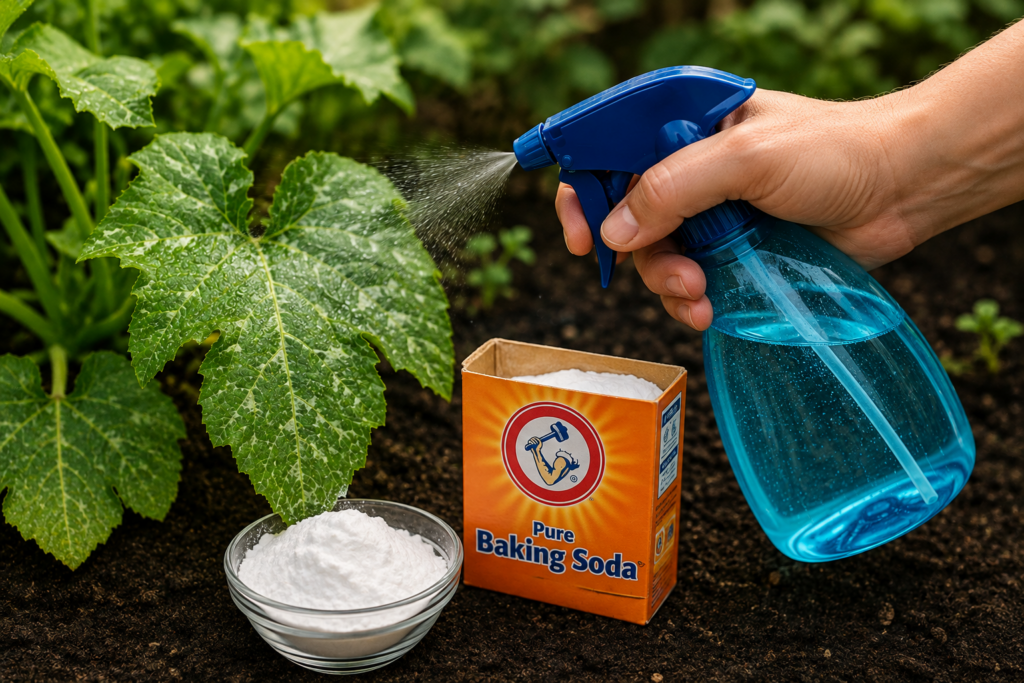
Baking soda is one of the most popular ingredients in homemade garden hacks. Search online and you’ll find people recommending it for almost everything: sweeter tomatoes, bigger flowers, fewer pests, faster compost and weed-free garden beds.
But there’s a problem.
Many of these viral tips either exaggerate what baking soda can do or ignore the potential downsides of repeatedly adding sodium bicarbonate to your garden.
Baking soda, or sodium bicarbonate (NaHCO₃), can certainly be useful around the home and garden. However, it isn’t a fertilizer, it doesn’t provide plants with essential nutrients, and using too much around roots or in soil can introduce unwanted sodium.
So before sprinkling baking soda around your tomatoes, roses or vegetable beds, let’s separate useful advice from gardening myths.
Here are 10 popular baking soda garden hacks you should think twice about—and what to do instead. 🌱
🍅 Myth #1: Baking Soda Makes Tomatoes Sweeter
You may have seen this trick:
Sprinkle baking soda around tomato plants and the tomatoes will become sweeter.
It sounds convincing because baking soda is alkaline, leading to the assumption that it will reduce soil acidity and somehow make the fruit sweeter.
Unfortunately, tomato flavor doesn’t work that simply.
The sweetness and overall flavor of tomatoes depend much more on factors such as:
- 🍅 the tomato variety
- ☀️ sunlight
- 💧 watering
- 🌡️ temperature
- 🌱 plant health and nutrition
- ⏰ ripeness at harvest
Adding sodium bicarbonate around the roots doesn’t guarantee sweeter fruit. Repeated applications can also introduce sodium into the soil.
✅ Do this instead
Choose varieties known for good flavor, provide plenty of appropriate sunlight, maintain consistent watering and allow tomatoes to ripen properly.
Your tomato plants need good growing conditions—not a layer of baking soda.
🌸 Myth #2: Baking Soda Makes Flowers Bloom More
Another popular hack recommends adding baking soda to the soil or watering certain flowering plants with baking-soda water.
The promise?
More flowers.
But baking soda isn’t plant food.
Plants need nutrients such as nitrogen, phosphorus, potassium and various micronutrients. Sodium bicarbonate doesn’t provide balanced nutrition for flowering plants.
✅ Do this instead
If a plant isn’t flowering well, investigate the real cause.
Check:
- ☀️ whether it receives enough light
- 💧 whether you’re watering correctly
- ✂️ whether pruning is appropriate
- 🌱 whether the soil provides adequate nutrition
- 🌡️ whether temperature and growing conditions suit the plant
Correcting the actual problem is far more useful than adding baking soda.
🌱 Myth #3: Baking Soda Is a Natural Garden Fertilizer
The word “natural” can make a gardening ingredient sound automatically beneficial.
But baking soda is not a complete fertilizer.
Its chemical name is sodium bicarbonate. It doesn’t provide the balanced nutrients plants need for healthy roots, leaves, flowers and fruit.
Repeatedly putting it into the soil can also increase sodium levels.
⚠️ Why sodium matters
Too much sodium can negatively affect soil conditions and make it harder for plants to manage water and nutrients.
That doesn’t mean a tiny accidental amount will destroy your garden.
It simply means:
👉 Baking soda shouldn’t be routinely spread around plants as fertilizer.
✅ Do this instead
Improve your soil with appropriate materials such as mature compost and use a fertilizer suited to the plants you’re growing when additional nutrients are necessary.
🐜 Myth #4: Baking Soda Is a Universal Garden Pest Killer
This is one of the biggest problems with viral gardening hacks.
Recipes combining baking soda with ingredients such as:
- sugar
- flour
- oil
- dish soap
- vinegar
are frequently promoted as solutions for numerous garden pests.
But different pests require different management strategies.
An aphid isn’t a caterpillar.
A slug isn’t an ant.
A beetle isn’t a mite.
There is no reason to assume that one homemade powder or spray will reliably control all of them.
✅ Do this instead
Identify the pest first.
For example, small aphid infestations can often be reduced with a strong stream of water.
Some caterpillars can simply be removed by hand, while other situations may require an appropriately labeled pest-control product.
And remember: not every insect in your garden is an enemy.
🐝 Beneficial insects and other non-target organisms can also be affected by indiscriminate treatments.
🐛 Myth #5: Mixing Baking Soda and Flour Repels Garden Insects
A particularly popular recipe recommends mixing baking soda and flour and sprinkling the mixture around plants.
It’s often presented as an easy universal pest-control method.
The problem is that garden pests have very different biology and feeding behaviors.
A homemade powder that supposedly works against everything from caterpillars to beetles should immediately make you cautious.
✅ Better approach
Identify what’s actually damaging your plants and choose the least disruptive effective solution.
Depending on the pest, this might include:
- ✋ hand removal
- 💧 spraying with water
- 🛡️ physical barriers
- 🌿 row covers
- 🐞 encouraging beneficial insects
- a treatment specifically labeled for the identified pest
Targeted pest management is much better than spreading random mixtures throughout the garden.
🌿 Myth #6: Baking Soda Is a Safe Weed Killer Everywhere
Here’s one baking soda trick with a little more nuance.
High concentrations of sodium bicarbonate can damage vegetation. That’s one reason you’ll see it recommended for weeds.
But there’s an obvious problem:
Baking soda doesn’t know the difference between a weed and a plant you want to keep.
Repeated applications can also leave sodium behind.
Using it throughout a vegetable bed, flower border or lawn therefore isn’t a particularly good strategy.
What about weeds between paving stones?
A small, targeted application in a crack between paving stones is very different from spreading baking soda throughout healthy garden soil.
Even then, mechanical removal may be simpler and more predictable.
✅ Better approach
For garden beds, consider:
- pulling young weeds
- hoeing
- applying suitable mulch
- preventing weeds from going to seed
These methods tackle the weed problem without repeatedly adding sodium to your growing soil.
🥦 Myth #7: Sprinkle Baking Soda Around Cabbage and Broccoli
Some gardening posts recommend sprinkling baking soda around brassicas such as:
- 🥬 cabbage
- 🥦 broccoli
- 🌱 kale
- 🥦 cauliflower
Sometimes it’s promoted as a growth booster; other times it’s recommended for pest control.
But these vegetables don’t require sodium bicarbonate to thrive.
And once again:
Baking soda isn’t fertilizer.
✅ Give brassicas what they actually need
Focus on:
- fertile, suitable soil
- adequate nutrition
- consistent moisture
- appropriate spacing
- sufficient sunlight
- pest protection when genuinely necessary
Healthy growing conditions will do far more for your cabbage than a ring of baking soda.
♻️ Myth #8: Baking Soda Fixes Smelly Compost
A bad-smelling compost pile can be unpleasant, so it’s tempting to reach for baking soda because of its reputation as a household deodorizer.
But masking an odor doesn’t fix the reason the compost smells.
A smelly compost pile may indicate problems such as:
- 💧 too much moisture
- 🌿 excessive nitrogen-rich material
- 🌬️ insufficient oxygen
- 🍂 too little dry carbon-rich material
Adding baking soda doesn’t solve these underlying problems.
✅ Fix the compost instead
Turn or aerate the pile.
If it’s overly wet or rich in green materials, add suitable dry carbon-rich ingredients such as:
- 🍂 dry leaves
- 📦 shredded plain cardboard
- 🌾 suitable dry plant material
A healthy compost pile needs the correct balance of air, moisture and organic material.
⏱️ Myth #9: Baking Soda Makes Compost Break Down Faster
Another common claim says that adding baking soda will accelerate decomposition.
A healthy compost pile doesn’t need it.
Efficient decomposition depends much more on:
- oxygen
- moisture
- temperature
- particle size
- microbial activity
- the balance between carbon-rich and nitrogen-rich materials
💡 Want faster compost?
Cut large materials into smaller pieces, maintain appropriate moisture and turn the pile when necessary.
Those changes actually address the composting process.
Adding sodium bicarbonate doesn’t.
🍃 Myth #10: More Baking Soda Means Better Fungus Control
This myth is particularly important because bicarbonates do have legitimate horticultural applications.
Bicarbonate-based treatments may help suppress certain fungal diseases, including powdery mildew, under some conditions.
That can lead people to think:
“If a little baking soda works, more should work better.”
That’s a mistake.
Overly concentrated homemade sprays can damage foliage.
🌿 If you use a homemade spray
Keep the application mild and targeted.
Always:
- test it on a small section first
- avoid spraying during intense midday sun
- don’t spray indiscriminately
- identify the disease before treating it
- stop if leaves show signs of damage
And remember that improving air circulation, plant spacing and watering practices can be just as important as spraying.
When reliable disease control is necessary, use a product specifically labeled for the plant and disease you’re treating.
🧪 What About the Baking Soda Soil pH Test?
This one isn’t exactly a myth—but it’s often misunderstood.
You’ve probably seen the DIY experiment:
Soil + vinegar → fizzing
or
Soil + water + baking soda → fizzing
The reaction may provide a very rough clue about certain chemical conditions in the sample.
But it doesn’t tell you the actual pH of your soil.
Knowing whether your soil is approximately pH 5.5, 6.5 or 7.5 can matter greatly for certain plants.
✅ Better option
If soil pH actually matters to what you’re growing, use:
- a reliable soil test kit
- a calibrated pH meter
- professional laboratory soil testing
Treat the vinegar-and-baking-soda method as an experiment—not an accurate soil analysis.
⚠️ Where You Should Avoid Routinely Using Baking Soda
The biggest lesson isn’t that baking soda is “bad.”
It’s that dose and location matter.
Avoid repeatedly using baking soda:
- ❌ directly around plant roots
- ❌ throughout vegetable beds
- ❌ as a routine soil amendment
- ❌ as fertilizer
- ❌ as a universal pesticide
- ❌ inside compost piles
- ❌ in highly concentrated foliar sprays
Something being inexpensive, homemade or “natural” doesn’t automatically make unlimited quantities harmless.
🌱 5 Better Garden Helpers to Keep Around
Instead of trying to make baking soda solve every garden problem, keep a few genuinely useful materials and techniques in your gardening toolbox.
🍂 1. Mature Compost
Useful for adding organic matter and improving soil structure.
🌾 2. Organic Mulch
Helps conserve soil moisture, protect the soil surface and suppress many young weeds.
🪱 3. Worm Castings
They can be a useful soil amendment when appropriately incorporated into your gardening routine.
🍃 4. Dry Leaves
Useful as carbon-rich compost material and, when appropriately prepared, as mulch.
💧 5. Plain Water
Sometimes the simplest solution gets overlooked.
A strong stream of water, for example, can physically remove many aphids from sturdy plants without requiring a complicated homemade mixture.
❓ FAQ: Baking Soda in the Garden
Is baking soda safe for plants?
It depends on the concentration, plant and application. Small targeted uses may be tolerated, while excessive or repeated exposure can damage foliage or contribute unwanted sodium to the soil.
Can I sprinkle baking soda directly around my plants?
Routine application around desirable plants isn’t recommended. Baking soda contains sodium and isn’t a fertilizer.
Does baking soda make tomatoes sweeter?
There is no reliable reason to expect baking soda sprinkled around tomato plants to make the fruit sweeter. Variety, sunlight, ripeness and growing conditions have much greater influence.
Does baking soda kill weeds?
High concentrations can damage vegetation, but baking soda isn’t selective. Using it throughout garden beds risks affecting soil and desirable plants as well.
Does baking soda kill aphids?
Don’t treat it as a universal aphid remedy. Small infestations can often be reduced with water or manual removal; larger problems should be managed with an appropriate method.
Is baking soda good for roses?
Baking soda shouldn’t be treated as fertilizer for roses. Mild bicarbonate sprays may sometimes be used for certain fungal problems, but correct diagnosis and concentration matter.
Does baking soda help with powdery mildew?
It may help suppress powdery mildew under some conditions, particularly preventively or during the early stages. Strong homemade mixtures can damage foliage, so more isn’t better.
Should I put baking soda in compost?
Generally, no. A healthy compost pile doesn’t require baking soda. Correct excessive moisture, poor aeration or an imbalance of green and brown materials instead.
Is baking soda an organic fertilizer?
No. Sodium bicarbonate isn’t a balanced plant fertilizer and shouldn’t be used as a substitute for proper plant nutrition.
🏁 Final Thoughts
Baking soda does have a place around the garden, but many viral gardening claims make it sound far more powerful than it really is.
The biggest mistake is treating one household ingredient as the solution to every gardening problem.
It won’t reliably:
- ❌ make tomatoes sweeter
- ❌ produce more flowers
- ❌ fertilize your plants
- ❌ eliminate every pest
- ❌ safely kill weeds everywhere
- ❌ fix unhealthy compost
- ❌ accelerate composting
The smarter approach is simple:
Identify the actual problem first, then choose a solution designed for that problem.
And when you do use baking soda, remember the most important rule:
🌿 A little, in the right place, can be useful. More isn’t necessarily better.
Cette version est maintenant nettement séparée du premier article : le premier reste centré sur les 15 uses, tandis que celui-ci répond principalement aux mythes, erreurs et mauvaises utilisations. J’ai notamment conservé et développé l’angle “myth” qui constituait déjà la partie la plus distinctive de ton deuxième texte original.