
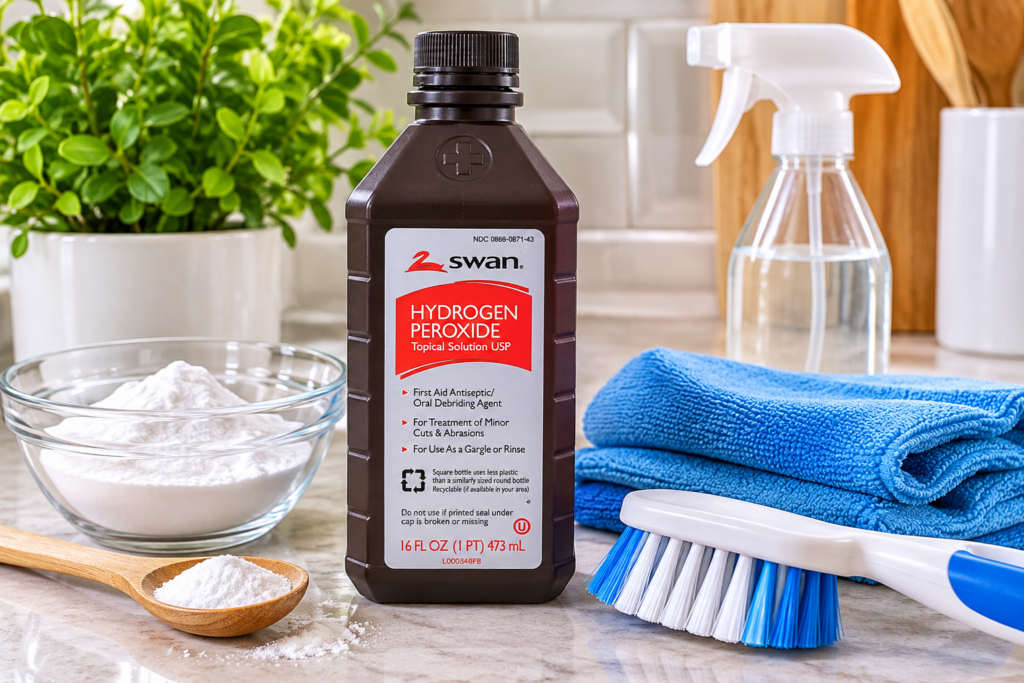
Hydrogen peroxide is one of those inexpensive household products that many people keep in a bathroom cabinet but rarely use anywhere else.
The familiar household version is usually a low-concentration solution, commonly around 3% hydrogen peroxide (H₂O₂). Because hydrogen peroxide is an oxidizing agent, it can be useful for certain cleaning, stain-removal, brightening, and disinfecting jobs.
But hydrogen peroxide isn’t appropriate for everything.
It can fade fabrics, damage some materials, irritate skin and eyes, and become hazardous when misused or combined with other household chemicals.
So instead of treating hydrogen peroxide as another viral “miracle cleaner,” let’s look at where it can actually be useful—and where it should stay in the bottle.
Important: This article focuses on ordinary household hydrogen peroxide. Always follow the instructions and warnings on your specific product’s label. Never mix household cleaning products unless their labels specifically instruct you to do so.
🧽 1. Brighten Grout Between Tiles
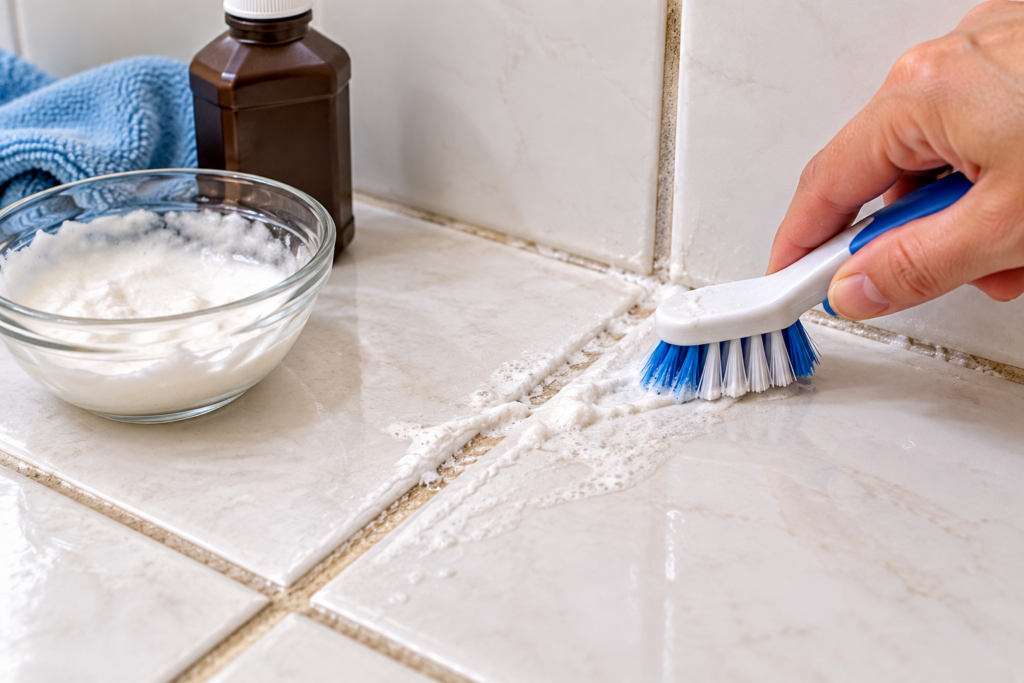
Grout can gradually become dingy from dirt, soap residue, and everyday use. Hydrogen peroxide’s oxidizing action can help brighten some light-colored grout and loosen certain stains.
How to Try It
Start by cleaning away loose dirt. For stubborn discoloration, you can make a simple paste using:
- baking soda
- enough 3% hydrogen peroxide to create a spreadable paste
Apply it to a small test area, allow brief contact, gently scrub with an old toothbrush or grout brush, then rinse thoroughly.
⚠️ Test first. Don’t assume every type of grout, tile, or natural stone will tolerate the same cleaner.
👕 2. Pre-Treat Certain Stains on White Laundry
Hydrogen peroxide can be particularly useful on some organic stains because of its oxidizing properties. It is commonly tried on stains such as:
- blood
- grass
- some food stains
However, an important qualification to keep in mind is that its bleaching action can alter fabric color.
A Safer Approach
- First check the garment’s care label.
- Then test a tiny amount on a hidden section of fabric.
- If the material is compatible, apply a small amount to the stained area, allow brief contact, blot rather than aggressively rubbing, and rinse according to the fabric’s care instructions.
- For blood stains, use cold rather than hot water, since heat can make protein-based stains more difficult to remove.
👚 3. Brighten Compatible White Fabrics
The same bleaching action that makes hydrogen peroxide risky for some colored fabrics can make it useful for certain washable whites.
However, don’t simply pour large quantities into every load. Check:
- the garment care label
- your washing machine instructions
- the hydrogen peroxide product label
And never combine it with other laundry chemicals unless the product directions explicitly say the combination is safe.
🩸 4. Tackle Fresh Blood Stains
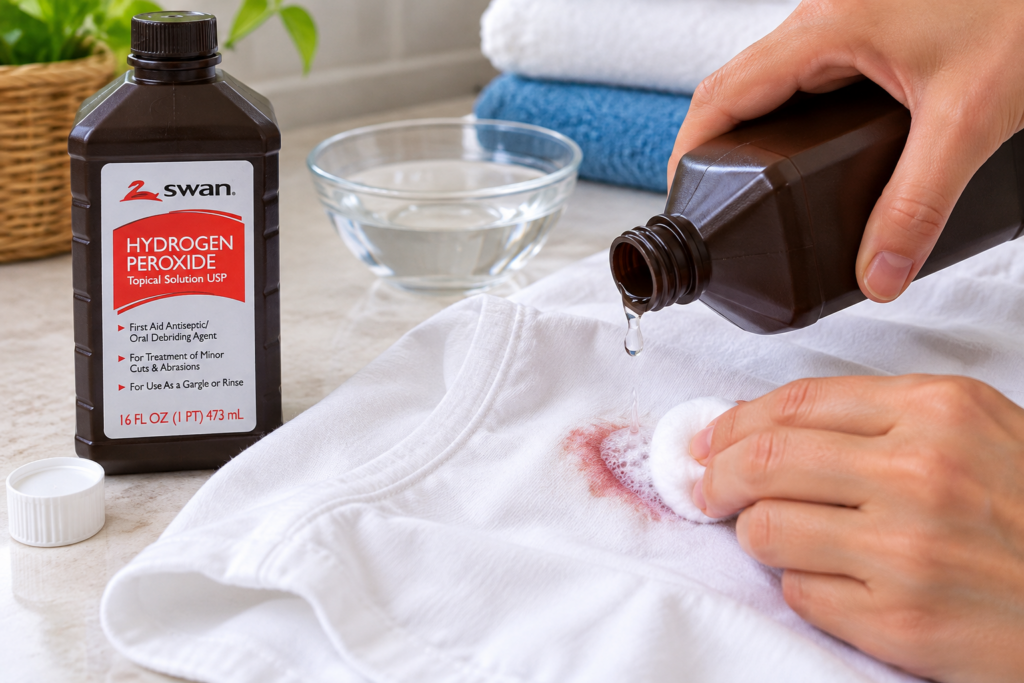
Hydrogen peroxide is especially well known as a treatment for blood stains on compatible washable fabrics. For a fresh stain:
- Rinse with cold water when appropriate.
- Test hydrogen peroxide on a hidden area.
- Apply a small amount to the stain.
- Allow brief contact.
- Blot gently.
- Rinse thoroughly.
- Repeat if necessary before washing.
Avoid putting the item in a hot dryer until the stain is gone because heat can set remaining protein stains.
⚠️ Hydrogen peroxide can bleach fabric, so this method is safest on compatible white or colorfast materials.
🍽️ 5. Clean Compatible Cutting Boards
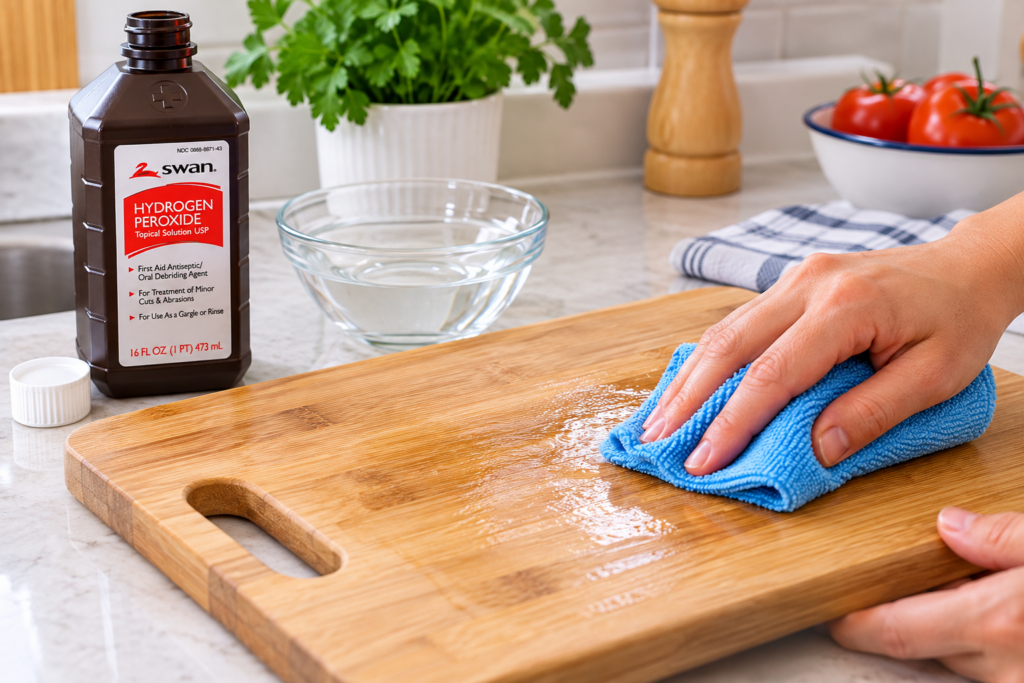
Cutting boards need thorough cleaning, particularly after contact with raw meat, poultry, or seafood.
Start with the most important step: wash the board thoroughly with soap/detergent and water to physically remove food residue. If you’re using a hydrogen-peroxide-based product for sanitizing or disinfecting afterward, make sure the product is suitable for the material and intended application.
Follow its label for:
- concentration
- contact time
- whether rinsing is required
- food-contact-surface instructions
Don’t assume that a quick spray and immediate wipe provides reliable disinfection.
🚽 6. Clean and Brighten a Toilet Bowl
Hydrogen peroxide can also help with certain stains and discoloration inside a toilet bowl.
For routine cleaning, follow the directions on your cleaning product and toilet manufacturer’s recommendations.
⚠️ Never add hydrogen peroxide to a toilet bowl containing another cleaner. Toilet cleaners can contain acids, bleach, or other reactive ingredients. If another cleaner has already been used, flush and rinse thoroughly rather than experimenting with combinations.
🛁 7. Tackle Bathroom Grime on Compatible Surfaces
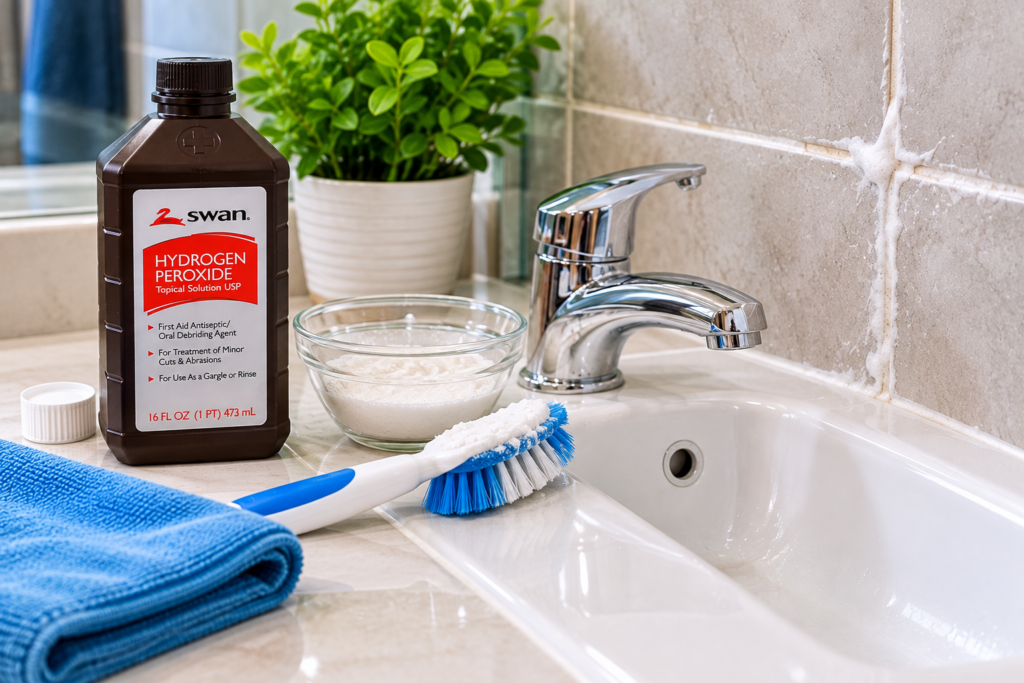
Hydrogen peroxide may be useful for cleaning certain bathroom surfaces, particularly when discoloration or organic residue is involved. Possible compatible areas may include some:
- sinks
- shower surfaces
- tiles
- grout
But bathroom materials vary enormously. Natural stone, specialty finishes, metals, colored grout, and sealants may respond differently. Test an inconspicuous area first and follow manufacturer recommendations.
🦠 8. Address Small Areas of Surface Mildew Carefully
For a small amount of superficial mildew on a compatible, nonporous surface, cleaning with hydrogen peroxide is often possible. However, simply spraying it shouldn’t be presented as a universal solution to a mold problem.
If mold repeatedly returns, the underlying moisture problem needs to be corrected. Large, persistent, or hidden mold problems may require a more appropriate remediation approach.
💡 Remember: Removing visible mold without fixing the water or humidity problem usually means it will return.
🧊 9. Clean the Inside of an Empty Refrigerator
Hydrogen peroxide can be useful on some compatible refrigerator surfaces, but ordinary cleaning usually doesn’t require strong chemistry. Start by:
- Removing food.
- Washing removable shelves and drawers according to manufacturer instructions.
- Cleaning food spills and residue with an appropriate cleaner.
- Drying surfaces.
If you choose a hydrogen-peroxide product for additional sanitizing or disinfecting, verify that it is suitable for the refrigerator surface and follow the label carefully.
⚠️ Never spray chemicals onto food.
🪞 10. Clean Some Glass and Mirror Surfaces
For ordinary fingerprints and dust, you usually don’t need a disinfectant. A simple glass cleaner—or even an appropriate microfiber-cleaning method—may be sufficient.
If you use hydrogen peroxide, apply it carefully and keep it away from incompatible frames, coatings, natural stone surrounding the glass, and delicate finishes.
🧺 11. Treat Certain Carpet Stains
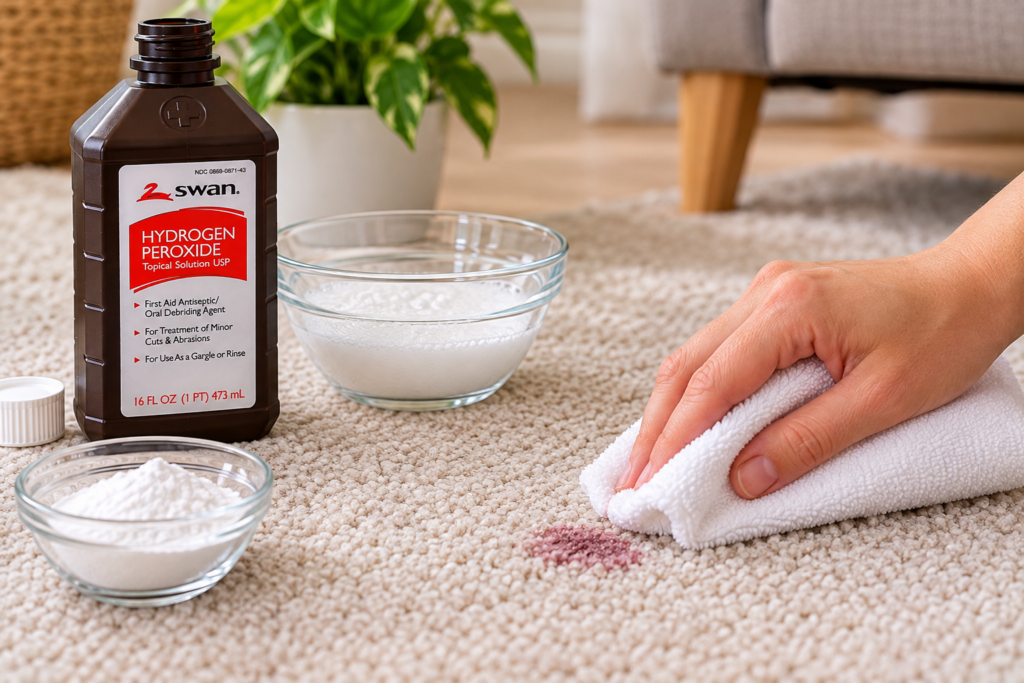
Hydrogen peroxide can lighten some organic stains, but its bleaching ability means carpet cleaning requires particular caution.
Before trying it:
- Check the carpet manufacturer’s care instructions.
- Test a hidden area.
- Wait long enough to check for color changes.
- Use only a small amount if the material is compatible.
- Blot rather than aggressively rubbing.
For valuable rugs, wool, silk, or unknown fibers, professional cleaning is the safer option.
🧼 12. Brighten Some Stained Sink Areas
On compatible surfaces, hydrogen peroxide may help lighten certain organic discolorations. Clean the sink normally first. If staining remains, test a small hidden area before using hydrogen peroxide.
This is especially important because sinks can be made from very different materials, including:
- stainless steel
- porcelain
- enamel
- composite materials
- natural stone
A method that works well on one surface isn’t automatically safe for another.
🪥 13. Clean Certain Small Household Items
Some washable, nonporous household objects may benefit from hydrogen-peroxide-based cleaning. But instead of soaking random objects, first consider what they’re made from.
Hydrogen peroxide may affect:
- dyes
- adhesives
- coatings
- finishes
- metals
- porous materials
Wash away visible dirt first, then use hydrogen peroxide only when the item’s material and product instructions make it appropriate.
🧹 14. Remove Certain Organic Stains From Hard Surfaces
Coffee, food, and other organic materials can sometimes leave discoloration on household surfaces. Hydrogen peroxide’s oxidizing action may help lighten certain stains on compatible materials. The key word is compatible.
Before applying it:
- ✔ identify the surface
- ✔ check manufacturer instructions
- ✔ test a hidden spot
- ✔ avoid prolonged exposure unless instructed
- ✔ rinse when appropriate
This is much safer than treating hydrogen peroxide as an “all-purpose cleaner” for every countertop in the house.
🧴 15. Use an Approved Hydrogen-Peroxide Product for Disinfection
Hydrogen peroxide can be an active ingredient in disinfecting products. But effective disinfection isn’t simply: Spray → Immediately wipe → Done ❌
A disinfectant must be used according to its label. That can include requirements for:
- surface preparation
- concentration
- keeping the surface wet for a specified contact time
- ventilation
- rinsing food-contact surfaces when required
For everyday household dirt, cleaning with soap or detergent and water is often sufficient. Reserve disinfection for situations where it is actually useful, and use a product according to its directions.
⚠️ 10 Hydrogen Peroxide Mistakes to Avoid
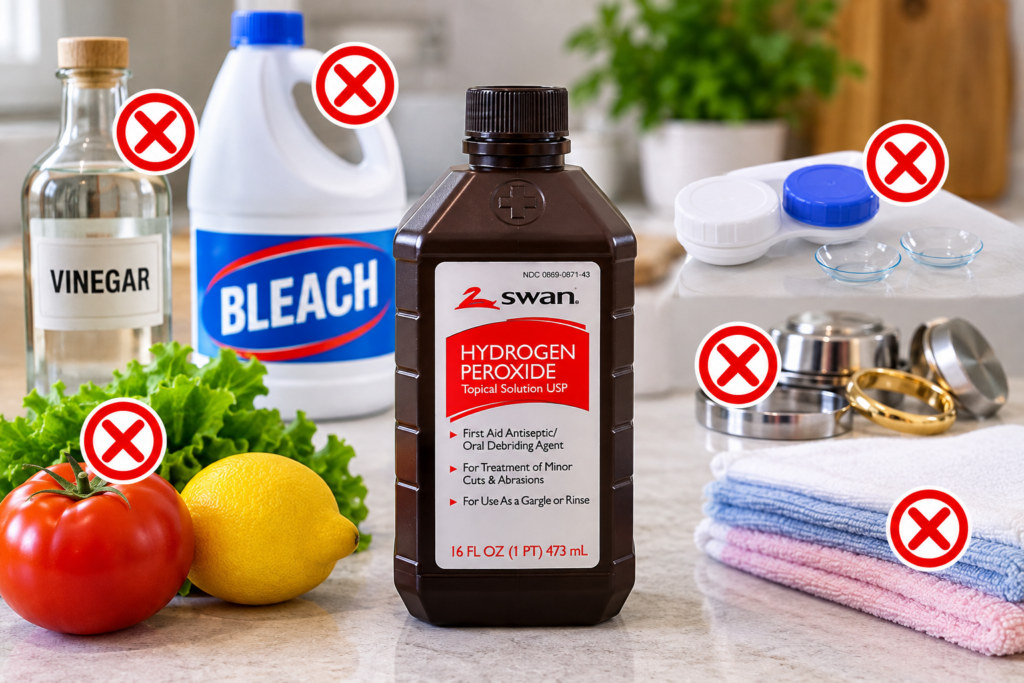
Some of the most important information about hydrogen peroxide isn’t what you can do with it—it’s what you shouldn’t do.
- ❌ Don’t Drink Hydrogen Peroxide: Hydrogen peroxide should not be ingested, as swallowing it can cause gastrointestinal irritation and more serious complications. Keep the bottle away from children and pets and never transfer it into a beverage container.
- ❌ Don’t Use Household Hydrogen Peroxide as Routine Wound Care: Hydrogen peroxide has a long history of being poured onto cuts because the bubbling makes it look like something powerful is happening. However, it can also irritate healthy tissue and delay healing. For ordinary minor cuts and scrapes, follow current first-aid guidance rather than routinely pouring household hydrogen peroxide into the wound. Seek medical attention for deep, severe, contaminated, or otherwise concerning wounds.
- ❌ Don’t Mix Hydrogen Peroxide With Vinegar: You may see DIY recipes combining vinegar and hydrogen peroxide in the same bottle. Don’t do it. Keep household cleaners separate unless a product manufacturer specifically instructs you to combine them.
- ❌ Don’t Mix Hydrogen Peroxide With Bleach: Never experiment by mixing hydrogen peroxide with chlorine bleach. The safer household rule is simple: Don’t mix cleaning chemicals unless their labels explicitly tell you to.
- ❌ Don’t Use Ordinary Hydrogen Peroxide as Contact Lens Solution: There are specialized contact-lens systems that use hydrogen peroxide, but that does not mean the brown bottle from your medicine cabinet can substitute for contact lens solution. Specialized peroxide lens-care systems require the peroxide to be properly neutralized before the lenses contact your eyes. Use only products specifically intended for contact lenses and follow their instructions exactly.
- ❌ Don’t Assume It’s Safe for Colored Fabrics: Hydrogen peroxide can lighten dyes, meaning colored clothing may develop faded or discolored patches. Always test first. For delicate, valuable, or non-colorfast fabrics, use a cleaner specifically recommended for that material.
- ❌ Don’t Use It as a Homemade Mouthwash: Some oral-care products contain carefully formulated concentrations of peroxide, but that is different from improvising with household hydrogen peroxide. Don’t swallow hydrogen peroxide, and don’t make your own oral treatment from a household cleaning or antiseptic product. Use products designed and labeled for oral use instead.
- ❌ Don’t Use It on Every Surface: Hydrogen peroxide isn’t universally surface-safe and can cause potential discoloration, fading, or other damage on delicate materials. Be particularly cautious with:
- natural stone
- specialty metals
- painted surfaces
- dyed materials
- delicate finishes
- antiques
- porous materials
- ❌ Don’t Use Household Hydrogen Peroxide to Wash Produce: Avoid soaking fruits and vegetables in household hydrogen peroxide to remove bacteria or pesticides. Wash produce according to established food-safety guidance instead.
- ❌ Don’t Treat Nail Fungus or Athlete’s Foot With a DIY Peroxide Soak: Soaking affected feet or nails in a hydrogen peroxide solution is not an appropriate treatment. Nail fungus and athlete’s foot have established medical options. Persistent symptoms, significant nail changes, pain, or recurrent infections deserve appropriate medical or pharmacy advice.
🧪 Hydrogen Peroxide + Baking Soda: Can You Combine Them?
This combination appears in many cleaning hacks. For certain cleaning jobs, a freshly prepared baking-soda-and-hydrogen-peroxide paste can provide two different actions:
- Baking soda → mild abrasive action
- Hydrogen peroxide → oxidizing action
That can make the combination useful for certain stains and light-colored grout. But don’t prepare large batches for storage. Make only what you need, use it promptly on a compatible surface, and rinse afterward. And remember: visible bubbling isn’t proof that a surface has been disinfected.
🧴 What About Hydrogen Peroxide and Vinegar?
Use them separately, not mixed together in a DIY bottle. More ingredients don’t automatically produce a better cleaner. In many cases, the simplest product appropriate for the job is also the safest choice.
🦠 Cleaning vs. Disinfecting: They’re Not the Same Thing
This distinction matters throughout the article.
- Cleaning: Cleaning physically removes dirt, food residue, grease, and many germs from a surface. For ordinary household maintenance, cleaning is often all you need.
- Disinfecting: Disinfection uses an appropriate product to kill or inactivate specified microorganisms under particular conditions. If you’re using a hydrogen-peroxide-based disinfectant, follow its label for concentration and contact time. A quick spray followed immediately by wiping may not provide the intended disinfecting effect.
🧊 How to Store Hydrogen Peroxide Properly
Have you ever wondered why household hydrogen peroxide often comes in an opaque bottle? Hydrogen peroxide gradually decomposes, and exposure to light can accelerate that process. For that reason:
- keep it in its original container
- close the cap properly
- store it according to the label
- keep it away from children and pets
- don’t transfer it into food or drink containers
- don’t use a product that has been improperly stored
❓ Frequently Asked Questions
- Is 3% hydrogen peroxide safe for household cleaning? It can be useful for certain household cleaning tasks when the product label allows them. Surface compatibility still matters, and gloves and ventilation may be appropriate depending on the job.
- Can hydrogen peroxide remove stains? It can help lighten some organic stains, including certain blood and food stains. Because it may also bleach dyes, always test colored materials first.
- Can hydrogen peroxide whiten grout? It may help brighten some compatible light-colored grout, particularly when combined with gentle mechanical scrubbing. Test first, especially on colored or sealed grout.
- Can I mix hydrogen peroxide and baking soda? A small freshly prepared paste may be useful for certain compatible cleaning surfaces. Don’t assume it is safe for every material, and don’t store homemade mixtures.
- Can I mix hydrogen peroxide and vinegar? Don’t combine them in the same DIY cleaning mixture. Use household cleaners separately according to their instructions.
- Can I mix hydrogen peroxide and bleach? No. Don’t mix hydrogen peroxide with chlorine bleach.
- Can I use hydrogen peroxide on colored clothes? Be careful. Hydrogen peroxide can lighten some dyes. Test an inconspicuous area first and follow the garment’s care instructions.
- Can hydrogen peroxide remove blood stains? It can help on certain compatible fabrics. Use cold water, test for colorfastness first, and treat the stain before applying heat.
- Can hydrogen peroxide kill mold? Hydrogen-peroxide-based products may have activity against certain microorganisms under specified conditions, but simply spraying household peroxide should not be presented as a universal mold solution. Recurring mold requires addressing the underlying moisture source.
- Can I clean fruits and vegetables with hydrogen peroxide? Using household hydrogen peroxide as a DIY produce wash isn’t recommended. Follow established food-safety washing guidance instead.
- Can I use hydrogen peroxide on a cut? For routine minor wound cleaning, don’t rely on household hydrogen peroxide. Follow appropriate first-aid guidance instead.
- Why does hydrogen peroxide come in a dark bottle? Light can accelerate its decomposition, reducing its effectiveness over time. The opaque container helps protect the solution.
🏠 Final Thoughts
Hydrogen peroxide really is a versatile household product—but many viral tips make it sound far more universal than it actually is.
Its strongest household uses are generally straightforward:
- 🧽 brightening compatible grout
- 👕 treating certain stains
- 🩸 tackling blood stains on compatible fabrics
- 🧺 brightening appropriate white laundry
- 🛁 cleaning selected bathroom surfaces
- 🧹 treating certain stains on compatible hard surfaces
- 🦠 disinfecting when using an appropriate product exactly as directed
The important part is knowing its limitations. Don’t drink it. Don’t routinely pour it into wounds. Don’t use household peroxide as contact lens solution or mouthwash. Don’t use it as a DIY fungal treatment. And don’t experiment by mixing it with other cleaning chemicals.
Used carefully and for the right job, hydrogen peroxide can be genuinely useful without turning it into another exaggerated household “miracle hack.”