
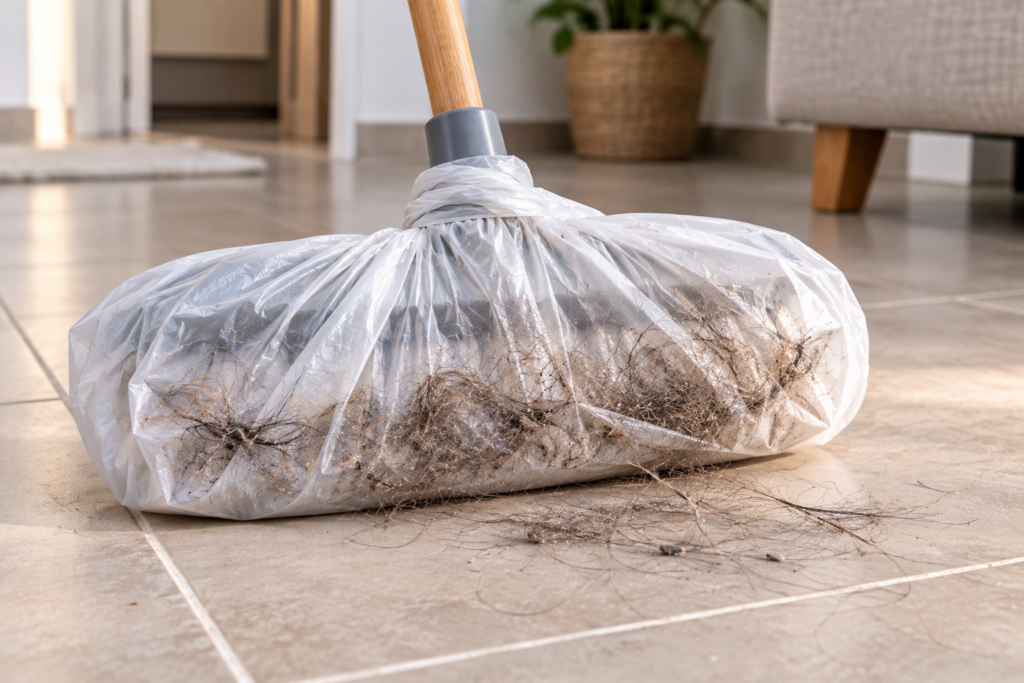
Hair, pet fur and light dust have an annoying habit of collecting in corners, under furniture and across freshly cleaned floors. You sweep once, turn around, and somehow another strand of hair is already there.
One surprisingly simple household trick has been circulating online: put a plastic bag over the head of a broom and sweep the floor with it.
It looks almost too simple to work. But unlike many viral cleaning hacks, there is a reasonable explanation behind this one. The plastic surface, friction and static charge can help collect or gather lightweight debris such as hair, pet fur and loose dust.
However, it isn’t a replacement for vacuuming or mopping. Think of it as a clever quick-cleaning trick between deeper cleaning sessions.
Here’s how to use it correctly, plus several other practical ways to remove dust and hair around your home.
[Image Idea: A split-image header showing a standard broom covered with a clean plastic bag on a smooth tile floor, next to a cozy living room setup.]
🛍️ 1. The Plastic Bag Broom Trick for Hair and Dust
This is the star of the method—and it’s incredibly easy to try.
What you’ll need:
- A clean, dry plastic bag
- A broom or flat floor sweeper
- A rubber band or tie if necessary
How to do it:
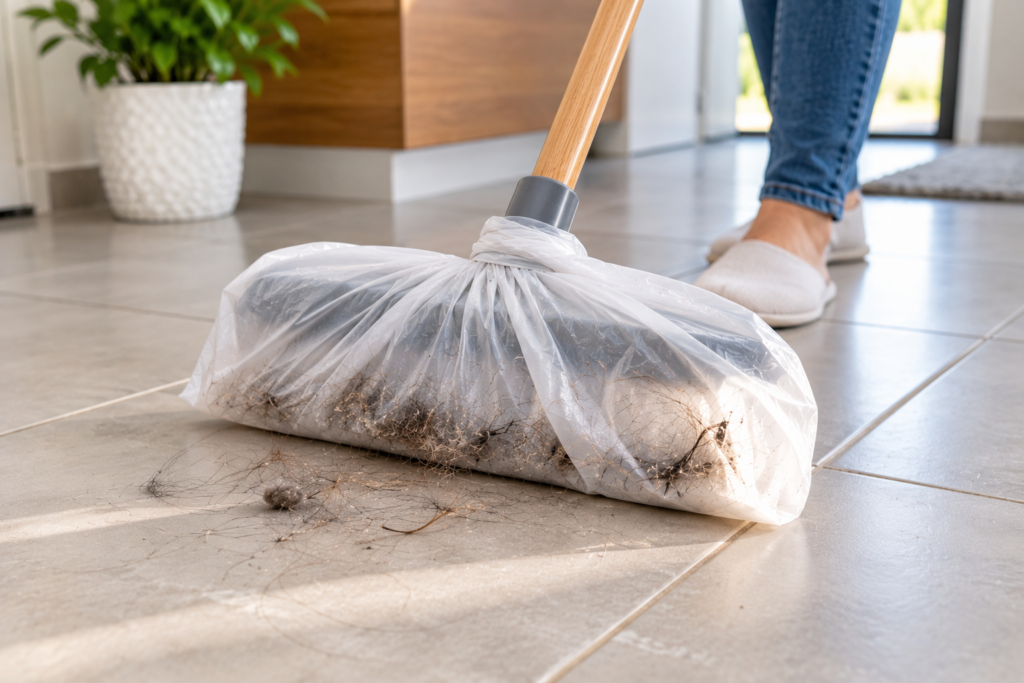
- Place the plastic bag completely over the broom head.
- Pull the bag tight enough that it doesn’t drag loosely behind the broom. If necessary, secure it around the handle with a rubber band or tie.
- Then gently sweep the broom across a clean, dry, smooth floor.
- As the plastic moves across the surface, you may notice loose hair, pet fur and lightweight dust beginning to collect on the bag or gather together where they’re easier to pick up.
- Once you’re finished, remove the debris and reuse the bag if it’s still clean and intact.
🔬 Why can this trick work?
When certain materials rub against one another, they can develop an electrostatic charge. Lightweight materials such as hair and fine particles can then be attracted to the charged surface.
There’s also a much simpler effect happening: the broad plastic surface physically catches and pushes loose hair together rather than allowing individual strands to slip through broom bristles.
That’s why the results can vary considerably depending on the flooring, plastic bag, humidity and type of debris.
🏠 Where Does the Plastic Bag Trick Work Best?
It’s most useful on smooth, dry flooring, such as tile, vinyl or some laminate floors.
Be more cautious with delicate flooring. Always follow the flooring manufacturer’s cleaning recommendations and stop if the plastic appears to scratch, drag or leave marks.
And don’t expect miracles. This trick is useful for:
- ✔️ loose hair
- ✔️ pet fur
- ✔️ lint
- ✔️ lightweight surface dust
It is much less effective for sand, crumbs, sticky dirt, dried spills or deeply embedded particles. For those, regular sweeping, vacuuming or appropriate damp cleaning remains the better solution.
🚫 What About Carpets?
This isn’t where the plastic-bag broom really shines. Hair can become intertwined with carpet fibers, making electrostatic attraction alone insufficient.
Fortunately, there’s another remarkably simple technique that is often much better suited to upholstered furniture and some carpets.
🧤 2. Use a Rubber Glove to Gather Pet Hair
Put on a clean household rubber glove and run your hand across the surface of a sofa, chair or other compatible upholstery.
The rubber creates friction and helps gather loose hair and fur into clumps, making it much easier to pick up. If necessary, very lightly dampening the glove can improve grip, but avoid soaking upholstery.
Best for: Sofas, fabric chairs, car seats, cushions, and some rugs and carpets. Always test an inconspicuous area first, especially with delicate textiles. This is one of the easiest methods to try when a lint roller simply isn’t enough.
🪟 3. Try a Rubber Squeegee on Hairy Carpets
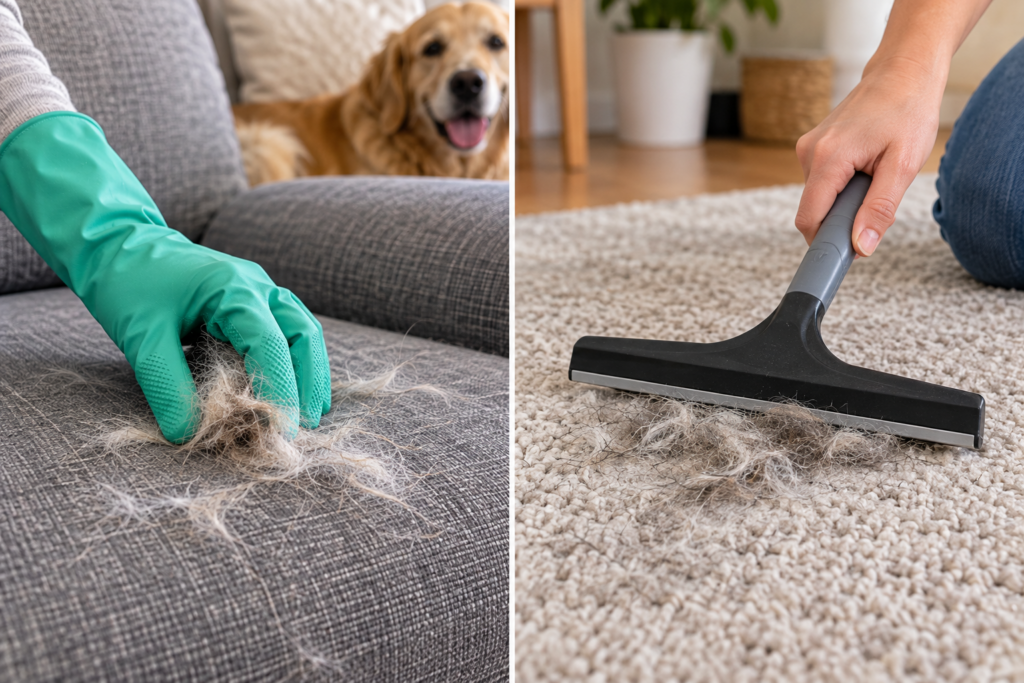
Here’s another useful trick for homes with pets. A clean rubber-edged squeegee can help pull loose hair from the surface of some low-pile carpets and rugs.
Draw it gently toward you in short strokes. Hair often begins forming little piles that can then be collected by hand or vacuumed. Don’t aggressively scrape delicate rugs, looped carpets or fragile fibers. Check the manufacturer’s care instructions if you’re uncertain.
[Image Idea: A close-up shot of someone using a rubber glove to effortlessly lift pet hair off a fabric sofa cushion.]
🧽 4. Use a Slightly Damp Microfiber Cloth for Dust
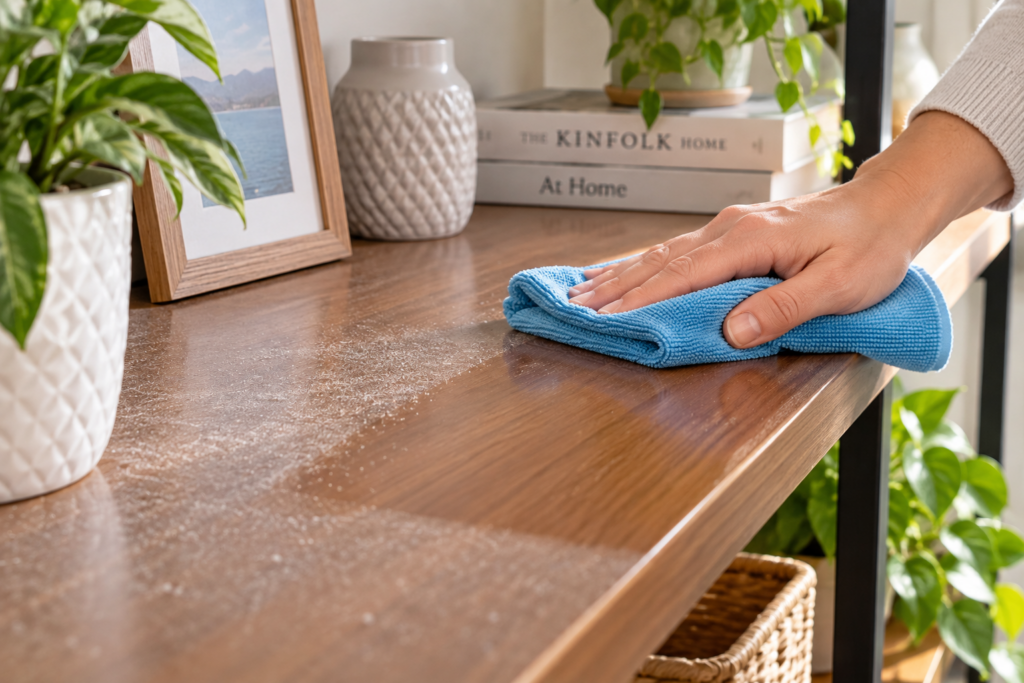
For ordinary household dust, sometimes the simplest method is the best. Instead of moving dust around with a dry cloth, use a clean microfiber cloth that is only slightly damp.
Microfiber contains extremely fine fibers that can capture particles effectively, while a small amount of moisture helps prevent dust from immediately becoming airborne again. Use it on compatible surfaces such as:
- shelves
- tables
- baseboards
- window sills
- many sealed furniture surfaces
The cloth should be damp, not wet. For wood, electronics and specialty finishes, follow the manufacturer’s cleaning instructions rather than assuming water is safe.
⬇️ 5. Dust From Top to Bottom
This sounds obvious, but it can save you from cleaning the same room twice.
Start with higher surfaces:
Shelves $\rightarrow$ furniture $\rightarrow$ baseboards $\rightarrow$ floor
Some dust inevitably falls while you’re cleaning. If you’ve already cleaned the floor first, you’ll simply have to do it again. Leave sweeping, vacuuming or mopping until the end. It’s a small change that can make your routine noticeably more efficient.
🧹 6. Don’t Forget the Baseboards and Corners
Hair and dust often accumulate along edges rather than remaining in the middle of the room. Pay particular attention to:
- baseboards
- corners
- underneath beds
- underneath sofas
- behind doors
- around furniture legs
A microfiber cloth or suitable dusting tool can reach these areas more effectively than repeatedly sweeping the center of the room. For tight gaps, a microfiber cloth wrapped around an appropriate flat cleaning tool can also help.
🐾 7. Reduce Pet Hair Before It Reaches the Floor
If you have a shedding pet, removing hair from the floor is only half the battle. Regular grooming appropriate for your pet can reduce the amount of loose fur that ends up on furniture and flooring.
Also wash pet bedding according to its care label and clean the areas where your pet spends the most time. Instead of constantly chasing hair around the entire house, you’re addressing one of its major sources.
🛋️ 8. Use a Lint Roller for Small Areas
A lint roller isn’t practical for cleaning an entire floor, but it’s excellent for quick touch-ups. Use it on compatible:
- cushions
- upholstered chairs
- clothing
- fabric headboards
- small sections of sofas
It’s particularly handy when guests are coming and you spot a few hairs on a chair at the last minute. For large surfaces, however, the rubber-glove technique is usually more economical.
🌬️ 9. Don’t Accidentally Send Dust Back Into the Air
One common cleaning mistake is aggressively flicking a dry duster around the room. Some of the dust may simply become airborne and eventually settle somewhere else.
For many hard surfaces, capturing the dust with microfiber is preferable to merely moving it around. If someone in your household is particularly sensitive to dust or allergens, more thorough measures may be appropriate, including regular vacuuming with suitable filtration and following relevant health guidance.
⚠️ What About Vinegar, Baking Soda and Other Viral Cleaning Ingredients?
You don’t need a homemade chemical mixture for every cleaning job.
- Vinegar: Diluted white vinegar can be useful for certain mineral deposits and compatible surfaces, but it isn’t a universal furniture or floor cleaner. Acid can damage some natural stone and certain finishes. Don’t automatically spray vinegar over wood furniture, stone or unknown surfaces. And don’t describe ordinary household vinegar as a reliable disinfectant.
- Baking soda: Baking soda can be useful for certain odors and cleaning jobs, but scattering it everywhere doesn’t magically pull dust and allergens out of furniture or carpets. It can also leave fine residue behind.
- Essential oils: They can add fragrance, but fragrance isn’t the same as cleanliness. Essential oils aren’t necessary for removing ordinary dust and hair, and they shouldn’t automatically be considered safe simply because they’re described as “natural.”
For everyday dust, simple mechanical cleaning is often all you need.
[Image Idea: An organized set of cleaning essentials featuring a damp microfiber cloth and a reusable plastic bag wrapped around a broom handle.]
❌ Cleaning Hacks That Aren’t Worth the Hype
Be skeptical of tricks claiming that one household ingredient can somehow “attract all allergens,” “disinfect everything naturally,” or keep a home dust-free for weeks.
For example, sprinkling ordinary salt over a sofa isn’t a reliable method for removing allergens. Similarly, adding multiple ingredients to a homemade spray doesn’t necessarily make it more effective.
Often the most dependable approach is also the least exciting: capture loose dust, remove hair mechanically, clean spills appropriately and use products suitable for the surface.
⚡ A 2-Minute Quick-Clean Routine
Can you thoroughly clean your entire home in two minutes? Of course not. But you can make a visible difference in a small area in two minutes.
Try this:
- First 30 seconds: Use the plastic-bag broom trick to collect loose hair from a smooth floor.
- Next 30 seconds: Gather visible pet hair from the sofa with a rubber glove.
- Next 30 seconds: Wipe a dusty table or shelf with a slightly damp microfiber cloth.
- Final 30 seconds: Collect the debris and quickly clean the most visible corner or baseboard.
The goal isn’t a perfectly clean home. It’s a fast maintenance routine between proper cleaning sessions.
♻️ A Small Zero-Waste Bonus
If you’re trying the broom trick, there’s no reason to open a brand-new plastic bag just for cleaning. Reuse a clean bag you already have and keep it specifically for this purpose if it remains in good condition.
That makes much more sense than turning a cleaning hack into another source of disposable plastic waste.
❓ Frequently Asked Questions
Does putting a plastic bag over a broom really collect hair?
It can. Friction and electrostatic effects may help attract lightweight hair and dust, while the plastic surface also physically gathers loose strands together. Results vary depending on the flooring, humidity and plastic.
Does it replace a vacuum cleaner?
No. It’s best considered a quick surface-cleaning trick. It won’t effectively remove embedded dirt, heavier debris or particles trapped deep inside carpets.
Should the plastic bag be wet?
Use it clean and dry for the electrostatic trick. Adding water changes how the surface behaves and isn’t necessary.
Can I use it on hardwood floors?
Be cautious. Wood floors vary considerably in their finishes and care requirements. Follow the flooring manufacturer’s instructions and test any unconventional cleaning method in an inconspicuous area first.
What’s the easiest way to remove pet hair from a sofa?
A clean rubber glove can work surprisingly well on many compatible upholstery fabrics. Rub gently across the surface to gather loose fur into manageable clumps.
Is microfiber better than a feather duster?
For many routine household surfaces, microfiber is excellent because it can capture dust rather than simply pushing it around. A slightly damp microfiber cloth can be particularly useful when the surface permits damp cleaning.
Do I need vinegar to remove household dust?
No. For ordinary dust, a suitable microfiber cloth is often sufficient. Vinegar should be reserved for compatible cleaning jobs where its acidity is actually useful.
Can I clean my whole house in two minutes?
No—but you can quickly remove visible hair and dust from a small high-traffic area. A genuine deep clean takes considerably longer.
🌟 The Bottom Line
The plastic-bag-over-the-broom trick isn’t magic, but the basic idea is reasonable.
On a smooth, dry floor, the combination of friction, electrostatic effects and the plastic surface can help gather loose hair, pet fur and lightweight dust. It’s cheap, takes seconds to set up and gives an old plastic bag another use.
The best results, however, come from combining the right simple method with the right surface: plastic-bag broom for quick floor hair, rubber gloves or a squeegee for some textile surfaces, microfiber for dust, and proper vacuuming or damp cleaning when a deeper clean is needed.
That makes the article much stronger than promising a miraculous “natural cleaner”: it’s a collection of simple physical cleaning tricks that actually make sense.
📌 Pinterest Pin Suggestion
- Pin Title: 🧹 The Plastic Bag Broom Trick: How to Pick Up Hair & Dust Fast!
- Pin Description: Tired of chasing pet hair and loose dust around your floors? Discover how the viral plastic-bag broom trick works, plus 8 other simple physical cleaning hacks that actually make sense!
- Visual Concept: Split layout showing a broom covered with a plastic bag sweeping up hair on a clean tile floor on top, and a rubber glove lifting pet fur off a sofa on the bottom, with bold text overlay.