
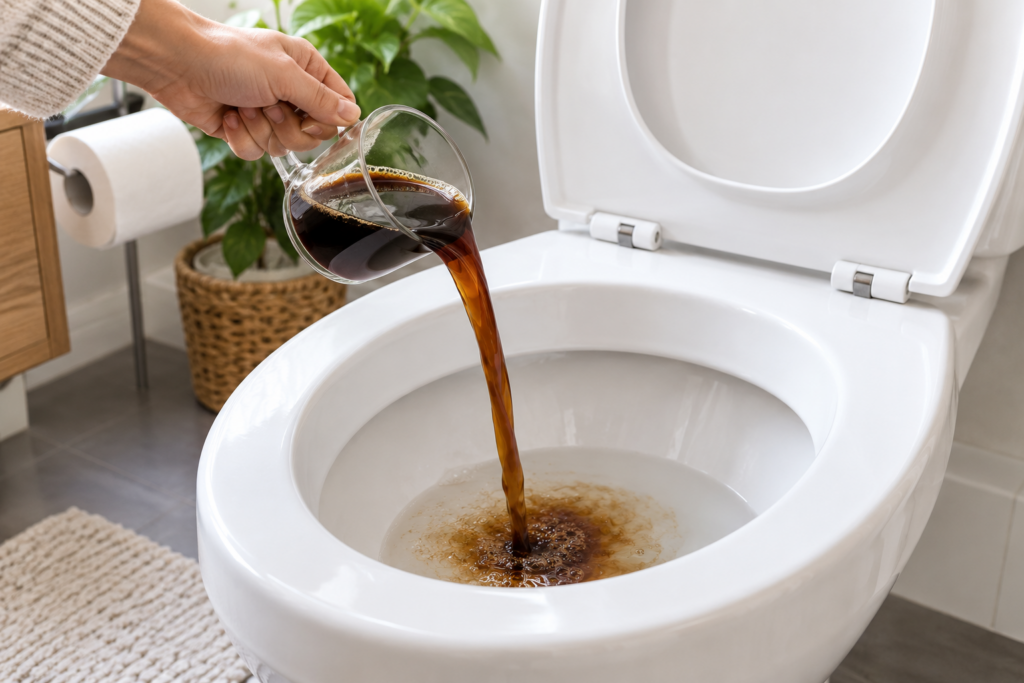
Pouring a cup of leftover coffee into the toilet sounds like one of those strange household tricks that immediately makes you curious.
According to some viral cleaning tips, coffee can supposedly remove odors, loosen stains, fight bacteria, and leave the toilet cleaner and fresher.
But does it really work?
The truth is less dramatic: plain brewed coffee is not a particularly effective toilet cleaner. Its strong aroma may temporarily cover another smell, but that doesn’t mean it has removed the source of the odor or cleaned mineral deposits from the bowl.
There is also one very important distinction that many viral posts overlook:
Liquid coffee and coffee grounds are not the same thing.
Before pouring your morning leftovers into the toilet, here’s what this unusual trick can actually do—and several simple alternatives that make much more sense.
[Image Idea: A split-image header showing a cup of dark coffee next to a clean toilet bowl with soft morning bathroom lighting.]
☕ Does Coffee Actually Clean a Toilet?
Not particularly well.
Brewed coffee contains various organic compounds and is mildly acidic, but that doesn’t automatically make a cup of coffee an effective toilet cleaner.
If your toilet has:
- yellow or brown stains,
- mineral deposits,
- residue around the waterline,
- unpleasant odors,
- or ordinary grime,
the coffee itself isn’t likely to solve the underlying problem.
What about coffee’s acidity?
Coffee is mildly acidic, but it isn’t a particularly practical household descaler.
For mineral deposits, an appropriate acidic cleaner—or, on compatible surfaces, ingredients such as citric acid or white vinegar—makes considerably more sense.
And when ordinary dirt is the problem, physical scrubbing with an appropriate cleaner is much more important than pouring another liquid into the bowl.
🚫 Don’t Flush Coffee Grounds Down the Toilet
This is probably the most important lesson from the entire coffee-toilet trend.
A little leftover liquid coffee without grounds is different from intentionally dumping coffee grounds into the toilet.
Coffee grounds are solid particles. They don’t simply disappear because they’re surrounded by water.
For that reason, don’t intentionally flush used coffee grounds down the toilet or pour them into household drains.
♻️ What should you do with used coffee grounds instead?
Depending on your local waste system, they may be better suited for:
- organic household waste,
- a properly managed compost pile,
- or regular household trash when composting isn’t available.
If you compost, treat coffee grounds as one ingredient among many rather than continuously adding large amounts.
👃 Does Coffee Remove Bad Toilet Odors?
This is where the viral claim becomes particularly misleading.
Coffee has a strong, recognizable aroma. That smell may temporarily mask another odor, making the bathroom seem fresher for a while.
But masking an odor isn’t the same thing as removing its source.
Persistent toilet odors may come from:
- residue inside the bowl,
- buildup under the rim,
- urine residue around the seat or hinges,
- the floor around the toilet,
- a dirty toilet brush or holder,
- damp bathroom textiles,
- poor ventilation,
- or, occasionally, a plumbing problem.
So if an odor keeps coming back, find and clean the source rather than repeatedly covering it with fragrance.
🌿 5 Natural Cleaning Alternatives That Make More Sense Than Coffee
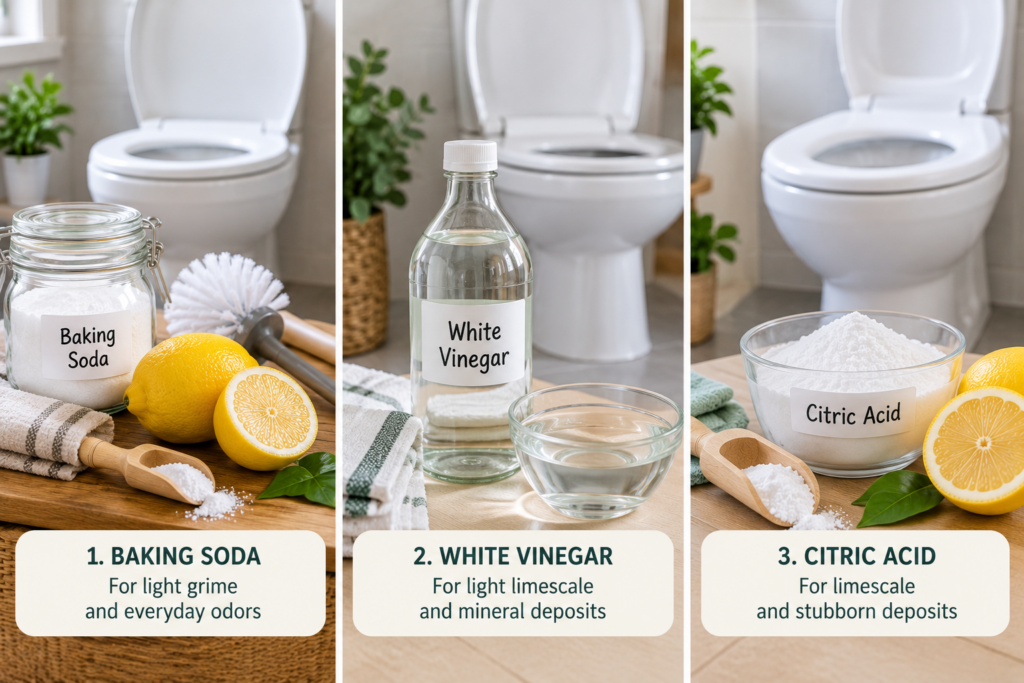
If you prefer simple household cleaning methods, several ingredients are more useful than brewed coffee. The key is choosing the right ingredient for the right problem.
🥄 1. Baking Soda for Light Grime and Everyday Odors
Baking soda can provide mild abrasive action and can be useful during routine toilet cleaning.
- What you’ll need: About $\frac{1}{2}$ cup baking soda and a toilet brush.
- How to use it: Sprinkle the baking soda around the inside of the bowl. Allow it to sit for approximately 15–30 minutes, then scrub thoroughly with a toilet brush, paying particular attention to the waterline and accessible areas beneath the rim. Flush when finished.
Best for: Light everyday grime, routine maintenance, and some ordinary odors. It isn’t the best choice for thick mineral scale, however.
🍋 2. Citric Acid for Limescale and Mineral Deposits
If the real problem is limescale, an acidic ingredient makes more sense. Citric acid can help dissolve certain calcium-based mineral deposits on compatible surfaces.
- How to use it: Follow the dilution instructions supplied with your citric-acid product. Apply the prepared solution to affected glazed ceramic areas and give it a short contact time. Scrub with a toilet brush and rinse thoroughly. For stubborn deposits, several gentle treatments may be preferable to aggressive scraping.
⚠️ Important: Check your toilet manufacturer’s recommendations first. Never combine citric acid with chlorine bleach or another toilet cleaner.
🧴 3. White Vinegar for Light Mineral Buildup
Plain white vinegar contains acetic acid and can help with light limescale or mineral deposits on compatible glazed ceramic.
Apply vinegar to the affected area, allow some contact time, scrub, and rinse thoroughly. Vinegar isn’t a universal bathroom cleaner, though. Avoid using it on acid-sensitive materials such as certain natural stones, and check compatibility with surrounding surfaces.
⚠️ Never mix vinegar with bleach. That combination can release dangerous chlorine-containing fumes.
🧼 4. Mild Dish Soap for Ordinary Grime
Sometimes the simplest method is all you need.
A small amount of mild dish soap diluted in warm water can help clean ordinary grime from compatible external toilet surfaces, such as the seat or exterior porcelain. Wipe afterward with clean water and dry the surface.
There’s no need to pour large quantities of dish soap into the bowl. More soap doesn’t automatically mean better cleaning.
💧 5. 3% Hydrogen Peroxide for Certain Stains
For some compatible light-colored surfaces, 3% hydrogen peroxide may be useful for certain organic stains.
Apply a small amount to the affected area, allow brief contact, gently scrub if appropriate, and rinse thoroughly. But hydrogen peroxide should still be treated as a cleaning chemical.
⚠️ Don’t mix it with other cleaners. In particular, don’t add hydrogen peroxide to a toilet containing bleach, acidic toilet cleaner, drain cleaner, or another cleaning product.
[Image Idea: A neat, organized flat lay showing natural cleaning supplies: a jar of baking soda, a bottle of white vinegar, a lemon, and a soft microfiber cloth.]
🌸 How to Naturally Remove Bad Toilet Odors
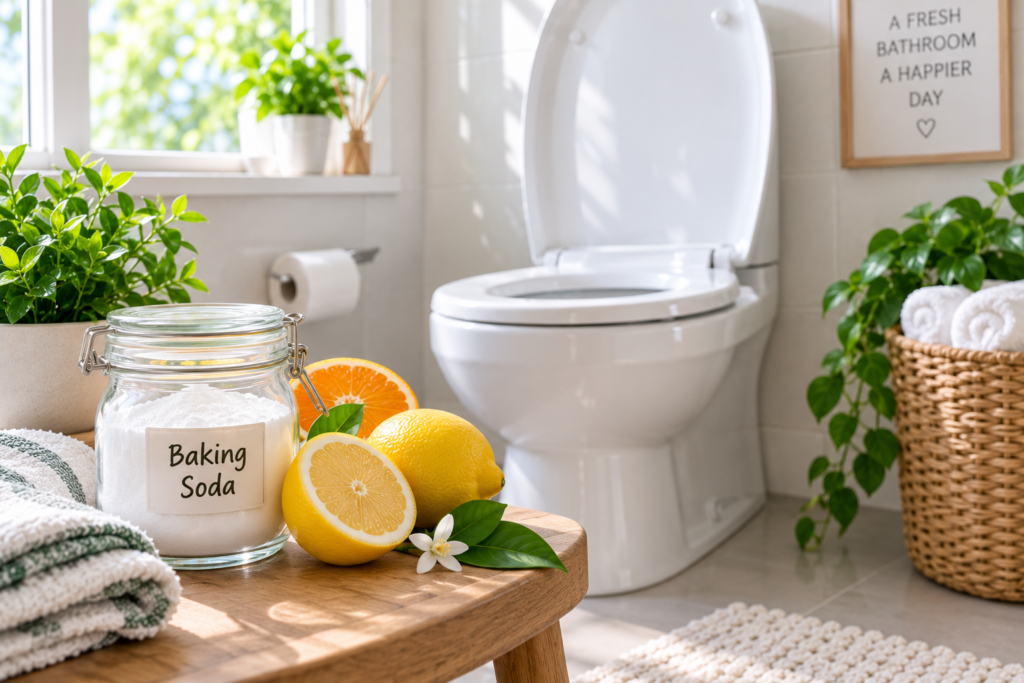
Cleaning stains and removing odors are related, but they’re not exactly the same job. If your main problem is a toilet or bathroom that smells unpleasant, start by thoroughly cleaning the bowl and the areas surrounding the toilet, then try one of these simple approaches:
- Method 1 (Baking Soda Odor Treatment): Sprinkle $\frac{1}{2}$ cup baking soda around the bowl, leave for 15–30 minutes, scrub thoroughly (including beneath the rim), and flush.
- Method 2 (Citrus Fragrance Option): If you want a fresh scent in the bathroom, use lemon juice or citrus peel entirely separately as an ambient fragrance. Keep cleaning and fragrance steps distinct rather than treating them as a combined “magic cleaning recipe.”
- Method 3 (White Vinegar for Stale Odors + Light Limescale): Apply plain white vinegar to compatible areas with light mineral buildup, allow contact time, scrub, rinse, and ventilate the bathroom.
- Method 4 (Simple Baking Soda Deodorizing Jar): Place baking soda in a small open jar in a secure, dry location. It may help with mild ambient odors, but it won’t replace cleaning, ventilation, or fixing the source of a persistent smell.
- Method 5 (Simple Citrus Bathroom Freshener): Place fresh lemon or orange peel in a small dish in the bathroom temporarily for a pleasant aroma, and discard before it spoils.
🧼 Don’t Forget the Toilet Seat, Hinges and Floor
If you’ve cleaned the bowl and the smell quickly returns, the bowl may not be the source. Check:
- underneath the toilet seat,
- seat hinges,
- exterior porcelain,
- the floor around the toilet base,
- toilet brush and holder,
- nearby trash bin,
- bathroom mats,
- damp towels.
Urine residue and other organic material can remain in small, easily overlooked areas. Clean each surface with a product appropriate for its material. Sometimes this simple inspection solves an odor problem that no amount of coffee, lemon or perfume poured into the bowl could fix.
🪒 Shaving Cream Hack for Urine Residue Around the Toilet
One unusual household hack involves using plain white shaving foam on areas around the toilet where urine residue can sometimes cause persistent odors.
Shaving foam contains surfactants and other cleaning ingredients that may help loosen residue from washable surfaces. However, it shouldn’t be considered a disinfectant or a guaranteed urine-odor neutralizer.
How to try it:
- First test a small hidden area for compatibility.
- Apply a thin layer of plain shaving foam to washable areas such as compatible tile flooring around the toilet or the exterior porcelain.
- Leave it for only a few minutes rather than allowing it to dry.
- Wipe thoroughly with a damp microfiber cloth.
- Rinse the surface with clean water and dry it completely.
💡 Important: Don’t spray shaving cream inside toilet mechanisms, into gaps where it can’t be completely removed, or onto natural stone, unsealed surfaces, wood, or other materials unless the manufacturer confirms compatibility.
For urine odor around the toilet, the most important step is still to physically remove the urine residue itself. If the smell remains after thorough cleaning, check the toilet-seat hinges, underside of the seat, grout, floor around the base, toilet brush holder, and other hidden areas.
Je modifierais également ta section “How to Naturally Remove Bad Toilet Odors” pour avoir maintenant 6 méthodes, la sixième étant :
Method 6 — Shaving Foam for Urine Residue Around the Toilet: A small amount of plain shaving foam may help loosen residue on certain washable surfaces around the toilet. Wipe, rinse and dry thoroughly. Treat it as an occasional cleaning hack rather than a proven urine-odor neutralizer.
💨 Ventilation Matters Too
A bathroom that remains damp can develop persistent musty odors. After showering or cleaning:
- use the extractor fan if available,
- open a window when practical,
- allow wet towels to dry,
- avoid leaving damp bath mats bunched together,
- clean areas where moisture repeatedly accumulates.
A genuinely fresh bathroom is usually the result of clean surfaces + moisture control + ventilation, not a single scented ingredient.
⚠️ When a Bad Toilet Smell Could Indicate a Plumbing Problem
There’s an important exception. A persistent sewer-like smell isn’t something you should continually cover with coffee, citrus peel or air freshener.
If the bathroom is clean but you notice a strong sewer odor together with symptoms such as:
- unusual gurgling,
- slow drainage,
- leaks,
- recurring smells,
- or unusual changes in toilet water level,
there may be an issue involving a seal, drain or plumbing ventilation system. That’s a different problem from ordinary bathroom odor and may require professional inspection.
[Image Idea: An infographic highlighting plumbing warning signs like gurgling pipes or slow drainage next to a clean bathroom setup.]
🧪 What About the Viral Coffee + Baking Soda + Hydrogen Peroxide Mixture?
Adding several household ingredients together can make a cleaning trick look more powerful. But it doesn’t mean every ingredient is contributing something useful.
In a mixture containing coffee + baking soda + hydrogen peroxide, coffee doesn’t have a clear reason to be there. If baking soda or hydrogen peroxide is doing the useful cleaning work, adding coffee simply makes the formula more complicated.
A good household-cleaning rule is:
Use the simplest effective method for the specific problem you’re trying to solve.
⚠️ The Most Important Safety Rule: Don’t Mix Cleaners
Homemade doesn’t automatically mean harmless. Never start combining household cleaners simply because each ingredient appears safe when used separately.
Never mix chlorine bleach with:
- vinegar,
- lemon juice,
- citric acid,
- ammonia,
- acidic toilet cleaners,
- or other household cleaning mixtures.
And don’t add hydrogen peroxide or homemade cleaning solutions to a toilet containing another cleaner. If you’ve already used a commercial toilet product, follow its label instructions and rinse appropriately before using anything else. More ingredients $\neq$ more cleaning power.
❌ 6 Viral Coffee-Toilet Claims You Shouldn’t Believe
- “Coffee removes limescale.” — Misleading. Brewed coffee isn’t a practical household descaler. Citric acid, vinegar on compatible surfaces, or an appropriate descaling product makes more sense.
- “Coffee disinfects your toilet.” — Don’t rely on it. An ordinary cup of brewed coffee shouldn’t be treated as a toilet disinfectant.
- “Coffee grounds naturally scrub the bowl.” — Not worth the plumbing risk. Don’t intentionally flush coffee grounds.
- “Coffee eliminates bathroom odors.” — Overstated. Its strong aroma may temporarily mask another smell without removing its source.
- “Coffee works better than toilet cleaner.” — There’s no good reason to make that claim. Use an appropriate cleaner for the type of dirt or deposit you’re dealing with.
- “Natural means you can safely mix everything.” — Definitely not. Vinegar, citric acid, hydrogen peroxide and other familiar household ingredients are still chemicals and must be used appropriately.
🌿 A Simple Natural Toilet-Care Routine
You don’t need a complicated five-ingredient viral mixture. For routine maintenance:
- Clean the bowl regularly: Don’t allow residue to accumulate for long periods.
- Scrub beneath the rim: This easily forgotten area can harbor residue.
- Clean the seat, hinges and exterior: Bad odors don’t always originate inside the bowl.
- Use baking soda for light routine cleaning when appropriate.
- Address mineral deposits separately: Citric acid or vinegar may help on compatible surfaces.
- Keep the bathroom ventilated and dry.
- Use fragrance separately if desired.
This approach is simpler, easier to understand and avoids unnecessary ingredient combinations.
♻️ Is Coffee in the Toilet Really a Zero-Waste Hack?
Not particularly.
If you have a tiny amount of leftover plain liquid coffee, putting it into the toilet isn’t the same concern as dumping solid grounds. But deliberately making or saving coffee for toilet cleaning doesn’t provide a meaningful advantage.
A better low-waste philosophy is to use the smallest amount of the right cleaner for the job and dispose of coffee grounds appropriately. Sometimes the most sustainable household hack is simply not using an unnecessary ingredient.
[Image Idea: A close-up shot of a sparkling clean toilet bowl with natural lighting reflecting off the ceramic surface.]
❓ Frequently Asked Questions
☕ Can I pour leftover liquid coffee into the toilet?
A small amount of plain liquid coffee without grounds is different from dumping coffee grounds, but there’s little cleaning benefit in deliberately doing so.
🚽 Can I flush coffee grounds?
It’s better not to intentionally flush them. Dispose of coffee grounds through an appropriate waste or composting route instead.
🌸 Does coffee make the toilet smell better?
Its aroma may temporarily mask another smell, but that doesn’t mean the source of the odor has disappeared. For recurring odors, clean the bowl, rim, seat, hinges, exterior, floor and toilet-brush holder and improve bathroom ventilation.
🥄 Is baking soda good for toilet odors?
Baking soda can be useful as part of routine cleaning and mild odor control. It works best alongside thorough physical cleaning rather than as a miracle deodorizer.
🍋 Can I put lemon juice in the toilet?
A small amount of diluted lemon juice may be used on compatible glazed ceramic as a separate fragrance option, but remember that it is acidic. Never combine lemon juice with chlorine bleach or another incompatible toilet cleaner.
🧴 Is vinegar good for toilet cleaning?
White vinegar can help with light mineral deposits on compatible surfaces. It isn’t a universal cleaner, and it should never be mixed with chlorine bleach.
💧 Can I use hydrogen peroxide?
3% hydrogen peroxide can be useful for certain stains on compatible surfaces. Don’t mix it with other cleaning chemicals, and never add it to a toilet that still contains another cleaner.
🧪 Should I mix baking soda and vinegar?
You can certainly observe plenty of fizz, but fizz isn’t proof of superior cleaning. Because one ingredient is alkaline and the other acidic, they react with each other. For many cleaning jobs, using the appropriate ingredient separately is more logical.
🌿 What’s the best natural way to make a bathroom smell fresh?
First remove the odor source. Clean the toilet and surrounding areas, wash damp textiles, empty the trash and improve ventilation. If you still want fragrance, use a separate bathroom freshener or temporary citrus fragrance rather than trying to turn the toilet bowl into an air freshener.
⚠️ Why does my clean toilet still smell bad?
Check the seat hinges, floor around the base, toilet brush, nearby textiles and drains. If a persistent sewer-like odor remains despite cleaning—particularly with gurgling, drainage problems or leaks—it may indicate a plumbing issue rather than a cleaning problem.
⭐ Final Verdict: Save the Coffee for Your Cup
The idea of pouring coffee into the toilet makes an irresistible household-hack headline. But the reality is much simpler.
Coffee isn’t a particularly useful toilet cleaner, disinfectant or limescale remover. Its aroma may temporarily mask odors, while coffee grounds are better kept out of the toilet altogether.
Fortunately, you don’t need coffee to maintain a fresh bathroom. For light routine cleaning, baking soda and physical scrubbing can be useful. For certain mineral deposits, citric acid or white vinegar may make more sense on compatible surfaces. And for unpleasant smells, the most effective approach is usually to find the source, clean it, keep the bathroom dry and ventilated, then add fragrance separately if you want it.
So the next time you see someone pouring a cup of coffee into the toilet, remember:
☕ Coffee belongs in your cup. The right cleaning method belongs in your bathroom.