
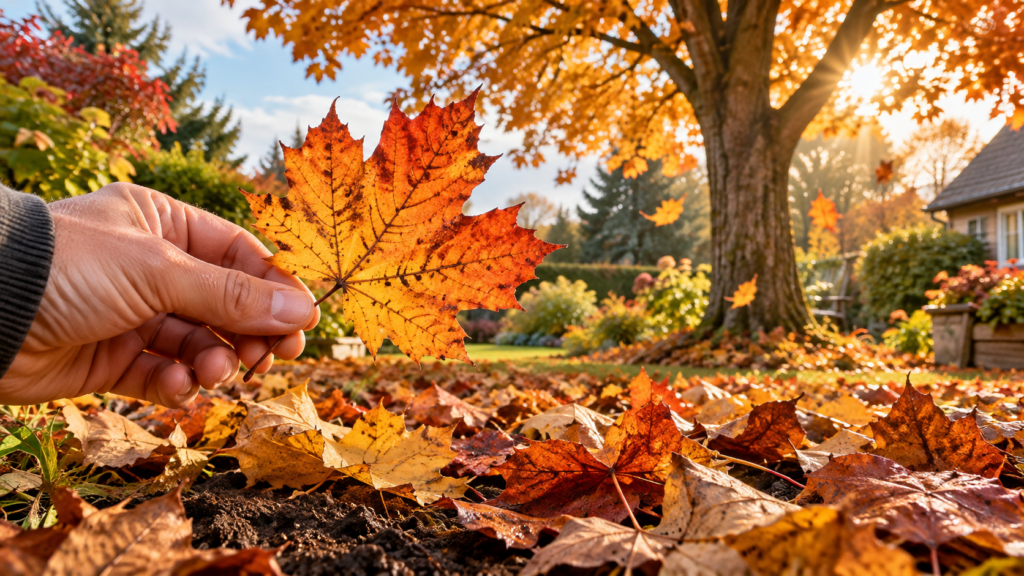
Every autumn, millions of bags of fallen leaves are raked up, packed away and removed from gardens. But those brown, dry leaves are not simply garden waste.
A fallen leaf is part of a natural recycling system that can feed soil organisms, return nutrients to the soil, protect garden beds, conserve moisture and provide winter habitat for wildlife.
There is, however, an important detail that viral gardening posts often miss: the process is more complicated than saying that a dead leaf simply “turns back into next year’s leaves.” Here’s what actually happens—and how you can put fallen leaves to work in your own garden.
🍁 What Happens to a Leaf Before It Falls?
The recycling process actually begins before the leaf reaches the ground. As deciduous leaves age in autumn, trees can withdraw and redistribute some mobile nutrients from the leaves into living tissues. Nitrogen and phosphorus are among the nutrients commonly involved in this process, known as nutrient resorption.
That means a tree does not simply allow all of the nutrients accumulated in its leaves to fall to the ground—it recovers some of them first. These stored resources can later contribute to the tree’s seasonal growth cycle.
Research on deciduous trees describes internal storage and remobilization as an important strategy that helps trees conserve nutrients. But the fallen leaf still contains organic matter and nutrients—and that’s where the next recycling system begins.
🍄 1. Fungi and Microorganisms Move In
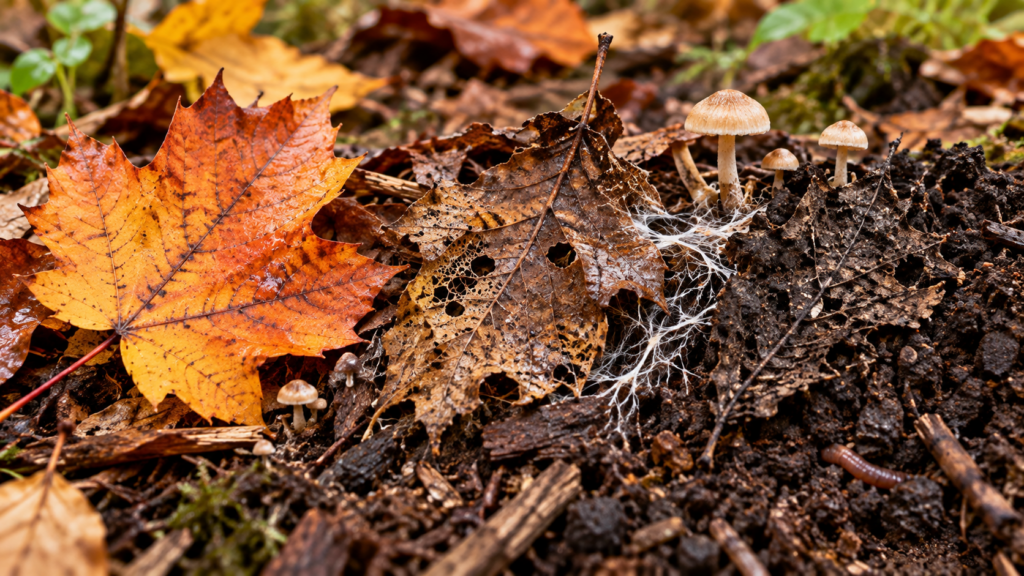
Once leaves reach the soil, they become part of what ecologists call leaf litter. They don’t disappear overnight. Instead, fallen plant material is gradually transformed through biological and physical processes involving microorganisms and soil animals.
- Fungi are especially important because many species produce enzymes capable of breaking down complex components of plant tissue.
- Bacteria and other microorganisms participate as decomposition progresses.
The result isn’t an instant transformation from leaf to fertilizer to new leaf. Instead, organic matter passes through a complicated soil food web, and that process can take months—or considerably longer depending on the type of leaf and environmental conditions.
🪱 2. Soil Animals Help Break Leaves Apart
Microorganisms aren’t working alone. Depending on your location and ecosystem, leaf litter can be inhabited by numerous small organisms and invertebrates.
By physically breaking up organic material and interacting with microorganisms, soil organisms contribute significantly to decomposition. Smaller fragments mean more surface area on which microorganisms can work. This is one reason a pile of autumn leaves can gradually change from recognizable leaves into dark, crumbly organic material.
🌱 3. Nutrients Gradually Return to the Soil
Leaves contain far more than carbon. Plant tissues contain nutrients including:
- Nitrogen
- Phosphorus
- Potassium
- Calcium
- Magnesium
- Sulfur
- Various micronutrients
An important distinction: A fallen leaf is not the same thing as a bag of fertilizer. Nutrients contained in organic material have to move through biological and chemical processes before some become available for plant uptake. The speed and amount vary with leaf species, temperature, moisture, soil conditions and microbial activity.
Research also shows that nutrient concentrations can change considerably as leaves senesce; trees may resorb some elements before leaf fall, while other elements remain relatively concentrated in senesced leaves. Think of leaves not as “free instant fertilizer,” but as a long-term contribution to the garden’s organic-matter cycle.
🌳 4. Does a Fallen Leaf Really Become Part of the Tree Again?
This is where a popular social-media claim needs some clarification. You may have seen diagrams suggesting a neat one-to-one cycle where an autumn leaf falls, gets consumed in winter, enters the soil in spring, and becomes the exact same new leaves in summer.
It’s a beautiful illustration of nutrient cycling—but it shouldn’t be interpreted literally. Trees can absorb nutrients from the soil, and decomposing organic matter contributes to ecosystem nutrient cycling. Trees also internally recycle nutrients before their leaves fall.
However, there isn’t a simple one-to-one pathway in which one particular autumn leaf is transported intact through fungi and rebuilt as one of the same tree’s leaves the following summer. Carbon and nutrients move through many different biological pools and pathways.
The takeaway: The leaf doesn’t come back as the same leaf. Its materials continue circulating through the ecosystem. And that’s arguably even more fascinating.
🏡 5. Should You Leave Fallen Leaves in Your Garden?
Often, yes—but location matters. You don’t necessarily need to choose between removing every leaf and allowing your entire property to disappear under a thick layer. A more practical approach is to move leaves to where they provide the greatest benefit.
The Xerces Society recommends leaving leaves or relocating them to suitable areas because leaf litter can provide overwintering habitat for invertebrates. It also notes that too many leaves can damage turf, while leaves placed in garden areas can provide useful cover.
🌿 Use Fallen Leaves as Mulch
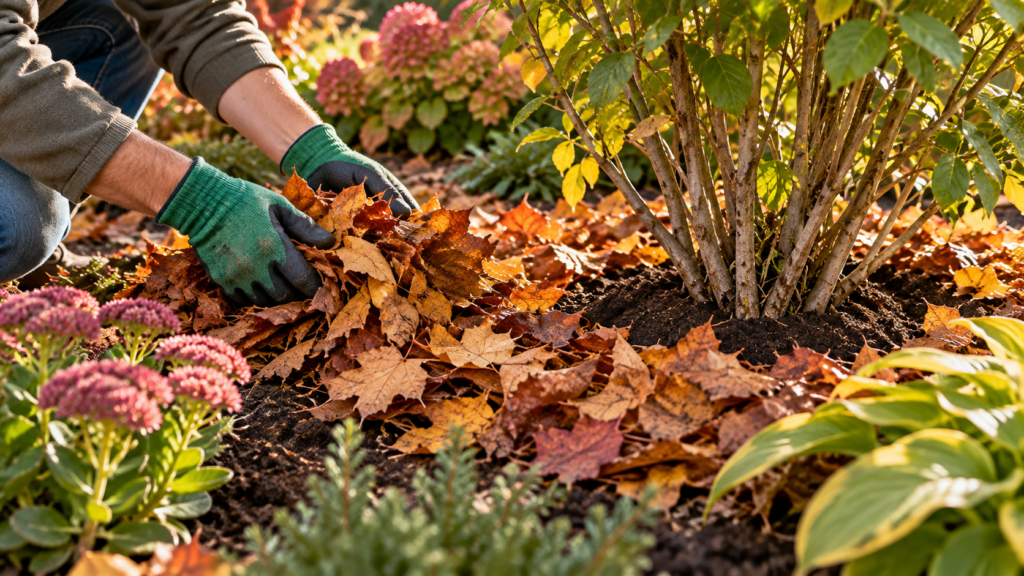
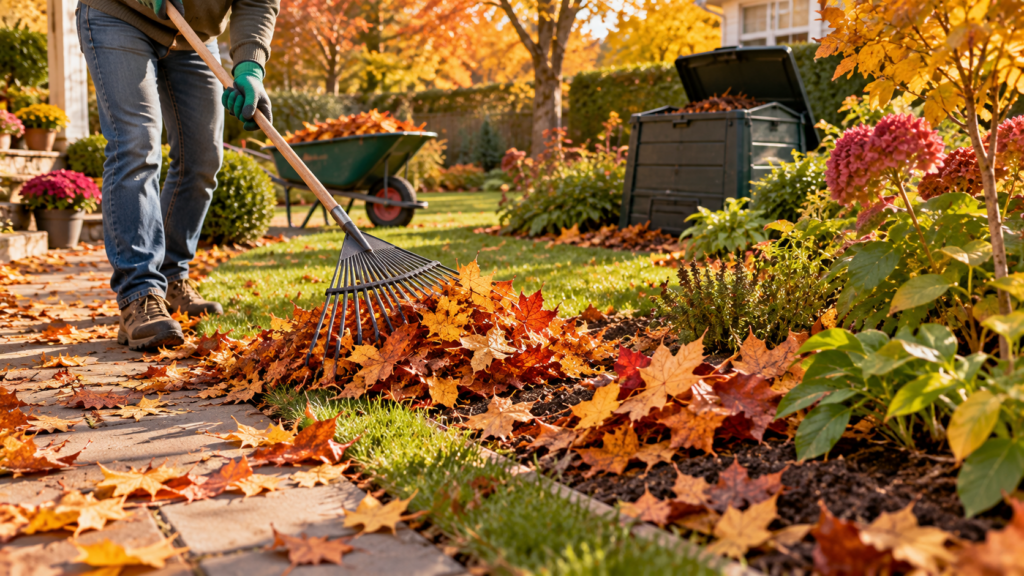
Instead of bagging leaves, rake some into:
- Flower beds
- Around shrubs
- Beneath trees
- Perennial beds
- Suitable vegetable beds
A leaf layer can help cover bare soil, retain moisture and suppress some weeds, while providing habitat and insulation for small organisms.
⚠️ Avoid: Piling thick mats directly against tree trunks or plant crowns. The goal is a protective layer—not a dense, wet mass smothering plants.
🦋 6. Fallen Leaves Can Be Winter Habitat
This is one of the strongest reasons not to remove every leaf from a garden. Some insects and other invertebrates spend part of their life cycle in or beneath fallen leaves and other dead plant material. Removing all leaves in autumn can therefore remove more than “mess.”
The Xerces Society specifically recommends retaining leaves and other plant debris where practical because they provide shelter and winter habitat for invertebrates, including species important to garden ecosystems.
This doesn’t mean your driveway and paths have to remain buried. Move leaves from places where they create problems into beds, under shrubs or other suitable areas.
🌱 7. Make Leaf Mold
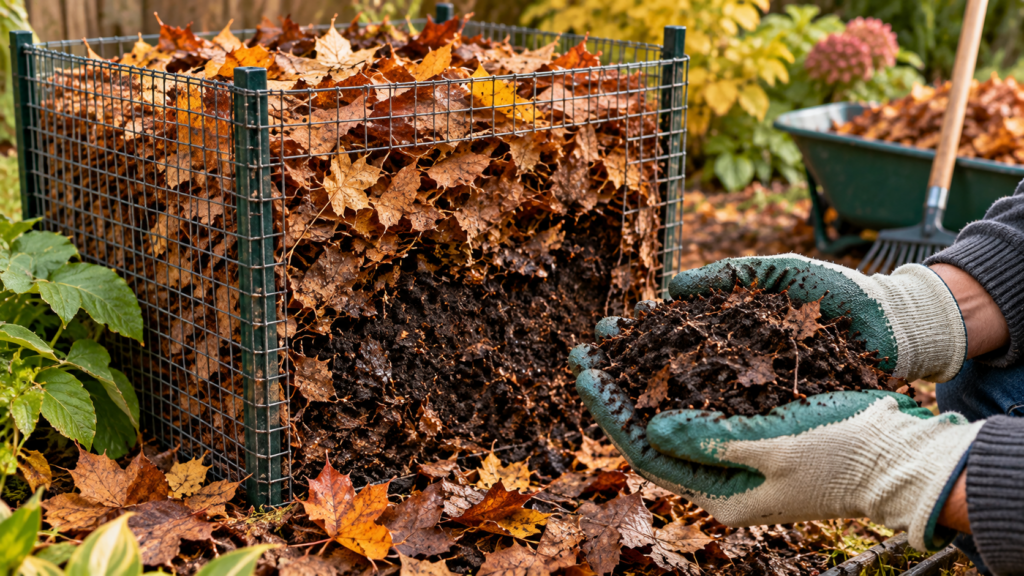
If you have more leaves than your beds can use, turn them into leaf mold. Leaf mold is partially or fully decomposed leaf material. Unlike a carefully balanced compost pile, it can be made largely from leaves.
Simple method:
- Collect fallen leaves and place them in a breathable enclosure, leaf cage or suitable pile.
- Keep them somewhat moist rather than completely dry or waterlogged.
- Wait. Decomposition takes time, but eventually the leaves become a dark material that can be useful for improving soil structure and adding organic matter.
♻️ 8. Add Leaves to Your Compost
Dry autumn leaves are also valuable compost material. They are generally treated as a carbon-rich “brown” ingredient and can be combined with more nitrogen-rich materials, such as appropriate fresh garden waste.
Instead of sending bags of leaves away every autumn, you’re keeping some of that organic material inside your garden’s nutrient cycle. Tip: Very thick, intact layers can mat together, so mixing leaves with other compost materials helps maintain structure and airflow.
🌾 9. What About Leaves on the Lawn?
This is where “leave all the leaves” can become bad advice if interpreted too literally. A thick, wet layer of leaves can block light and smother turf. The Xerces Society notes that too many leaves can kill grass, while a thin layer may be compatible with turf.
If your lawn is disappearing under autumn leaves, you have several choices:
- Move them into garden beds.
- Collect them for leaf mold.
- Add some to compost.
Where appropriate, manage a light layer rather than allowing a dense wet mat to remain all winter. The objective isn’t to stop autumn cleanup completely—it’s to stop treating every fallen leaf as garbage.
⚠️ 10. Are There Leaves You Shouldn’t Keep?
Not every fallen leaf belongs everywhere:
- Diseased plant material: If leaves are heavily affected by a serious plant disease, simply piling them beneath the same susceptible plants may not be wise. Follow recommendations specific to that plant and pathogen.
- Roads and contaminated areas: Leaves collected from heavily trafficked or potentially contaminated locations aren’t necessarily the material you want spread around an edible garden.
- Thick layers on paths: Wet leaves can become slippery. Keep walkways, steps and doorways reasonably clear.
- Storm drains: Don’t allow piles of leaves to clog drainage systems.
🍂 Whole Leaves or Shredded Leaves?
For pure garden management, shredding leaves can make them easier to handle and can increase the surface area exposed to decomposition.
However, if your objective is to preserve overwintering insects and other organisms already using the leaf litter, aggressively shredding everything can work against that goal. The Xerces Society specifically recommends keeping leaves whole when wildlife habitat is the priority.
A sensible compromise: Manage different parts of the garden differently. Keep some leaves intact in wildlife-friendly beds and less-disturbed corners, while managing other leaves for compost or practical garden use.
❌ 5 Myths About Fallen Leaves
- Myth 1: Fallen leaves are useless wasteNot true. They contain organic matter and nutrients and provide habitat.
- Myth 2: Every leaf should stay exactly where it fallsNot necessarily. Thick accumulations can damage lawns and create problems on paths.
- Myth 3: Fallen leaves instantly fertilize plantsNo. Decomposition and nutrient cycling take time.
- Myth 4: One dead leaf literally becomes next year’s leafToo simplistic. Matter and nutrients circulate through numerous biological processes.
- Myth 5: A perfectly clean garden is always healthierNot necessarily. Removing every piece of plant litter can also remove valuable habitat for invertebrates.
🍁 A Simple Autumn Leaf Strategy
If you want a tidy garden without wasting this resource, try this balanced approach:
- Remove leaves from: paths, steps, drains and excessively covered lawn.
- Move leaves to: beds, beneath suitable shrubs and less-disturbed garden areas.
- Save excess leaves for: compost or leaf mold.
- Leave some intact: where they can provide winter habitat.
This creates a useful balance between garden maintenance, soil care and wildlife habitat.
❓ Frequently Asked Questions
- Are fallen leaves good for garden soil?They can be. As leaves decompose, they contribute organic matter and participate in nutrient cycling, though their exact effects depend on the type of leaves, soil and how they’re used.
- Can I put autumn leaves directly on flower beds?Often yes. A moderate layer can act as natural cover. Avoid burying small plants or piling a dense wet layer directly against crowns and trunks.
- Do leaves add nitrogen to the soil?Leaves contain nitrogen, but trees can resorb a substantial portion of mobile nutrients before leaf fall, and the nitrogen remaining in fallen leaves is not equivalent to immediately available fertilizer.
- Should I remove all leaves from my lawn?Don’t allow a heavy wet layer to smother the grass. Leaves can instead be moved to garden beds or used for compost or leaf mold.
- Are dead leaves good for insects?Yes, leaf litter can provide important shelter and overwintering habitat for various invertebrates.
- Can I compost oak leaves?Yes. Oak leaves can be composted, although tougher leaves may take longer to break down than softer material.
- Is leaf mold the same as compost?Not exactly. Leaf mold is produced primarily through the decomposition of leaves, while conventional compost usually combines different carbon- and nitrogen-rich materials.
- Should I shred fallen leaves?It depends on your objective. Shredding makes leaves easier to manage, but leaving some intact is preferable when protecting organisms overwintering in leaf litter is a priority.
🌳 The Bottom Line
A fallen autumn leaf is not useless waste. Before it falls, the tree may reclaim some of its nutrients. After it reaches the ground, the remaining organic matter enters a complex decomposition process involving microorganisms and soil organisms. Over time, some nutrients cycle through the soil ecosystem, while the leaf layer itself can provide cover and wildlife habitat.
So this autumn, don’t automatically put every leaf into a trash bag. Move them where they can do some good. A pile beneath shrubs, a layer over suitable garden beds, a leaf-mold cage or a compost pile can turn what looks like seasonal waste into a useful garden resource.
And perhaps that’s the best way to describe an autumn leaf: It isn’t simply at the end of its life. It’s becoming part of what happens next.