
Dish Soap, Soft Soap, Vinegar & Other Practical Ways to Tackle Sticky Kitchen Grease
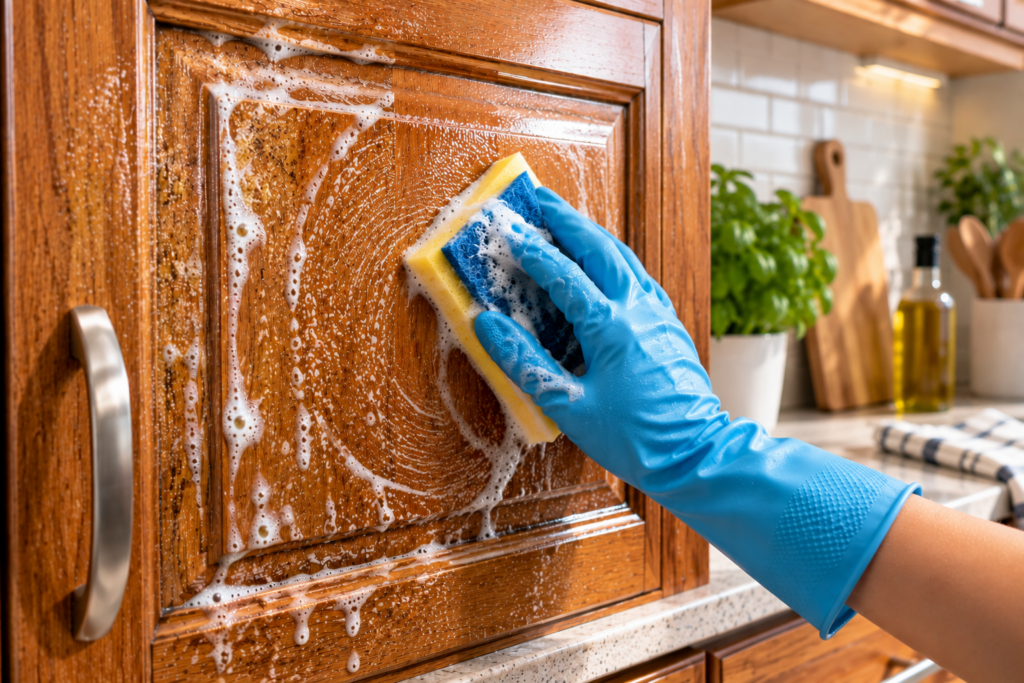
Greasy kitchen cabinets are frustrating. Even when the kitchen looks clean, cabinet doors near the stove can slowly develop a sticky film that attracts dust and becomes increasingly difficult to remove.
Fortunately, you usually don’t need an aggressive degreaser. For everyday grease, the best approach is surprisingly simple: start with warm water and a small amount of dish soap, then move to stronger methods only when the surface allows it.
The important part isn’t finding the strongest cleaner. It’s choosing a method that removes grease without damaging paint, lacquer, wood finishes or high-gloss surfaces.
🧪 Why Do Kitchen Cabinets Become So Greasy?
When you fry, sauté or cook food, tiny droplets and particles containing grease can become airborne.
Over time, these residues settle on nearby surfaces and mix with:
- Dust
- Cooking residue
- Moisture
- Other airborne particles
The result is the familiar sticky coating found especially around:
🍳 Cabinets near the stove
🚪 Cabinet handles
🧽 Drawer fronts
🪵 Wooden cabinets
✨ Glossy kitchen doors
🌬️ Range hoods and surrounding surfaces
The longer this layer remains, the more difficult it can become to remove.
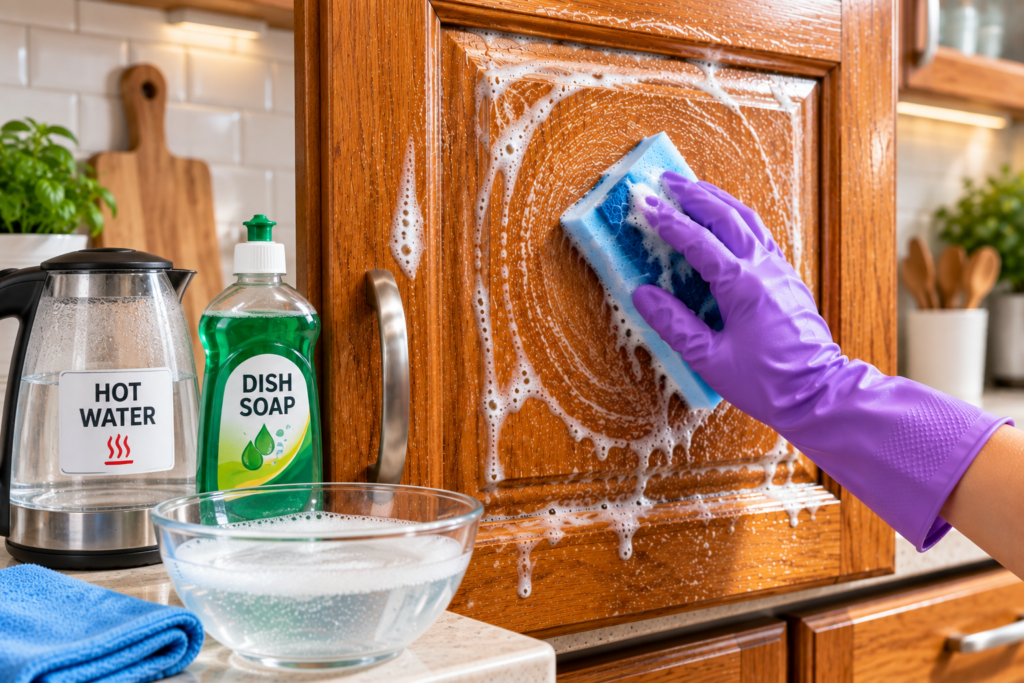
🥇 1. Warm Water + Dish Soap: Start Here
⭐⭐⭐⭐⭐
For most washable kitchen cabinet surfaces, this should be your first method.
Dishwashing liquid contains surfactants designed to help loosen and disperse grease. That’s why you usually don’t need vinegar, baking soda or another ingredient for ordinary kitchen grease.
What you’ll need
- A bowl of warm water
- A few drops of mild dish soap
- 2 soft microfiber cloths
How to use it
- Add a small amount of dish soap to warm water.
- Dip a microfiber cloth into the solution.
- Wring it out well—the cloth should be damp, not dripping.
- Gently wipe the greasy area.
- For stubborn spots, allow the damp solution a short contact time rather than immediately scrubbing hard.
- Wipe again with a clean damp cloth if necessary.
- Dry the cabinet thoroughly.
💡 For very sticky grease
Repeat the process rather than reaching immediately for an abrasive cleaner.
Several gentle passes are usually safer than one aggressive scrubbing session.
⚠️ Important
Don’t allow water to accumulate around cabinet edges, joints, hinges or damaged areas where moisture could penetrate.
🥈 2. Soft Soap: Useful for Stubborn Greasy Residue
⭐⭐⭐⭐☆
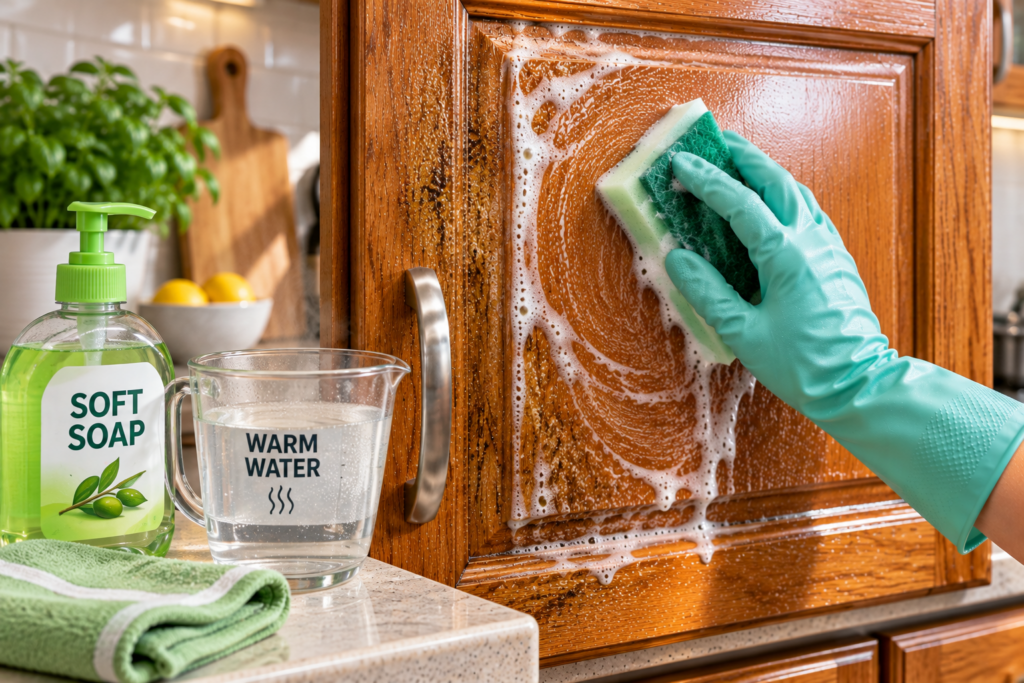
Soft soap can be another useful option for washable surfaces when ordinary dish soap isn’t quite enough.
How to use it
Dilute a small amount of soft soap in lukewarm water according to the product directions.
Apply it using a soft cloth or non-scratching sponge.
Then:
✔ Wipe gently
✔ Remove remaining cleaner
✔ Dry the surface thoroughly
🪵 What about wood?
Don’t assume that every cleaner described as “natural” is automatically safe for every wooden cabinet.
Solid wood can be:
- Painted
- Lacquered
- Varnished
- Oiled
- Waxed
- Otherwise coated
These finishes can react differently to cleaning products.
Check the cabinet manufacturer’s care instructions and test an inconspicuous area first.
🧼 3. Marseille Soap: A Gentle Alternative
⭐⭐⭐⭐☆
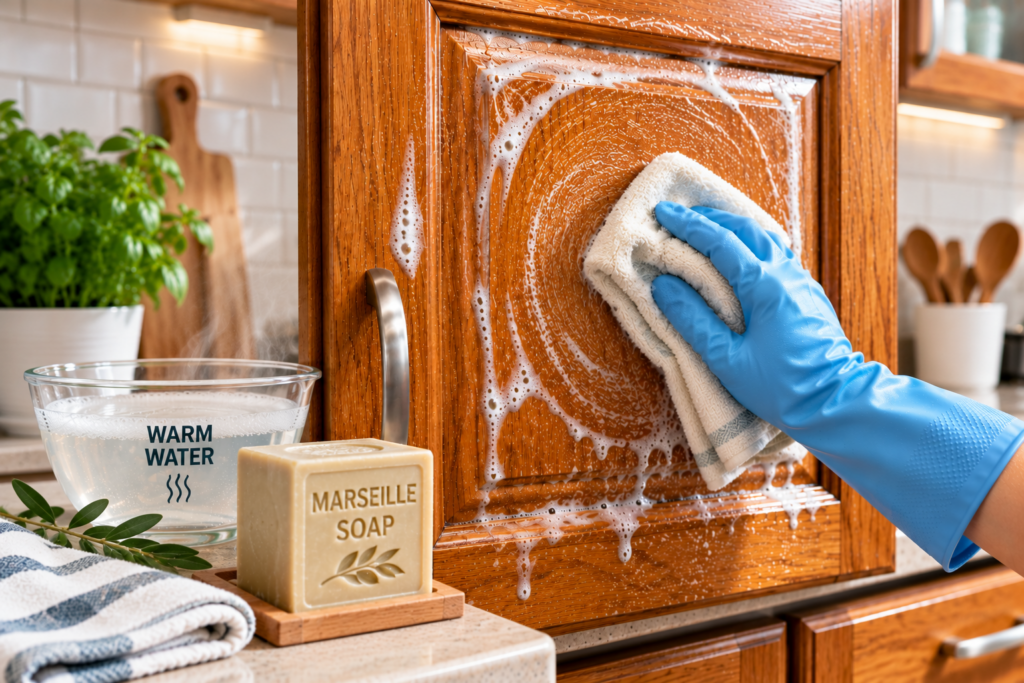
Marseille soap can also help with greasy dirt when appropriately diluted.
It can be particularly useful when you want to try a simple soap-based cleaner before moving to more aggressive options.
Simple method
- Dissolve a small amount of soap in warm water.
- Apply with a well-wrung soft cloth.
- Gently clean the greasy area.
- Remove residue with a second damp cloth if needed.
- Dry immediately.
⚠️ Remember
The fact that a soap is traditional or plant-based doesn’t guarantee compatibility with every cabinet finish.
Always test first.
⭐ 4. Diluted White Vinegar: Only on Compatible Surfaces
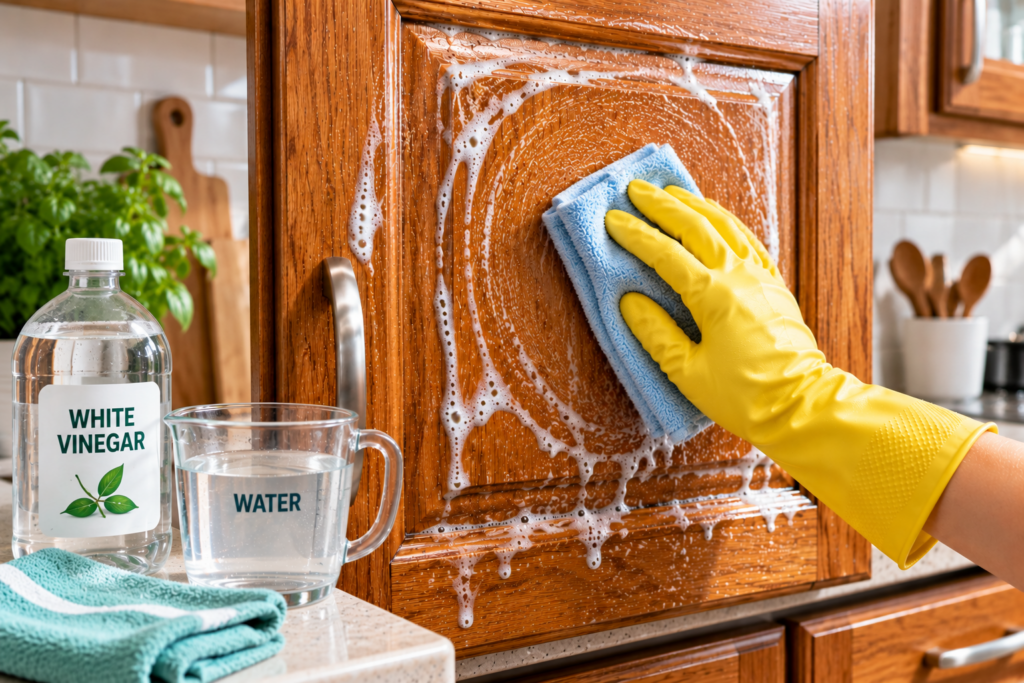
⭐⭐⭐☆☆
Vinegar is extremely popular in homemade cleaning recipes, but there’s an important distinction:
Vinegar isn’t the main grease remover.
For greasy cabinets, dish soap generally does most of the degreasing work.
Vinegar’s acidity can be useful for certain residues, but acidic cleaners aren’t suitable for every material or finish.
So I wouldn’t use a strong vinegar mixture as the universal first treatment for kitchen cabinets.
If you want to use vinegar
Use a diluted solution and only on a surface known to tolerate acidic cleaners.
Apply it to your cloth rather than saturating the cabinet.
Then wipe and dry the surface.
❌ Be especially cautious with:
- Natural stone
- Waxed surfaces
- Certain painted finishes
- Some lacquered finishes
- Sensitive wood finishes
- Damaged cabinet surfaces
When in doubt, follow the manufacturer’s instructions instead.
💡 Important
More vinegar does not necessarily mean better grease removal.
🍋 5. Lemon Juice + Dish Soap
⭐⭐⭐☆☆
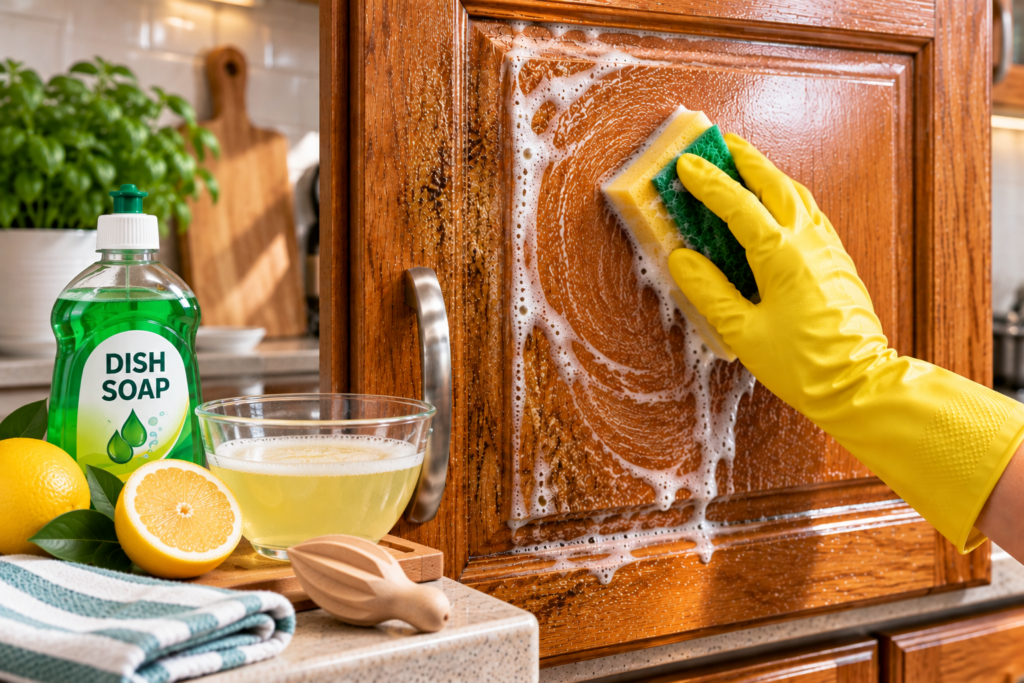
Lemon juice often appears in natural cleaning recipes because it’s acidic and leaves a fresh citrus scent.
A small amount can be combined with diluted dish soap if the surface tolerates acidic cleaners.
But here’s the important part:
The dish soap is doing most of the heavy lifting against grease.
The lemon isn’t essential.
So if you’re unsure whether your cabinets tolerate acids, simply stick with warm water and dish soap.
Avoid acidic cleaners on
❌ Acid-sensitive natural stone
❌ Unknown or delicate finishes
❌ Surfaces whose manufacturer advises against acidic products
⭐ 6. Baking Soda Paste: Reserve It for Robust Surfaces
⭐⭐⭐☆☆
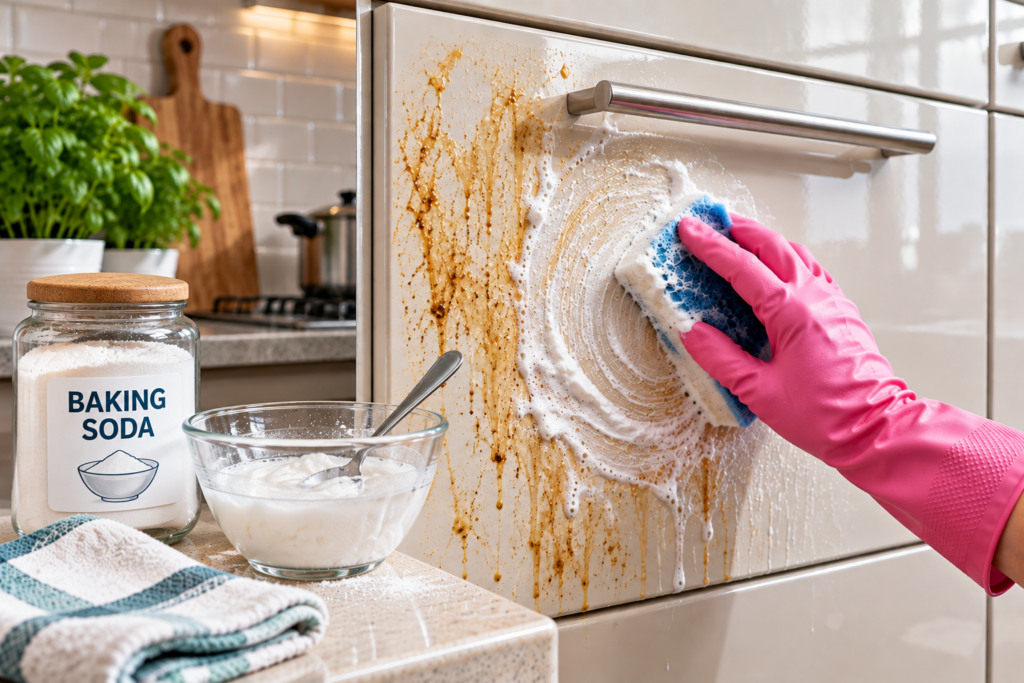
Baking soda is another enormously popular household cleaner.
It can help loosen stubborn grime partly because it provides mild abrasive action.
But that same property means it deserves caution.
How to make a simple paste
Mix:
- 2 tablespoons baking soda
- Enough water to create a soft paste
Apply a very small amount to a suitable robust surface and rub extremely gently with a soft cloth.
Remove all residue afterward.
⚠️ Don’t automatically use baking soda on:
❌ High-gloss cabinet doors
❌ Delicate painted finishes
❌ Waxed wood
❌ Easily scratched surfaces
Even a relatively mild abrasive can change the appearance of a sensitive finish.
Test an inconspicuous area first.
♨️ 7. Steam Cleaner: Only If the Manufacturer Allows It
⭐⭐☆☆☆
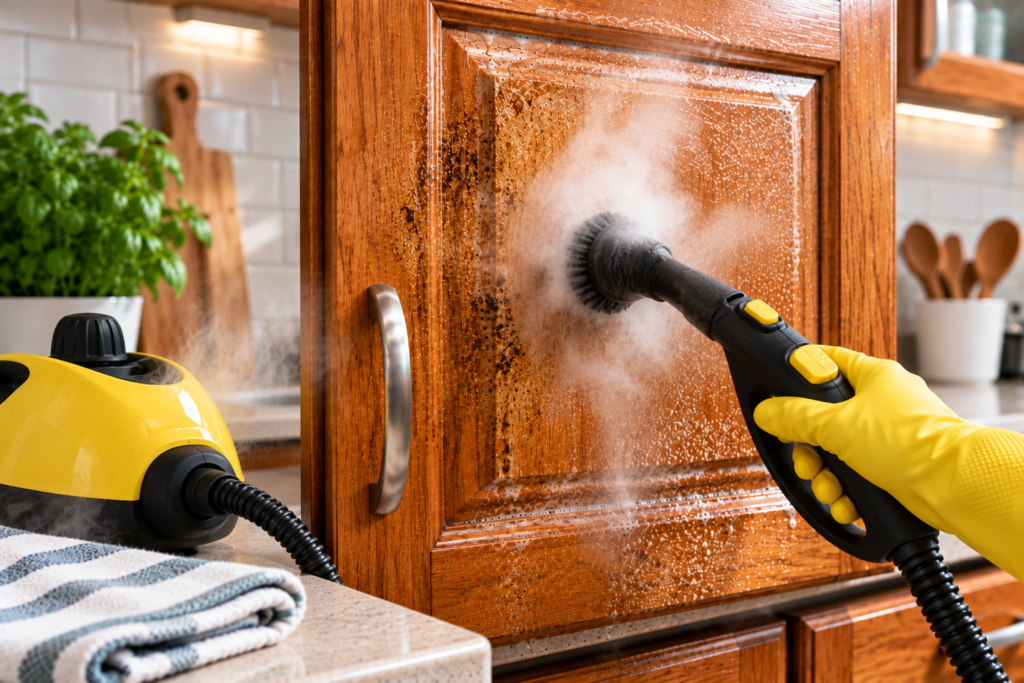
Steam can loosen grease extremely effectively—but that doesn’t automatically make a steam cleaner suitable for kitchen cabinets.
Steam introduces both heat and moisture.
Depending on the cabinet construction, these can potentially affect:
- Edges
- Joints
- Adhesives
- Coatings
- Wood-based panels
- Damaged finishes
For that reason, don’t assume a cabinet is steam-safe simply because the front looks durable.
The safest rule:
Use a steam cleaner on kitchen cabinets only when the cabinet manufacturer specifically allows steam cleaning.
If you don’t know, choose a gentler cleaning method.
🪵 What About Black Soap?
Black soap can be an effective cleaner for greasy household surfaces and deserves consideration as an additional option.
However, just like soft soap, it shouldn’t be described as universally safe for:
wood + lacquer + plastic + tiles + every cabinet finish.
Products and concentrations vary.
Follow the product instructions, check the cabinet manufacturer’s recommendations and test a hidden area first.
🚫 8 Common Mistakes That Can Damage Kitchen Cabinets
Sometimes the cleaning method causes more damage than the grease itself.
Avoid:
❌ Steel wool
❌ Rough scouring pads
❌ Aggressive abrasive cleaners
❌ Oven cleaner on cabinet doors
❌ Excessive water, especially around edges
❌ Hard brushes on delicate finishes
❌ Excessive scrubbing
❌ Randomly mixing household cleaners
⚠️ Especially important
Never mix chlorine bleach with acidic cleaners such as vinegar.
Don’t experiment by combining cleaning chemicals unless the product labels specifically indicate that they can be used together.
🪵 Which Method Is Best for Your Cabinet Surface?
There isn’t one homemade cleaner that’s perfect for every kitchen.
Natural or finished wood
Start with the manufacturer-recommended cleaning method.
When permitted, a slightly damp cloth with a small amount of mild dish soap may be appropriate.
Avoid soaking the wood.
Don’t automatically apply vinegar, baking soda or oil.
What about furniture oil?
Don’t apply mineral oil or wood-care oil simply because a cabinet is made from wood.
An oiled surface and a lacquered surface require very different maintenance.
Only use a conditioning product specifically compatible with the existing finish.
✨ High-gloss cabinets
These surfaces can show scratches and dull areas very easily.
Start with:
✔ Soft microfiber cloth
✔ Warm water
✔ Mild dish soap
Avoid:
❌ Abrasive powders
❌ Rough sponges
❌ Aggressive scrubbing
And don’t assume baking soda is safe.
🧴 Laminate
Many laminate surfaces tolerate gentle cleaning well.
Start with:
✔ Dish soap
✔ Warm water
✔ Soft cloth
Keep moisture away from damaged edges and seams.
🧽 Plastic surfaces
A mild dish-soap solution is again a sensible starting point.
For stubborn stains, check the manufacturer’s instructions before trying abrasives or acidic cleaners.
🏆 So, What Is the Best Way to Remove Grease From Kitchen Cabinets?
For most washable cabinet surfaces, you don’t need a complicated homemade recipe.
🥇 Best first choice:
Warm water + mild dish soap
⭐⭐⭐⭐⭐
🥈 Alternative:
Diluted soft soap or Marseille soap, when compatible
⭐⭐⭐⭐☆
🥉 For certain compatible surfaces:
Diluted vinegar
⭐⭐⭐☆☆
For stubborn grime on robust surfaces:
Baking soda—with caution
⭐⭐⭐☆☆
Steam:
Only when explicitly permitted by the manufacturer
⭐⭐☆☆☆
This order is important.
Start with the least aggressive method likely to work and increase cleaning intensity only when necessary.
🧽 How to Clean Extremely Sticky Kitchen Cabinets
If your cabinets haven’t been cleaned for a long time, you may find a thick, sticky film around the stove.
Don’t immediately attack it with a scouring pad.
Try this instead:
Step 1
Prepare warm water with a small amount of dish soap.
Step 2
Apply the solution with a damp microfiber cloth.
Step 3
Give it a little time to soften the greasy film.
Step 4
Wipe gently.
Step 5
Repeat if necessary.
Step 6
Finish with a clean damp cloth if soap residue remains.
Step 7
Dry the cabinet thoroughly.
💡 Two or three gentle cleaning cycles can be safer than one aggressive scrubbing session.
🧼 Don’t Forget Cabinet Handles
Handles are frequently touched while cooking, so grease and dirt can accumulate surprisingly quickly.
Use a soft cloth with mild soapy water and clean around:
- Handles
- Knobs
- Pulls
- Areas immediately surrounding them
Be careful not to let excessive moisture enter screw holes or cabinet joints.
💡 How to Prevent Greasy Kitchen Cabinets
Prevention makes deep cleaning much easier.
Try these simple habits:
✔ Turn on the range hood while cooking.
✔ Clean or replace range-hood filters as recommended.
✔ Wipe fresh grease splashes promptly.
✔ Regularly wipe cabinets close to the stove.
✔ Clean handles frequently.
✔ Dry surfaces after wet cleaning.
✔ Don’t wait until the grease becomes thick and sticky.
You don’t necessarily need to deep-clean every cabinet every week.
Focus regular maintenance on high-exposure areas around the cooking zone.
❓ Frequently Asked Questions
What is the best homemade degreaser for kitchen cabinets?
For most washable cabinet surfaces, warm water with a small amount of mild dish soap is the best place to start. It’s simple, effective against everyday grease and generally less aggressive than acidic or abrasive alternatives.
Does vinegar remove grease from kitchen cabinets?
Vinegar can help with certain residues on compatible surfaces, but it isn’t necessarily the best primary degreaser.
Dish soap is generally more directly useful against kitchen grease.
Because vinegar is acidic, check surface compatibility before using it.
Can vinegar damage wood cabinets?
Potentially, depending on the finish and concentration.
“Wood cabinet” isn’t one single type of surface. Painted, lacquered, waxed and oiled wood can require different care.
Check the manufacturer’s instructions and test first.
Can I use baking soda on glossy kitchen cabinets?
It’s better to avoid it unless the manufacturer specifically considers it safe.
Baking soda has mild abrasive properties and could dull or mark a sensitive glossy finish.
Is lemon juice a good kitchen degreaser?
Lemon juice can be part of a cleaning solution, but it isn’t necessary for ordinary grease removal.
When lemon juice is mixed with dish soap, the dish soap is the main degreasing ingredient.
Because lemon juice is acidic, avoid it on acid-sensitive surfaces.
Can I use a steam cleaner on kitchen cabinets?
Only if the cabinet manufacturer permits it.
Heat and moisture can potentially affect certain finishes, joints, edges and adhesives.
How often should kitchen cabinets be cleaned?
There’s no universal schedule.
Cabinets around the stove and frequently touched handles may need cleaning much more often than cabinets farther away.
A quick regular wipe is usually easier than waiting for a thick grease layer to develop.
What should I do if dish soap doesn’t remove the sticky film?
Repeat the cleaning process and give the solution a little contact time before wiping.
If the residue remains, identify the cabinet material and finish before moving to a stronger cleaner.
✨ Final Thoughts
Removing grease from kitchen cabinets doesn’t require the strongest cleaner in your cupboard.
In fact, the safest strategy is often the opposite:
Start gentle, identify the surface, and only increase cleaning strength when necessary.
For most washable kitchen fronts, warm water and mild dish soap should be your first choice. Soft soap or Marseille soap can be useful alternatives when compatible, while vinegar, lemon juice and baking soda require more attention to the cabinet finish.
And steam cleaning? Save it for surfaces whose manufacturer specifically allows it.
With regular maintenance, a soft microfiber cloth and the right cleaning method for your particular cabinets, you can keep kitchen fronts looking clean without unnecessarily exposing them to aggressive chemicals or abrasive scrubbing.