
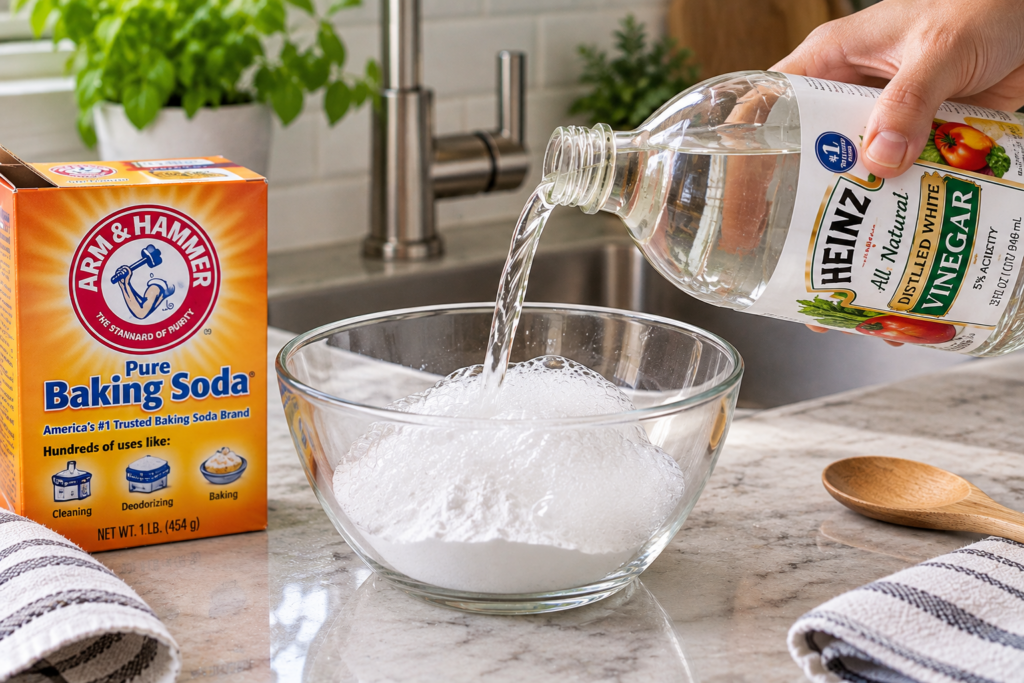
For years, I thought I had discovered one of the easiest cleaning tricks imaginable.
Sprinkle baking soda over a dirty surface, pour on some white vinegar, watch the mixture explode into bubbles—and surely all that fizz must mean serious cleaning power, right?
It certainly looks impressive.
But there’s an important piece of chemistry behind this popular household hack that completely changes how you should think about it.
Baking soda and vinegar can both be useful around the home. But mixing them together doesn’t automatically create a more powerful cleaner.
In fact, for many cleaning jobs, you’ll get better results by using them separately.
So what actually happens inside that bubbling mixture? When can the fizz still be useful? And which cleaning jobs are better suited to baking soda or vinegar on its own?
Here’s what you should know before reaching for both bottles again.
🧪 What Actually Happens When You Mix Baking Soda and Vinegar?
Baking soda—sodium bicarbonate—is mildly alkaline.
Vinegar contains acetic acid, making it acidic.
When you combine an acid and a base, they react with each other.
That familiar bubbling is largely the release of carbon dioxide gas.
In simple terms:
Baking soda + vinegar → carbon dioxide + water + sodium acetate
Those dramatic bubbles therefore aren’t proof that you’ve just created a super-cleaner.
Quite the opposite: as the reaction progresses, the acidic vinegar and alkaline baking soda consume and neutralize each other.
That was the detail I had been missing.
😲 So Is the Famous Fizz Completely Useless?
Not necessarily.
This is where the answer becomes more interesting.
The immediate bubbling creates physical agitation, which may help loosen some debris in certain situations.
But that is very different from saying that the final mixture is a universally powerful cleaning solution.
Think of it this way:
The fizz is an action—not evidence of extraordinary cleaning strength.
If your cleaning job specifically benefits from acidity, you generally want the vinegar to remain acidic.
If you need baking soda’s mild alkalinity or gentle abrasive action, you don’t necessarily want to neutralize it immediately with vinegar.
That’s why understanding what you’re trying to remove is more useful than simply looking for the biggest chemical reaction.
🧂 When Baking Soda Makes More Sense
Baking soda can be surprisingly useful on its own.
Utah State University Extension describes baking soda as useful for neutralizing some odors and as a gentle cleanser on various household surfaces.
Here are some situations where it may be the better choice.
1. 👃 Dealing With Certain Household Odors
Baking soda is well known for odor control.
That’s one reason people commonly use it in refrigerators, trash cans and other areas where unwanted smells develop.
Instead of masking an odor with fragrance, baking soda can interact with some odor-causing compounds.
Of course, if something is actually dirty or spoiled, baking soda shouldn’t replace removing and cleaning the source.
2. 🧽 Gentle Scrubbing
The fine particles in baking soda can provide mild abrasive action.
A small amount mixed with water can form a paste that may help loosen certain residues.
That can be useful for some:
- sinks
- cookware
- kitchen surfaces
- bathroom surfaces
But “gentle” doesn’t mean safe for absolutely everything.
Always check the manufacturer’s care instructions and test an inconspicuous area when you’re uncertain.
3. 🍳 Tackling Some Greasy or Cooked-On Residue
Because baking soda is mildly alkaline and mildly abrasive, it can sometimes help with greasy or cooked-on messes.
The key is giving it time and using appropriate mechanical cleaning rather than expecting an instant miracle.
🍶 When Vinegar Makes More Sense
Vinegar has a completely different strength.
Its acidity can be useful against alkaline mineral deposits, particularly the whitish buildup associated with hard water. Utah State University Extension specifically notes that vinegar’s acidity can help with hard-water scale.
Poison Control likewise describes mild acid cleaners such as vinegar as useful against hard-water spots and soap-scum-type buildup on appropriate surfaces.
That makes vinegar potentially useful for jobs such as:
🚿 Hard-Water Deposits
Those chalky white marks around certain faucets and bathroom fixtures are often mineral deposits.
Acid can help dissolve them.
🚿 Some Shower Buildup
On compatible surfaces, diluted vinegar may help with mineral residue and some soap buildup.
🫖 Certain Appliances
Vinegar is sometimes used for descaling compatible appliances—but this is one place where you should follow the manufacturer’s instructions rather than automatically pouring vinegar into everything.
Some manufacturers specify particular descaling procedures or products.
⚠️ But Vinegar Is NOT Safe for Every Surface
This is perhaps even more important than the baking-soda-and-vinegar myth.
Because vinegar is acidic, it can damage certain materials.
Be particularly cautious around acid-sensitive natural stone, including materials such as marble and limestone.
Consumer Reports notes that acidic substances can etch stones such as marble, travertine and limestone.
And don’t assume every floor, countertop, appliance, seal or finish is vinegar-safe.
When you’re uncertain:
Check the manufacturer’s instructions first.
That’s much safer than assuming that something is harmless simply because it’s a common kitchen ingredient.
🧽 Baking Soda vs. Vinegar: Choose the Cleaner for the Job
Here’s the simple rule I wish I’d understood years ago:
Don’t choose a cleaner because the reaction looks impressive. Choose it according to what you’re trying to clean.
Choose baking soda when you want:
✓ Mild abrasive action
✓ Help with certain odors
✓ A gentle scrubbing paste on compatible surfaces
Choose vinegar when you want:
✓ Acidic action against certain mineral deposits
✓ Help with hard-water scale on compatible surfaces
✓ An acidic cleaner where the manufacturer permits it
Mix them when:
You have a specific reason to benefit from the short-lived bubbling action, rather than assuming the combination will always outperform the individual ingredients.
🚰 What About Baking Soda and Vinegar Down the Drain?
This may be the most famous version of the hack.
People pour baking soda into a drain, follow it with vinegar, and watch the foam rise.
It certainly looks satisfying.
But don’t confuse bubbling with proof that a stubborn blockage has been dissolved.
A serious clog caused by hair, grease or a physical obstruction may require mechanical removal, appropriate drain-cleaning methods, or a plumber.
And there’s another important precaution.
⚠️ Don’t start combining homemade ingredients with commercial drain cleaners.
Drain products can contain powerful chemicals. Poison Control warns that strong alkaline drain cleaners can be caustic and that mixing household cleaning chemicals can produce dangerous reactions.
If you’ve already used a commercial product, follow its label rather than adding another chemical.
🚫 6 Mistakes People Make With Baking Soda and Vinegar
1. Assuming More Fizz Means More Cleaning Power
This is the biggest misconception.
The bubbles mainly show that a chemical reaction is taking place.
They don’t tell you how effectively the mixture will remove the particular dirt, grease or mineral deposit you’re trying to clean.
2. Premixing Them and Saving the Bottle
This defeats much of the point.
The characteristic reaction occurs when the two ingredients meet.
Once the reaction has largely finished, you’re no longer dealing with the same acidic vinegar and alkaline baking soda you started with.
If you see homemade-cleaner recipes telling you to mix them together and store the finished solution as an ultra-powerful cleaner, be skeptical.
3. Using Vinegar on Every Surface
Vinegar isn’t a universal cleaner.
Natural stone and some specialized finishes can be damaged by acids.
Always check compatibility.
4. Assuming “Natural” Means Harmless
Both ingredients are familiar kitchen products, but familiar doesn’t mean appropriate for every application.
Vinegar can irritate the eyes and skin, particularly with inappropriate or prolonged exposure.
Use household substances thoughtfully and keep them away from children.
5. Using the Combination as a Disinfectant
Cleaning and disinfecting aren’t the same thing.
Don’t assume a homemade mixture has disinfected a surface simply because it bubbled dramatically.
When actual disinfection is necessary, use an appropriate product according to its label instructions.
6. Mixing Vinegar With Other Cleaning Chemicals
This one deserves special attention.
Never mix vinegar with chlorine bleach.
Vinegar is acidic, and mixing an acid with hypochlorite bleach can release chlorine gas, which can irritate and injure the eyes and respiratory system.
More broadly, don’t experiment by mixing household cleaning products unless the product directions explicitly tell you to do so. Poison Control specifically advises against casually mixing cleaners because potentially dangerous reactions can occur.
🧠 The Better Cleaning Strategy
Instead of automatically reaching for both ingredients, ask yourself one question:
What kind of mess am I trying to remove?
If you’re dealing with mineral scale on a vinegar-compatible surface, an acidic approach may make sense.
If you’re dealing with an odor or need mild abrasive scrubbing on an appropriate surface, baking soda may make more sense.
If you’re dealing with ordinary grease and dirt, sometimes the simplest solution—water plus an appropriate detergent or dish soap—is the better tool.
And if you’re dealing with a delicate surface, expensive appliance or specialized finish, follow the manufacturer’s instructions rather than experimenting.
The best cleaning trick isn’t always the one with the most dramatic reaction.
It’s the one that matches the mess.
🔬 Why Does This Myth Keep Going Viral?
Because the reaction is incredibly visual.
Sprinkle white powder into a sink.
Pour clear liquid over it.
Suddenly:
FIZZ! 🫧
It looks like something powerful is happening.
And that’s perfect for short-form videos and before-and-after posts.
But visual drama and cleaning effectiveness aren’t necessarily the same thing.
Understanding that difference makes baking soda and vinegar more useful—not less useful—because now you can use each ingredient where its properties actually help.
❓ Frequently Asked Questions
Is mixing baking soda and vinegar dangerous?
Ordinary household baking soda and vinegar react by producing carbon dioxide, water and sodium acetate. The familiar fizz itself isn’t comparable to dangerous cleaner combinations such as vinegar plus chlorine bleach. Still, avoid sealing a vigorously reacting mixture inside a closed container because gas is being produced.
Does baking soda and vinegar make a stronger cleaner?
Not automatically. Because one is alkaline and the other acidic, they react with and neutralize each other. The temporary bubbling may provide physical agitation, but that doesn’t make the resulting mixture universally stronger.
Why does the mixture foam so much?
The acid-base reaction releases carbon dioxide gas, producing the familiar bubbles.
Is baking soda good for cleaning?
It can be useful as a mild abrasive and for managing some odors on appropriate surfaces.
Is vinegar good for cleaning?
It can be useful against certain mineral deposits and hard-water buildup because of its acidity, provided the surface is acid-compatible.
Can vinegar damage countertops?
Yes, some materials are acid-sensitive. Marble, limestone and similar natural stones require particular caution. Check the manufacturer or stone supplier’s care instructions.
Can I mix vinegar with bleach?
No. Never do this. Mixing vinegar or another acid with hypochlorite bleach can produce dangerous chlorine gas.
Should I throw away my baking soda and vinegar?
Absolutely not. Both can still be useful household products.
The trick is simply to stop assuming they always become better when mixed together.
✨ Final Thoughts
I used to think the bubbling was the secret.
Baking soda + vinegar = more bubbles = more cleaning power.
But the reality is much more useful.
Baking soda and vinegar have different properties. Baking soda can provide mild abrasive action and help with certain odors, while vinegar’s acidity can help dissolve some mineral buildup on compatible surfaces.
Mix them together and you get that famous fizz—but you’re also causing the acid and base to react with each other.
So the next time you reach for both bottles, don’t ask:
“How much will this fizz?”
Ask:
“What am I actually trying to clean?”
That small change can make your cleaning routine simpler, safer and much more effective. 🧽✨