
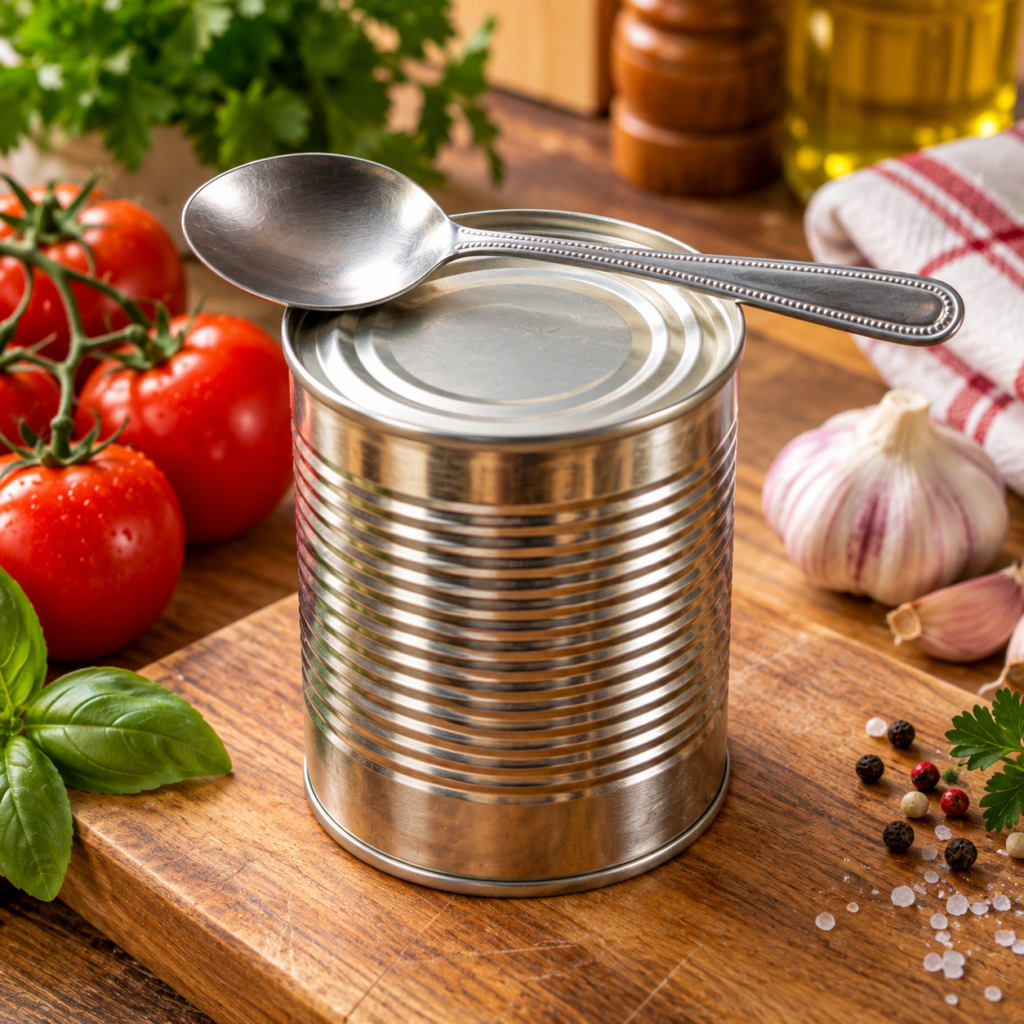
You have a can of food ready for dinner, but suddenly realize there’s no can opener anywhere. Maybe the opener broke, you’re camping, or you simply forgot to pack one. 🏕️
One well-known emergency trick uses something found in almost every kitchen: a sturdy metal spoon.
The technique was demonstrated by DaveHax in the video “How to Open a Can in an Emergency – Life Hack.” By repeatedly rubbing the edge of a metal spoon against the lid, friction and pressure can eventually wear through the thin metal.
It can work—but there’s an important detail often missing from viral demonstrations: an improvised opening can leave extremely sharp edges and may create small metal fragments. For that reason, this should be considered an emergency workaround rather than a replacement for a proper can opener.
Here’s how the method works, what to watch out for, and when it’s better not to try it.
🥫 Why Can a Spoon Open a Metal Can?
At first, it seems unlikely. A spoon isn’t sharp, so how could it possibly cut through a can?
The trick relies less on sharpness and more on repeated friction and concentrated pressure.
When the rounded edge or tip of a strong metal spoon is rubbed repeatedly over the same small area of the lid, the metal can gradually become thinner. Eventually, enough pressure can create an opening.
Once that first opening exists, the spoon may be worked carefully along the lid.
However, this requires effort, patience and a sturdy spoon. Different cans also use different materials and lid thicknesses, so results can vary.
🛠️ How to Open a Can With a Spoon
What You’ll Need
- 🥄 A strong metal spoon
- 🥫 The unopened can
- 🧤 Cut-resistant gloves, if available
- 🧻 A clean towel or stable non-slip surface
Avoid plastic, disposable or very thin spoons. They can bend or break before making meaningful progress.
Step-by-Step Instructions
- 🧼 Clean the Top of the Can First: The outside of a food can may have picked up dust or dirt during transportation and storage. Wipe or wash the top of the can before opening it, then dry it afterward so it’s easier to hold securely.
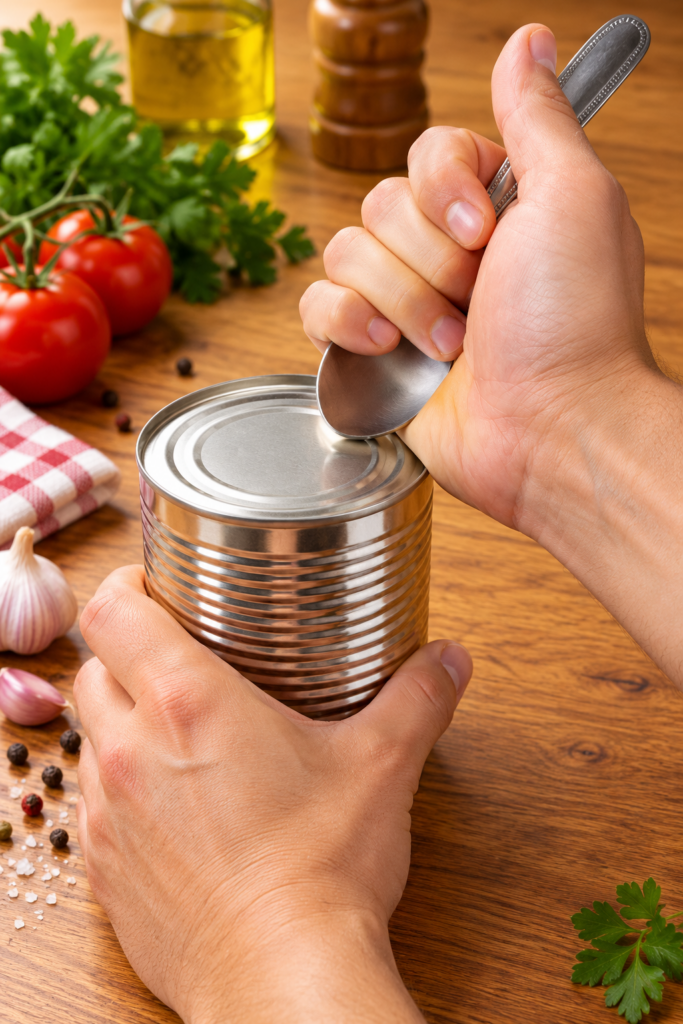
- 🥄 Hold a Sturdy Spoon Firmly: Grip the bowl of the spoon firmly in your hand so that only a short section near the tip extends beyond your grip. Don’t hold the spoon loosely or position your fingers near the area where the metal may eventually tear.
- 🎯 Position the Spoon Near the Inner Rim: Place the tip or edge of the spoon against the inside edge of the lid, close to the raised rim. Choose one small area and keep working on that same spot on a stable, flat surface.
- ↔️ Rub Back and Forth: Rub the spoon firmly back and forth over the same small section of metal. You need enough pressure to create friction, but don’t use uncontrolled force. Patience is much safer than trying to stab or strike the lid.
- 🕳️ Create the First Opening: Eventually, the weakened section may give way and create a small hole. Slow down here, as the newly exposed metal can be razor-sharp. Keep your fingers well away from the opening.
- 🔄 Carefully Work Around the Lid: Once you’ve made an opening, use the edge of the spoon carefully to continue separating the lid near the rim. You don’t necessarily need to remove the lid completely.
- ⚠️ Carefully Lift the Lid: A lid opened this way can have jagged, sharp edges. Don’t grab the cut edge with bare fingers; use an appropriate tool or protective gloves if the lid must be moved.
⚠️ The Most Important Safety Warning
The spoon trick looks surprisingly simple in a short video, but opening a can manually can create a serious cut hazard. A torn metal lid may be sharp enough to cause a deep cut.
Never:
- ❌ Run your finger around the cut edge
- ❌ Stab the lid forcefully with the spoon
- ❌ Hold the can between your legs or against your body
- ❌ Let children attempt the technique
- ❌ Use a cracked, damaged or badly rusted can
- ❌ Continue if your spoon is bending or slipping
- ❌ Eat the contents if you suspect metal fragments have fallen inside
A regular can opener remains the safer and easier choice whenever one is available.
🧲 What About Metal Shavings?
Repeatedly scraping metal against metal can potentially create tiny fragments. If you notice visible metal particles inside the food—or have reason to believe fragments entered it—the safest choice is not to eat the food.
Don’t assume that picking out one visible fragment means you’ve removed everything. This is another reason the spoon method is best reserved for genuine emergencies.
🏕️ When Could This Trick Actually Be Useful?
This technique makes the most sense as an emergency or backup skill, such as while:
- 🏕️ Camping
- 🚐 Traveling in a camper
- 🎣 Fishing
- 🥾 Spending time outdoors
- 🏠 Dealing with a broken can opener
- 📦 Opening emergency food supplies when the normal tool isn’t available
For planned camping or emergency preparedness, though, the better solution is simple: pack a reliable manual can opener. They’re small, inexpensive and much safer.
🎥 Watch the Spoon Technique in Action
The original DaveHax demonstration, “How to Open a Can in an Emergency – Life Hack,” shows how the spoon is positioned, rubbed against the lid and gradually worked around the can.
❓ Frequently Asked Questions
🥄 Can you really open a can with a spoon?
Yes, it can be possible with a sturdy metal spoon. Repeatedly rubbing the spoon against a small area near the lid’s rim can gradually wear through the metal. However, the technique isn’t equally easy with every can and creates sharper edges than a normal can opener.
🥫 What’s the safest way to open a can without a can opener?
If an appropriate purpose-built opener is available, use it. Improvised methods generally introduce additional risks. The spoon method should therefore be treated as an emergency workaround rather than a preferred opening technique.
🔪 Should I use a knife instead?
Using a knife to stab or pry open a can introduces a serious slipping and cutting hazard. A purpose-built can opener is preferable.
🥄 Can I use a plastic spoon?
No. A plastic spoon isn’t suitable for the pressure and friction required and may bend or break.
💪 Does the spoon need to be strong?
Yes. A thick, sturdy metal spoon is preferable. Thin cutlery can bend under pressure.
🧤 Should I wear gloves?
If you have appropriate cut-resistant gloves, they can add protection. Ordinary thin disposable gloves should not be treated as protection against sharp metal.
🧲 Can metal pieces fall into the food?
Improvised scraping and tearing can potentially create metal fragments. If you see metal particles in the food or suspect fragments have entered it, don’t eat the contents.
🥫 Can I open any type of can this way?
Not necessarily. Construction and metal thickness vary considerably between cans, so the amount of effort required can also vary.
🏕️ Is this a good camping trick?
It’s useful knowledge for an unexpected situation, but packing a small manual can opener is a much better camping strategy.
🧼 Should I wash the can before opening it?
Cleaning the top is a sensible precaution, especially when the lid is dusty or dirty, because you’ll be working directly around the opening.
⭐ Final Takeaway
The spoon can-opening trick really can work, which makes it an interesting emergency life hack to know. 🥄🥫
But the viral version sometimes makes the technique look easier and safer than it actually is. The biggest problem isn’t getting through the lid—it’s dealing with the sharp, irregular metal edges afterward.
So remember the simple rule: 👉 Use a proper can opener whenever possible. Keep the spoon trick for an emergency.
If you ever need to try it, work slowly on a stable surface, keep your fingers away from torn metal, and don’t consume the food if you suspect metal fragments have entered it. Sometimes the best life hack isn’t replacing the proper tool—it’s knowing what to do when that tool suddenly isn’t there. 🥄✨