
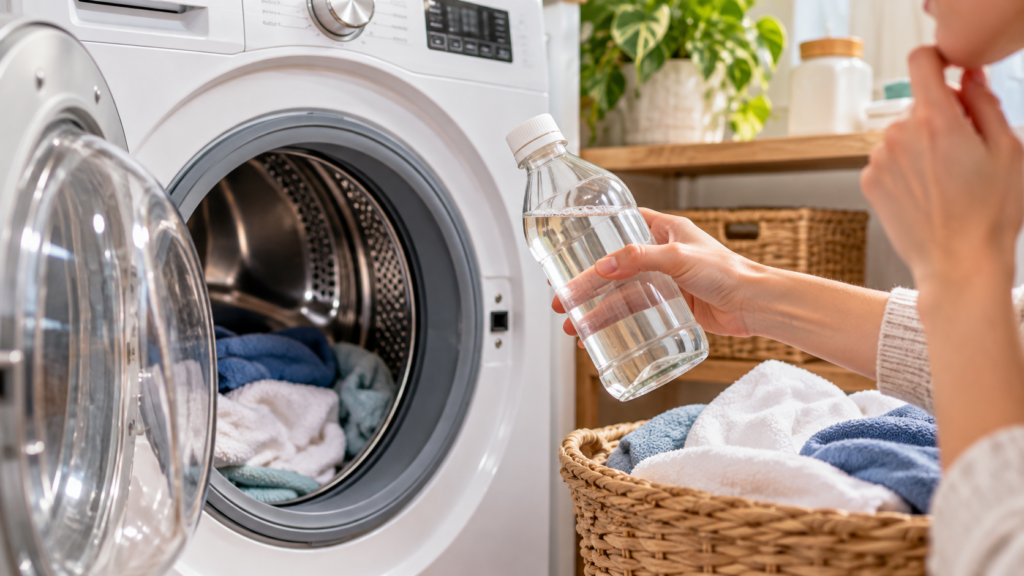
White vinegar is one of the most popular laundry ingredients on the internet.
Search for ways to soften towels, remove odors, clean a washing machine, eliminate detergent buildup, or freshen clothes, and chances are you’ll find someone recommending vinegar.
But there’s an important detail that often gets lost in these viral laundry hacks:
Vinegar can be useful for certain laundry problems, but it isn’t something you should automatically pour into every load.
In fact, some washing-machine manufacturers caution against regularly putting vinegar inside their machines because its acidity may affect rubber seals, hoses, or other components over time.
And there’s one situation where vinegar absolutely doesn’t belong:
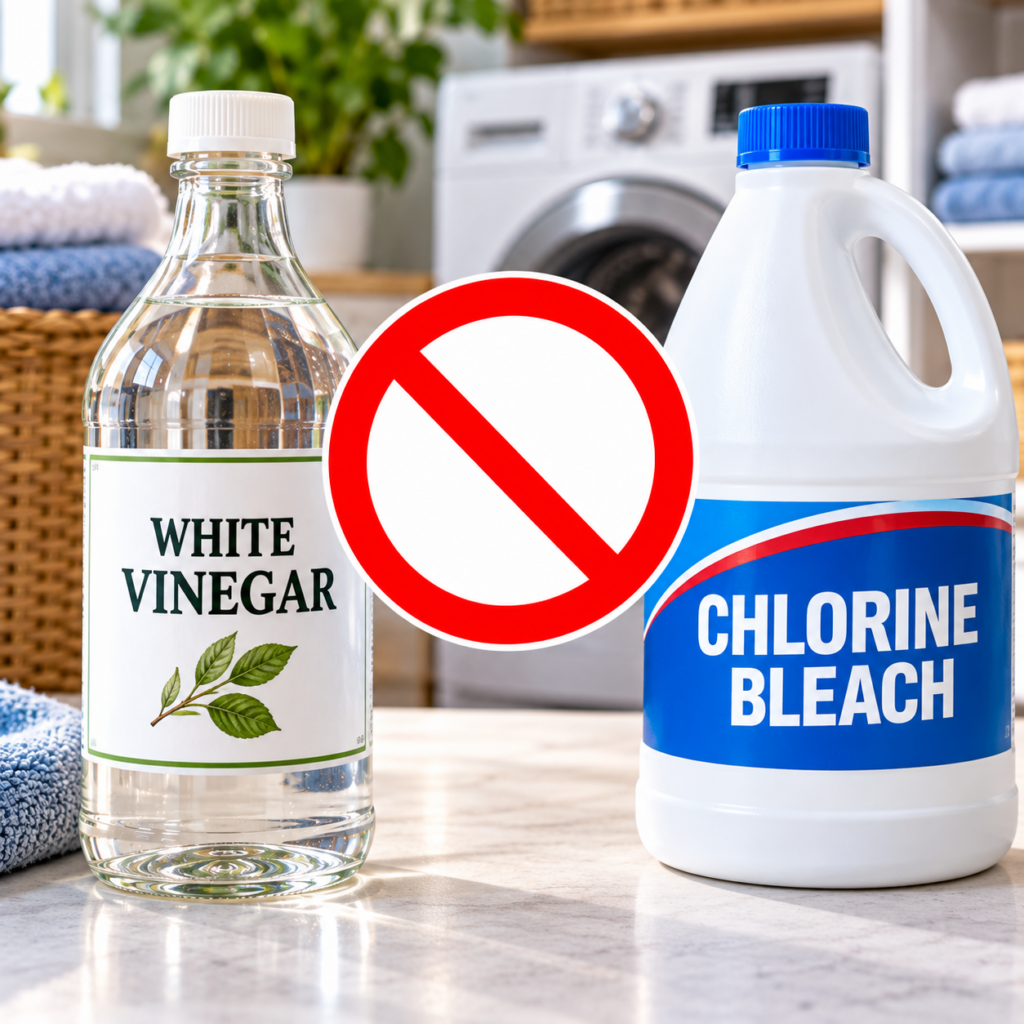
⚠️ Never mix vinegar with chlorine bleach. Combining an acid such as vinegar with hypochlorite bleach can release dangerous chlorine gas.
So what’s the sensible approach?
Use vinegar for a specific, compatible laundry problem—not simply because you’re doing laundry.
Here’s how to tell the difference.
🍶 Why Is Vinegar Used in Laundry Anyway?
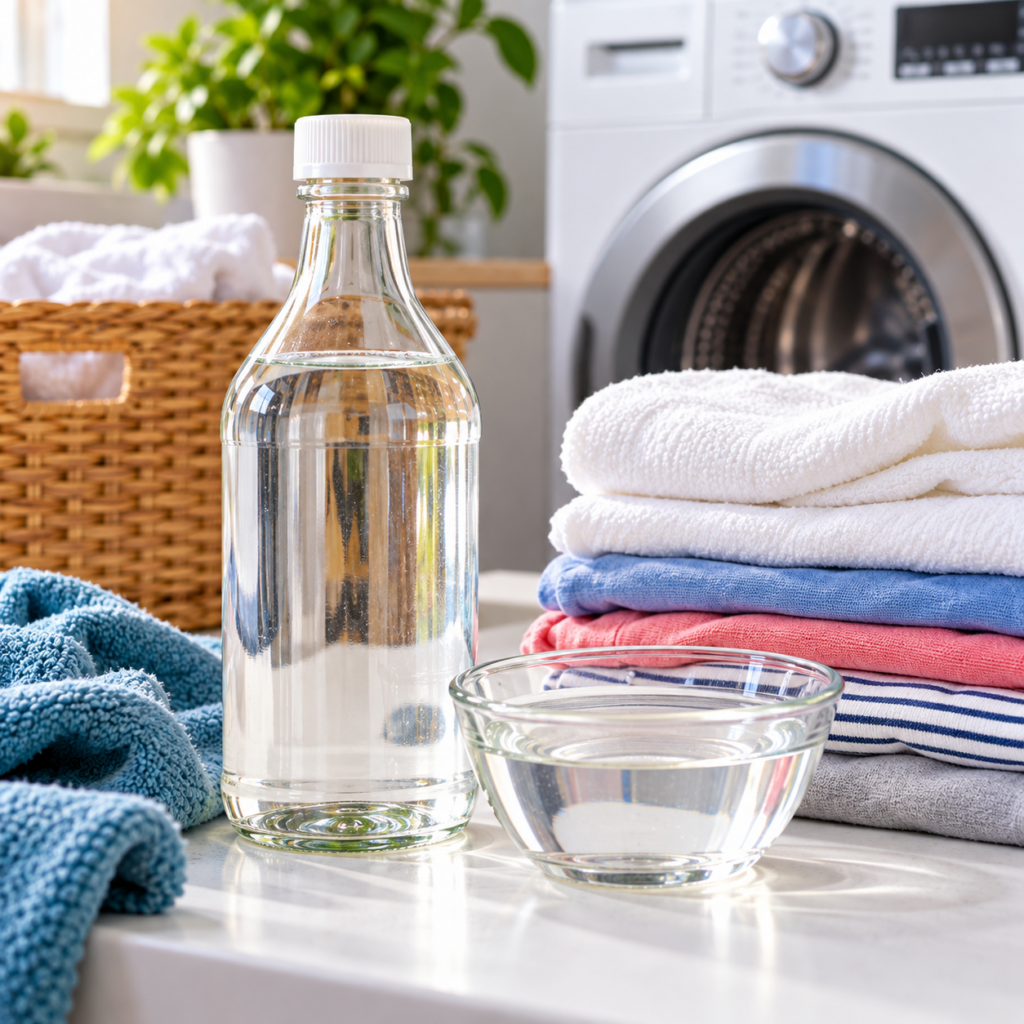
Distilled white vinegar contains acetic acid, which gives vinegar its acidity.
That acidity can be useful against certain mineral deposits and residues. This is one reason vinegar has legitimate uses in textile care.
For example, the American Cleaning Institute includes a diluted white-vinegar soak among its solutions for certain detergent and hard-water residues on clothing.
But that doesn’t turn vinegar into a universal laundry product.
It isn’t a substitute for detergent, and it shouldn’t be treated as a general-purpose laundry disinfectant.
Think of vinegar as a special-purpose treatment, not something every load automatically needs.
🚫 When You Should NOT Use Vinegar in Laundry
Let’s start with the situations where reaching for vinegar may be the wrong solution.
🚫 1. When Your Washing Machine Manufacturer Says Not to Use It
This is probably the most overlooked rule.
A viral laundry hack might tell you to pour a cup of vinegar into the fabric-softener compartment or directly into the drum.
But your washing-machine manufacturer gets the final say.
Whirlpool, for example, warns that repeatedly exposing certain washing-machine components to vinegar may damage rubber seals and hoses over time.
Other manufacturers may provide different instructions.
✅ What to do instead
Check the manual for your specific washer.
If your machine has a:
- Clean Washer
- Tub Clean
- Drum Clean
- Self Clean
cycle, use it according to the manufacturer’s directions.
And if the manufacturer recommends a particular washing-machine cleaner, use that rather than assuming vinegar is universally safe.
Simple rule: Your washer manual beats a viral cleaning hack.
☠️ 2. Never Use Vinegar With Chlorine Bleach
This isn’t about protecting your clothes or your washing machine.
It’s about protecting you.
Vinegar is acidic. Chlorine bleach typically contains sodium hypochlorite.
Combining hypochlorite bleach with an acid can release chlorine gas, which can seriously irritate the eyes and respiratory system and can be dangerous at sufficient exposure.
❌ Never intentionally combine:
Vinegar + chlorine bleach
Don’t combine them in a bowl, spray bottle, washer compartment, bucket, sink, or homemade cleaning mixture.
✅ What to do instead
If you’re using chlorine bleach, follow the bleach label and your washer’s instructions.
Don’t add vinegar to the mixture.
🦠 3. Don’t Rely on Vinegar When You Actually Need Disinfection
Another common claim is that vinegar “naturally disinfects” laundry.
That’s not a good reason to rely on ordinary household vinegar when genuine laundry sanitization or disinfection is required.
✅ What to do instead
Use an appropriate laundry sanitizer or other product specifically labeled for the intended purpose, provided it is compatible with your fabrics and washer.
If bleach is appropriate for the garment, follow the product label and care instructions.
For normal everyday laundry, properly washing with detergent and thoroughly drying the items is generally more relevant than trying to turn vinegar into a disinfectant.
🧼 4. Don’t Automatically Use Vinegar to Clean a Smelly Washer
If your washing machine smells unpleasant, pouring several cups of vinegar into the drum and running a hot cycle may sound tempting.
But again, manufacturers differ.
Bosch, for example, advises against using vinegar to clean or descale its washing machines because of the potential effect on rubber components. Bosch washing-machine guidance
✅ What to do instead
First inspect the common trouble spots:
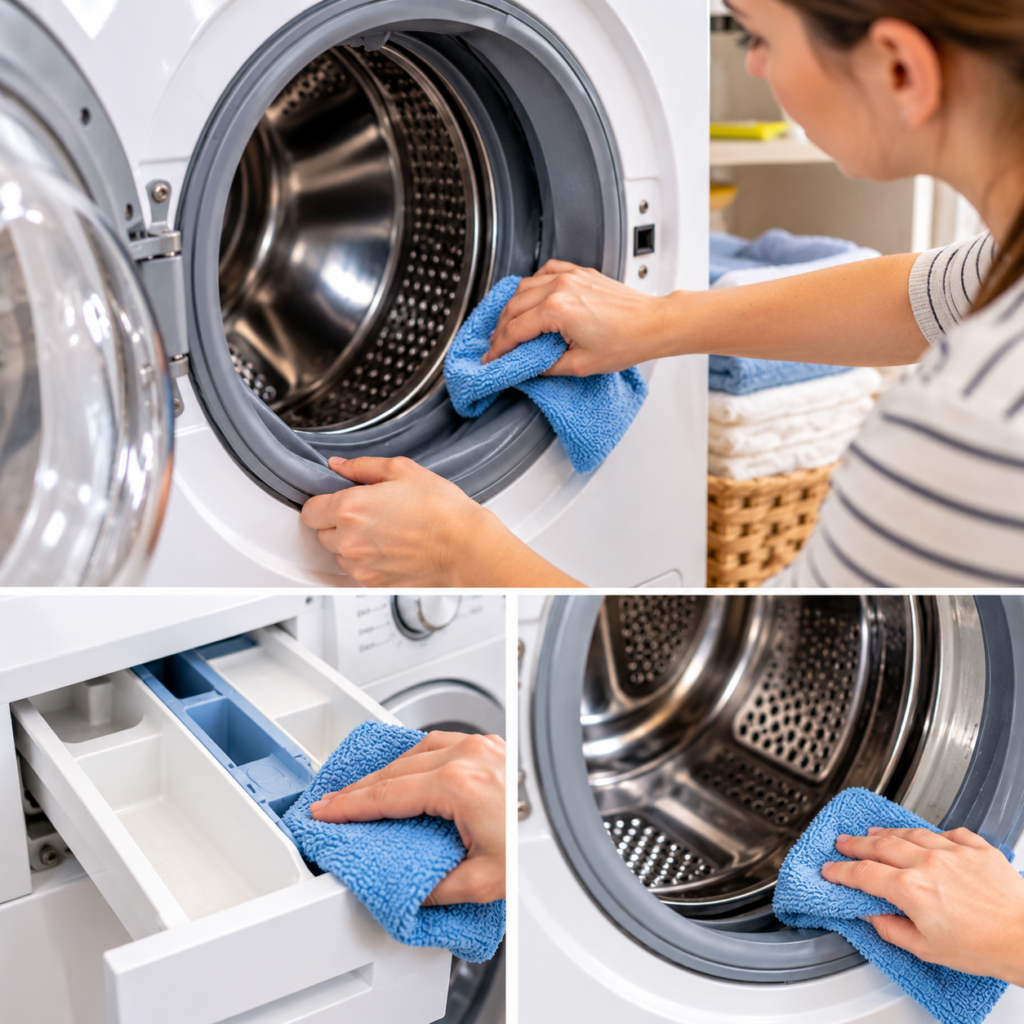
- Door gasket
- Detergent drawer
- Drain/filter area where user-accessible
- Moisture left inside the drum
Then run the manufacturer’s recommended cleaning program.
After washing, leaving the door or lid open when appropriate can also help the interior dry instead of remaining continuously damp.
👕 5. Don’t Automatically Add Vinegar Because Clothes Smell
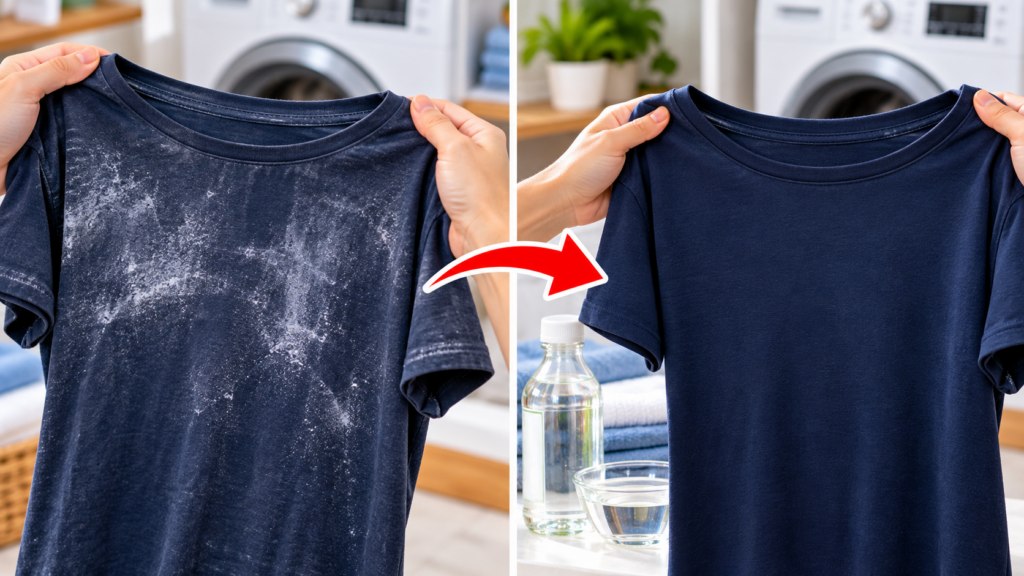
If clothes still smell after washing, vinegar may not address the underlying problem.
The real cause could be:
- Too much detergent
- Overloading the machine
- Wet clothing sitting too long
- Incomplete drying
- Residue inside the washer
- A dirty detergent drawer or gasket
✅ Try this first
Use the recommended amount of detergent.
Don’t overload the drum.
Remove wet clothes promptly.
Dry them completely.
And if multiple loads emerge smelling musty, inspect and clean the washer according to its instructions.
🛁 6. Don’t Assume Vinegar Is a Universal Fabric Softener
You’ve probably encountered this advice:
“Stop buying fabric softener. Just use vinegar.”
It’s an oversimplification.
Commercial fabric softeners are formulated to modify fiber properties such as feel and static. Vinegar doesn’t work in exactly the same way.
What vinegar may sometimes do is help remove certain residues that were making fabric feel stiff.
Those aren’t the same thing.
✅ What to do instead
If towels have become rough, first investigate:
Too much detergent → insufficient rinsing → overloading → hard water → drying method.
Fixing the reason the fabric feels stiff can be more effective than simply adding another ingredient.
🧪 7. Don’t Expect Vinegar + Baking Soda to Become a Super Cleaner
This combination produces impressive fizzing.
But the bubbles aren’t proof that you’ve created a more powerful laundry cleaner.
Vinegar contains an acid, while baking soda is alkaline. When mixed together, they react and neutralize much of each other’s characteristic chemistry while producing carbon dioxide gas.
That fizzy reaction can be useful mechanically in certain contexts, but:
More bubbles ≠ more cleaning power.
If either product is appropriate for a particular task, using it separately at the appropriate stage generally makes more chemical sense than premixing the two simply for the fizz.
🍶 When Vinegar CAN Actually Be Useful in Laundry
Now for the other half of the story.
You don’t need to throw away your bottle of white vinegar.
There are situations where it can be useful.
The difference is that we’re going to use it to solve a specific problem.
👕 1. When Clothes Have Detergent or Soap Residue
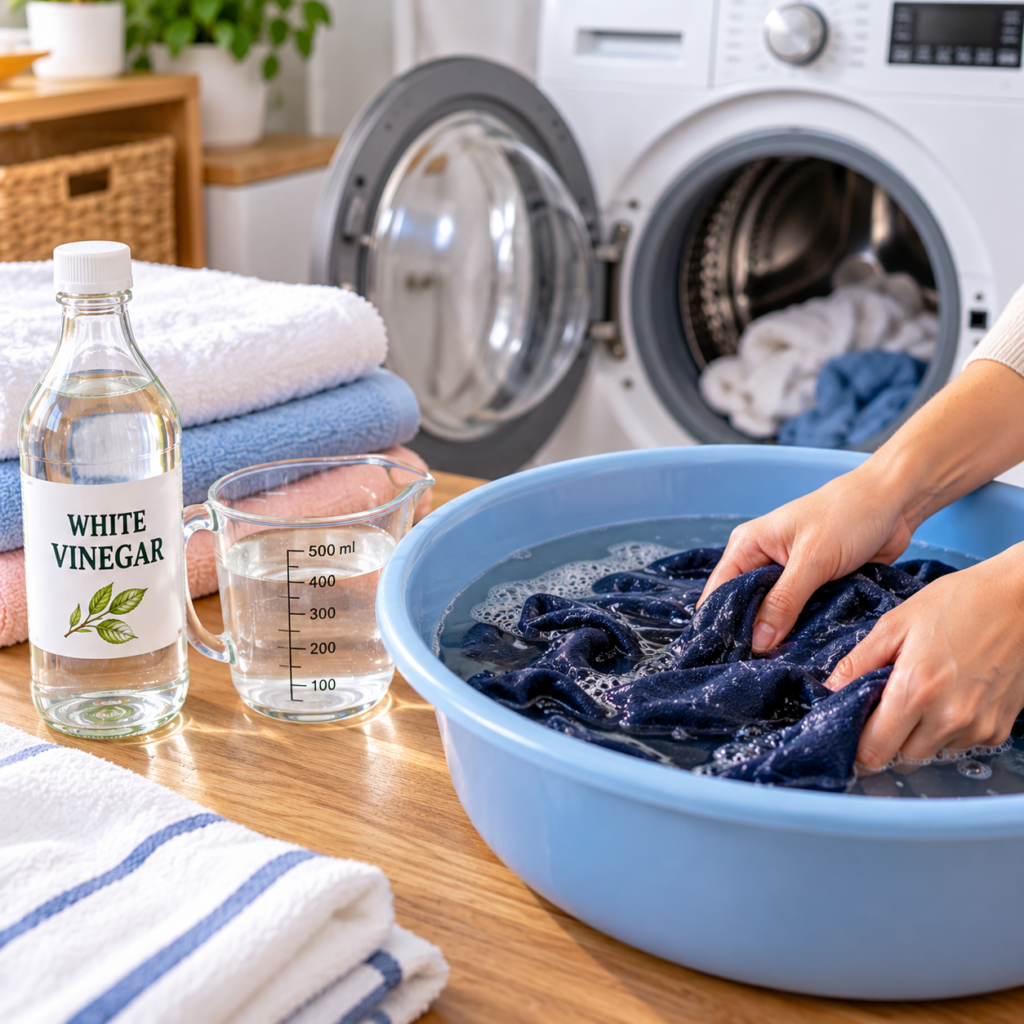
Have you ever removed dark clothes from the washer and noticed pale streaks or a powdery residue?
Sometimes detergent doesn’t dissolve or rinse away properly.
The American Cleaning Institute recommends a diluted vinegar soak for certain detergent residues:
1 cup (240 ml) white vinegar + 1 gallon (3.8 L) warm water.
Soak the affected garment and then rinse it.
Notice the important distinction:
This is a separate treatment for the clothing—not an instruction to pour vinegar into every load.
💡 Prevent it next time
Also investigate why the residue occurred.
Try:
- Using less detergent
- Not overloading the machine
- Selecting an appropriate cycle
- Using an additional rinse when needed
- Ensuring powdered detergent can dissolve properly
Prevention is better than repeatedly treating residue afterward.
💧 2. When Hard-Water Residue Makes Fabric Feel Stiff
Hard water contains minerals such as calcium and magnesium.
Under some washing conditions, mineral and detergent deposits can contribute to fabric feeling rough or stiff.
The American Cleaning Institute also suggests the 1 cup vinegar to 1 gallon warm water soak for certain hard-water/detergent deposits, followed by rinsing.
But remember
If this happens constantly, vinegar isn’t fixing the source of the problem.
You may need to adjust:
- Detergent type
- Detergent dosage
- Rinsing
- Water treatment
Use vinegar as a targeted corrective treatment, not as permanent compensation for an unresolved laundry problem.
👃 3. When a Compatible Garment Needs Odor Pretreatment
Vinegar can also be useful as a separate pretreatment for certain odors.
This is particularly useful if you want to avoid routinely putting vinegar through the washing machine.
Maytag, for example, discusses using vinegar for pretreating some stains and odors while cautioning against putting vinegar directly into the washing machine. Maytag’s vinegar laundry guidance
How to approach it
Treat or soak the compatible garment separately with diluted white vinegar.
Then:
Rinse → wash normally → dry completely.
Always check the garment’s care label first.
And if the odor keeps returning, don’t keep increasing the vinegar concentration—find the underlying cause.
☕ 4. For Certain Stains
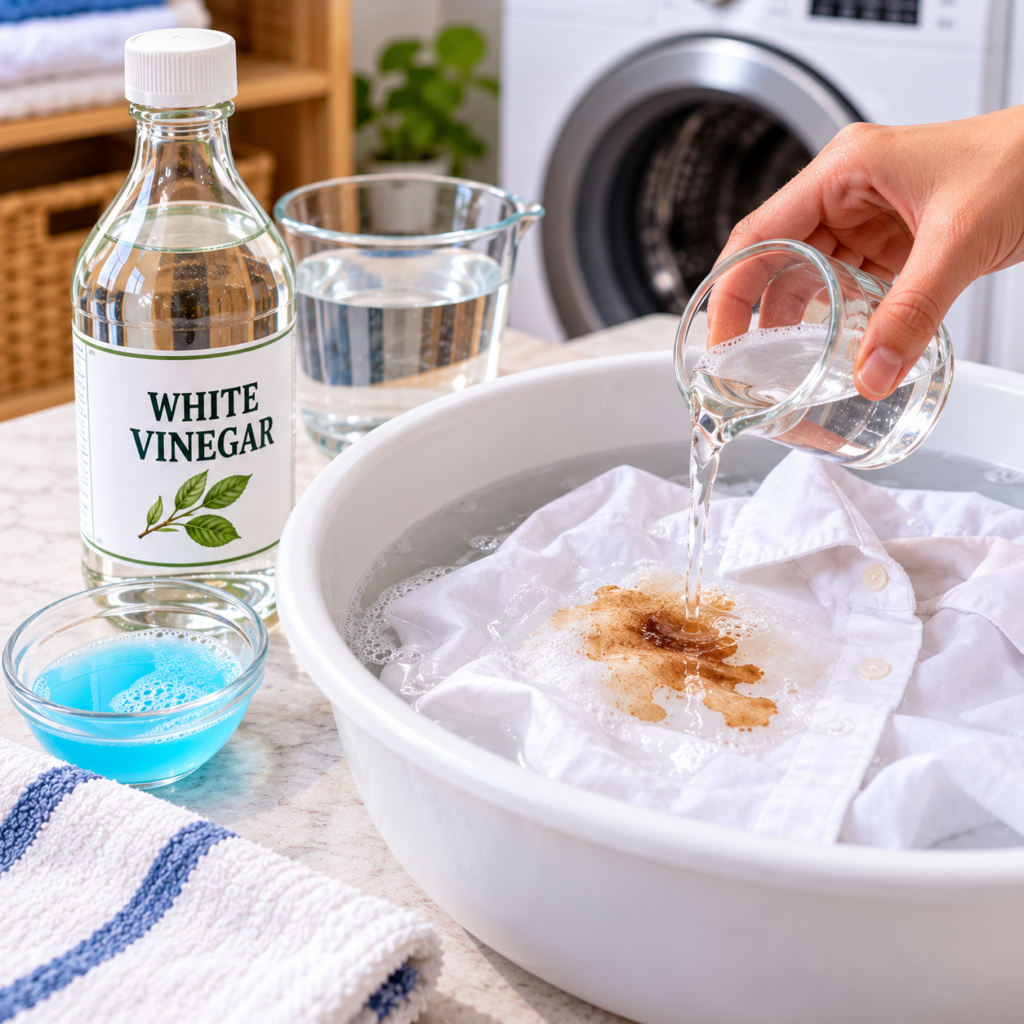
This is one of vinegar’s more legitimate but often misunderstood laundry applications.
White vinegar appears in textile-care recommendations for specific stains, rather than as a universal stain remover.
University of Georgia textile guidance, for example, recommends a soak for coffee and tea stains containing:
- 1 quart warm water
- ½ teaspoon detergent
- 1 tablespoon white vinegar
The garment is soaked for about 15 minutes and then rinsed before further treatment.
That’s very different from pouring undiluted vinegar onto every stain you encounter.
⚠️ Always check first
Some dyes and materials may react poorly to acids.
Check:
Care label → colorfastness → stain type → recommended treatment.
If you’re uncertain, test the treatment on an inconspicuous area first.
👚 5. When Your Washer Manufacturer Specifically Permits Vinegar
This is another important nuance.
Not every washing-machine manufacturer gives exactly the same recommendation.
If your manufacturer’s instructions specifically permit vinegar for a particular purpose, you can follow their amount, location and frequency.
That’s very different from following a social-media recipe designed for an unspecified washing machine.
Use the appliance manufacturer’s instructions—not “one cup works for everything.”
🧺 Problem → Should You Use Vinegar?
Here’s the simplest way to remember everything:
| Laundry problem | Vinegar? | Better approach |
|---|---|---|
| Detergent residue on compatible clothing | ✅ Sometimes useful | Separate diluted vinegar soak + rinse |
| Certain hard-water/mineral residue | ✅ Sometimes useful | Diluted soak; address water/detergent issue |
| Certain stains | ✅ Sometimes | Use a tested stain-specific treatment |
| Certain garment odors | ✅ Sometimes | Separate pretreatment + rinse |
| Washer manufacturer specifically permits vinegar | ✅ As directed | Follow manufacturer’s dosage |
| Ordinary everyday washing | ⚠️ Usually unnecessary | Appropriate laundry detergent |
| Towels feel stiff | ⚠️ Find the cause first | Check detergent, rinsing and water hardness |
| Washing machine smells | ⚠️ Depends on manufacturer | Use approved cleaning procedure |
| Laundry needs genuine sanitization/disinfection | ❌ Don’t rely on vinegar | Appropriate labeled product/method |
| Manufacturer says no vinegar | ❌ No | Follow washer instructions |
| Chlorine bleach is being used | ⛔ Never mix them | Keep vinegar completely separate |
⚠️ 7 Vinegar Laundry Mistakes to Avoid
1. Adding It to Every Load
There’s usually no reason to automatically add vinegar every time you wash clothes.
2. Ignoring Your Washer Manual
A hack that works with one appliance isn’t necessarily appropriate for another.
3. Using More Because “More Must Work Better”
Increasing the amount of acid doesn’t automatically improve cleaning.
4. Treating Vinegar Like Laundry Detergent
Vinegar doesn’t replace a properly formulated detergent for routine soil and body-oil removal.
5. Assuming It Disinfects Everything
Don’t rely on ordinary vinegar when actual sanitization or disinfection is required.
6. Mixing It With Baking Soda for the Fizz
The reaction looks dramatic but doesn’t automatically improve cleaning.
7. Mixing It With Chlorine Bleach
Never do this.
This is the most important safety rule in the entire article.
🧠 The Smartest Way to Think About Vinegar
Before reaching for the bottle, ask yourself:
“What problem am I actually trying to solve?”
Detergent residue?
→ A separate diluted vinegar soak may help.
Hard-water deposits?
→ Vinegar may help with existing residue, but investigate the underlying water problem.
Specific compatible stain?
→ Check whether a tested vinegar treatment exists for that stain.
Persistent clothing odor?
→ A separate pretreatment may be worth trying, but investigate the cause if it returns.
Smelly washing machine?
→ Follow the machine manufacturer’s cleaning instructions.
Need to disinfect laundry?
→ Use an appropriate labeled method/product rather than relying on vinegar.
Using chlorine bleach?
→ Keep vinegar away from it.
That’s much more useful than simply saying:
“Add one cup of vinegar to every wash.”
❓ Frequently Asked Questions
Can vinegar damage a washing machine?
Potentially, depending on the appliance and how frequently or where vinegar is used. Some manufacturers warn that repeated exposure can affect rubber seals, hoses, and other components. Check the manual for your machine.
Can vinegar remove detergent residue?
It can help with certain detergent and mineral residues. The American Cleaning Institute recommends a diluted vinegar soak for some residue problems.
Can vinegar help clothes that smell?
It can sometimes be useful as a separate pretreatment for compatible washable fabrics. But persistent odor may indicate another problem, such as excess detergent, incomplete drying, or a dirty washer.
Can vinegar make towels softer?
If mineral or detergent residue is contributing to stiffness, removing that residue may make towels feel better. That’s different from saying vinegar universally replaces fabric softener.
Can I put vinegar in the fabric-softener dispenser?
Only if your washing-machine manufacturer’s instructions permit it. Don’t assume this is safe for every appliance.
Can vinegar remove stains?
It can be part of appropriate treatments for certain stains, including some coffee and tea stains, but it isn’t a universal stain remover.
Can vinegar disinfect laundry?
Don’t rely on ordinary household vinegar as a general laundry disinfectant. When genuine sanitization or disinfection is required, use an appropriate labeled method or product.
Can I mix vinegar with baking soda?
They react and produce carbon dioxide bubbles, but the fizz doesn’t automatically make the mixture a more powerful laundry cleaner.
Can I mix vinegar with chlorine bleach?
No. Never intentionally mix them. Acidifying hypochlorite bleach can release dangerous chlorine gas.
✨ Final Thoughts
White vinegar isn’t a miracle laundry product.
But it isn’t useless either.
The mistake is treating it as something that automatically belongs in every load.
A much smarter approach is:
Identify the problem → check the fabric → check your washer instructions → choose the appropriate treatment.
Vinegar can be useful for certain detergent or mineral residues, selected stains, and some garment pretreatments.
But when the washing-machine manufacturer advises against vinegar, when actual disinfection is required, or when you’re using chlorine bleach, another solution is the better choice.
So the next time you see someone pouring vinegar into the washing machine simply because “it makes laundry better,” remember:
Don’t ask, “How much vinegar should I use?”
Ask, “Do I actually need vinegar for this problem?”
Sometimes the answer is yes.
And sometimes the smartest laundry trick is knowing when to leave the vinegar in the cupboard.