
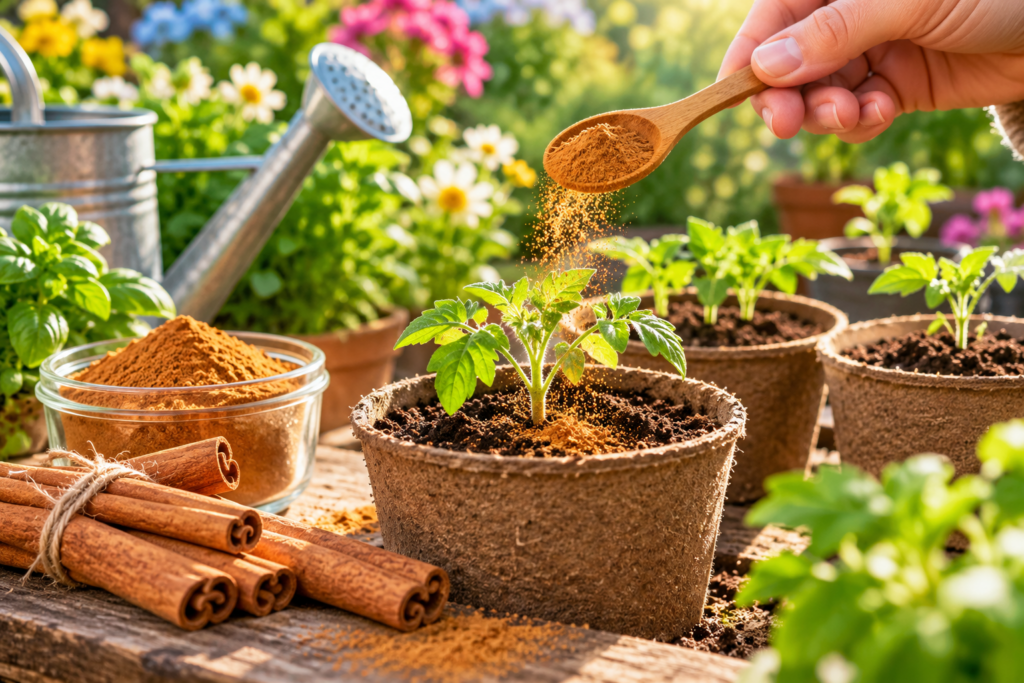
Cinnamon is one of those everyday ingredients that seems to appear everywhere in gardening advice.
Sprinkle it on seedlings. Dip cuttings in it. Put it around ants. Add it to potting soil. Use it against fungus.
According to social media, this familiar kitchen spice can seemingly solve almost every garden problem. 🌱
There is a genuine reason behind some of these claims. Cinnamon contains biologically active compounds—particularly cinnamaldehyde—and research has demonstrated antifungal and antimicrobial activity from cinnamon essential oils and some of their components. Recent research has also investigated cinnamon bark essential oil against several plant pathogens.
But there is an important catch:
A laboratory-tested cinnamon essential oil, purified cinnamaldehyde, and a spoonful of ground cinnamon from your kitchen are not interchangeable.
So instead of repeating 10 viral hacks as proven facts, let’s look at what cinnamon may actually do in the garden, what you can reasonably try, and which popular claims deserve skepticism.
🌱 1. Cinnamon Around Seedlings: Helpful or Hype?
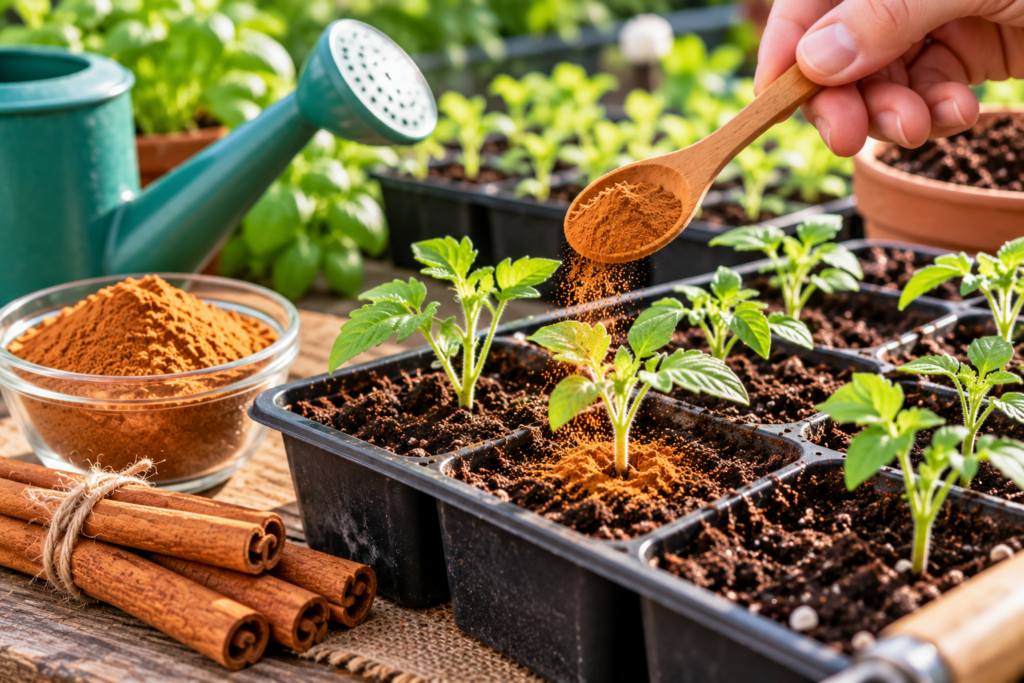
One of the most popular gardening tips is to sprinkle cinnamon over seed-starting mix to prevent damping-off, a group of diseases that can cause young seedlings to collapse.
There’s some logic behind the idea. Cinnamon contains compounds with antifungal activity, and cinnamon essential oil and cinnamaldehyde have demonstrated effects against various fungi under experimental conditions.
However, that doesn’t establish ordinary ground cinnamon as a reliable treatment for damping-off in a seed tray.
What should you do instead?
For healthy seedlings, prioritize the fundamentals:
- use clean containers;
- start with suitable seed-starting mix;
- avoid excessive watering;
- provide adequate air circulation;
- avoid overcrowding.
If you want to experiment with a very light dusting of cinnamon, treat it as an optional garden experiment—not as a substitute for good seedling care.
✂️ 2. Cinnamon on Plant Cuttings
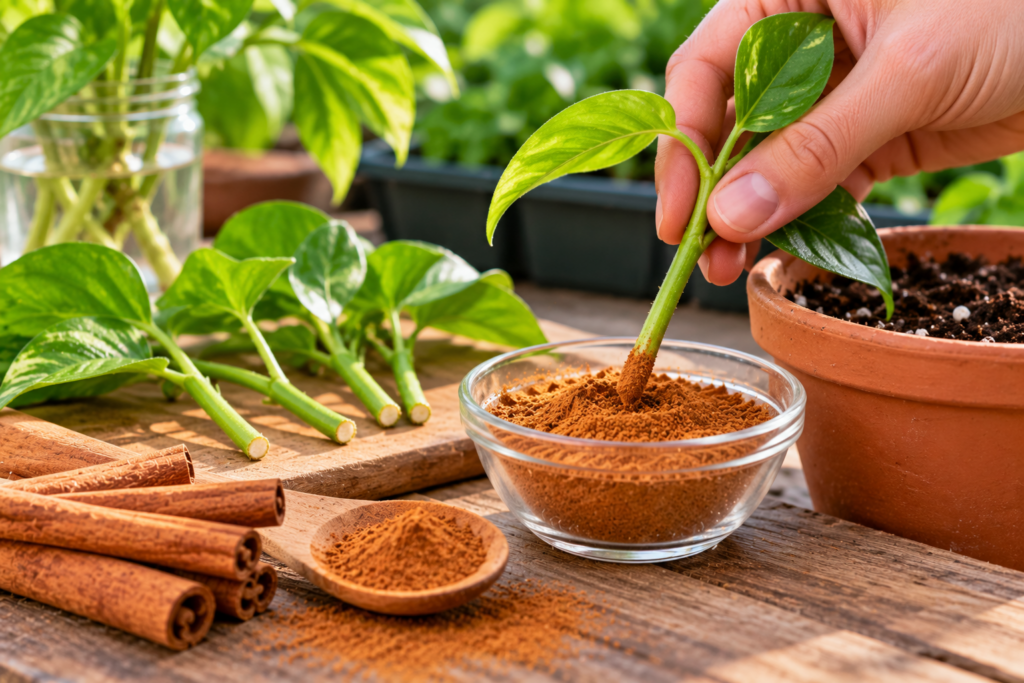
You’ve probably seen this one:
- Dip a cutting in cinnamon and it will act as a natural rooting hormone.*
Unfortunately, that’s an exaggeration.
University of New Hampshire Extension describes the evidence for cinnamon as a rooting hormone as mixed and fairly weak overall. It notes that commercial rooting products containing IBA provide more reliable results.
So why do gardeners use it?
The theory is that cinnamon’s antimicrobial properties might help reduce decay around a fresh cutting. That’s different from stimulating new roots.
If you want to experiment, you can lightly dust the cut end before inserting it into an appropriate propagation medium—but don’t expect cinnamon to perform like an actual rooting hormone.
- Verdict: Interesting experiment, but not a proven rooting-hormone substitute.
🍄 3. Cinnamon and Fungal Growth
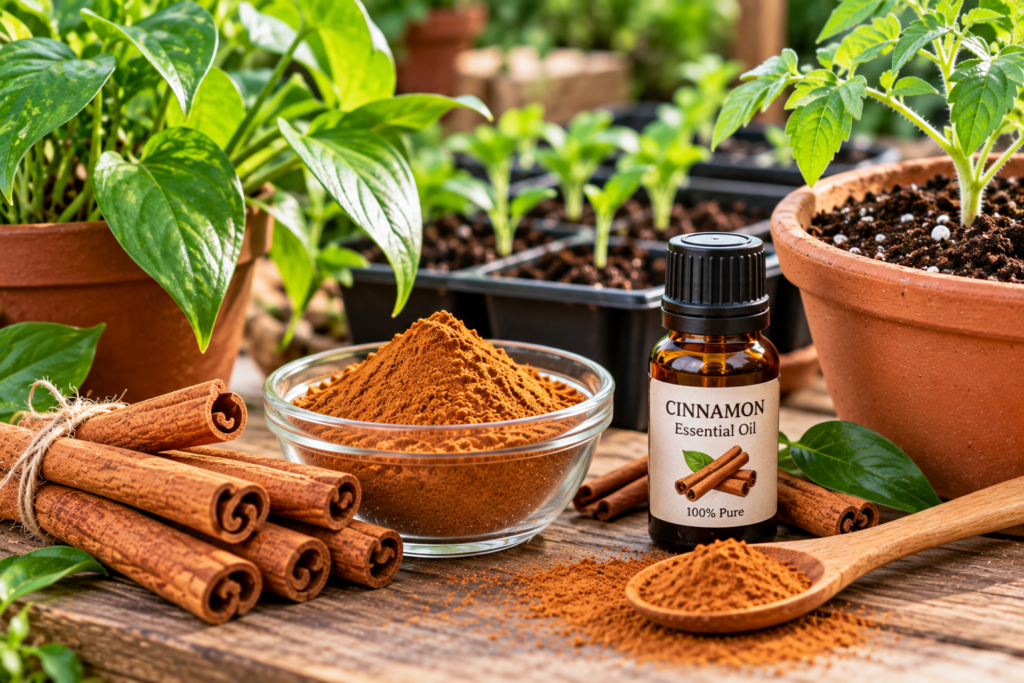
This is where the story becomes genuinely interesting.
Cinnamon and especially cinnamon essential oil and cinnamaldehyde have demonstrated antifungal activity against numerous fungi in laboratory research. A recent study of Ceylon cinnamon bark essential oil, for example, reported activity against several plant pathogens, including Fusarium, Rhizoctonia and Phytophthora.
Other research has similarly documented antifungal activity from cinnamon essential oils and cinnamaldehyde.
But here’s the important distinction:
That doesn’t mean you can simply mix cinnamon powder into garden soil and call it a homemade fungicide. Concentration, cinnamon species, extraction method, formulation and target organism can all matter.
So cinnamon is scientifically interesting as a source of antifungal compounds, but ordinary culinary powder shouldn’t be presented as a universal garden fungicide.
🪴 4. Cinnamon on Surface Mold in Houseplant Pots
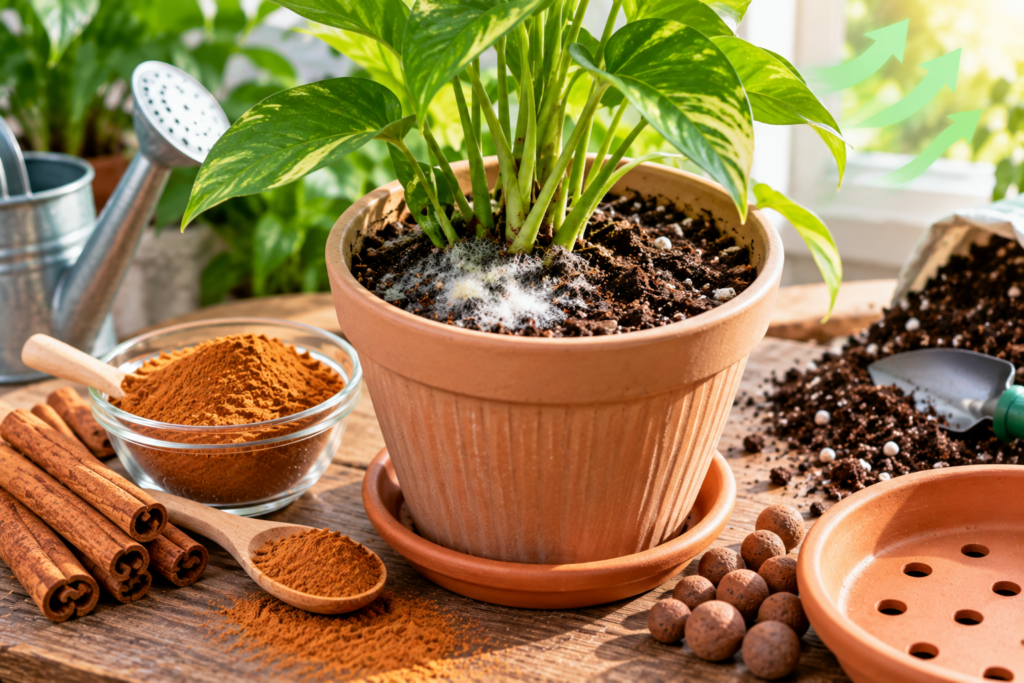
Sometimes a white or fuzzy growth appears on the surface of moist potting soil. It’s tempting to cover it with cinnamon.
A light dusting may be something gardeners experiment with, but first ask a more important question: Why is the pot staying so damp?
Surface fungal growth can be encouraged by persistently moist conditions and organic material.
Try instead:
- letting the surface dry appropriately between waterings;
- improving drainage;
- increasing air circulation;
- removing decomposing plant debris;
- checking that the plant isn’t sitting in water.
Cinnamon shouldn’t be used to hide a moisture problem. Fix the growing conditions first.
🐜 5. Cinnamon Around Ant Trails
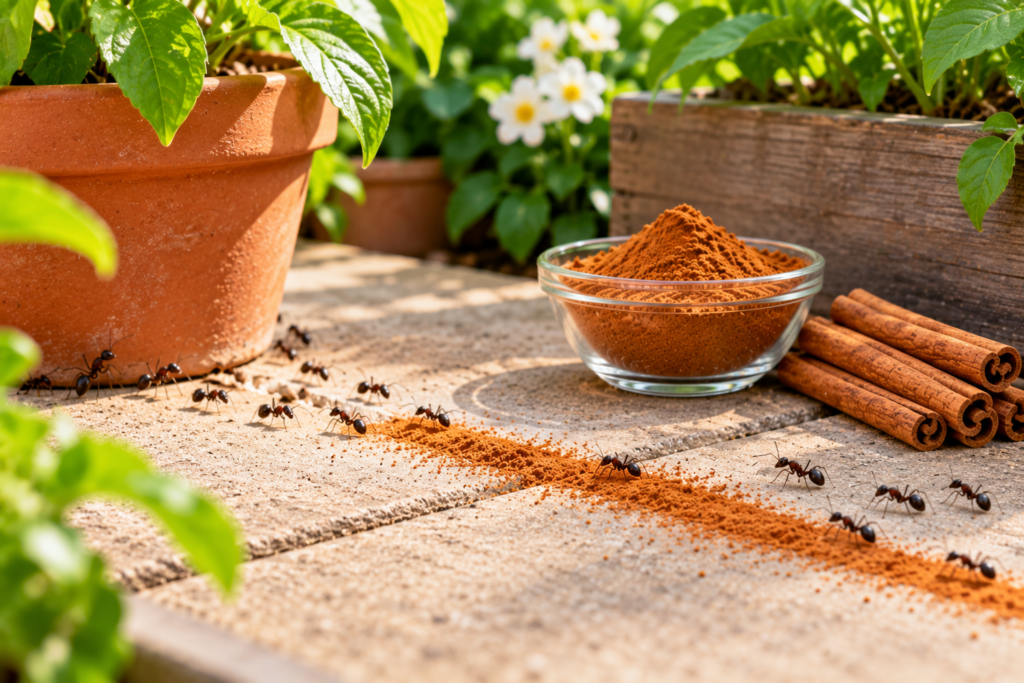
This is another enormously popular cinnamon hack.
Some research provides an interesting basis for it. Cinnamon essential oils and their components have demonstrated insecticidal activity, including activity against certain ants and other insects.
But again: cinnamon essential oil $\neq$ a line of cinnamon powder.
Sprinkling culinary cinnamon across an ant trail may temporarily disturb the trail or alter the area, but don’t assume you’ve eliminated the colony.
A better approach:
If ants repeatedly appear in one place:
- Determine where they’re traveling.
- Remove accessible food sources.
- Seal entry points when practical.
- Address the nest or colony appropriately if necessary.
Think of cinnamon powder as an experimental temporary deterrent, not guaranteed pest control.
🦟 6. Can Cinnamon Repel Mosquitoes?
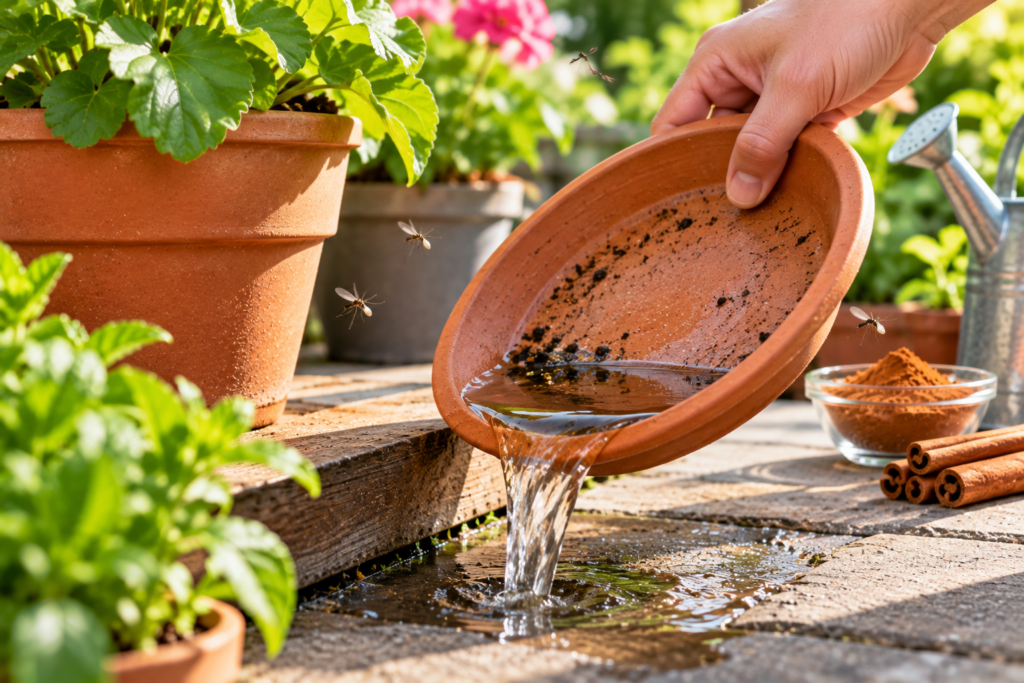
There’s real research behind cinnamon-derived compounds as insect-control candidates. Reviews report insecticidal activity from cinnamon oils and compounds against various insects, including mosquito larvae.
But that doesn’t mean sprinkling cinnamon around your tomato plants creates a mosquito-free garden.
For mosquitoes around the home and garden, one of the most useful measures remains eliminating or managing standing water where mosquitoes can breed.
Check:
- saucers beneath pots;
- buckets;
- watering cans;
- clogged gutters;
- containers;
- tarps that collect rainwater.
What about cinnamon?
It’s scientifically interesting, but ground cinnamon scattered around plants isn’t a proven mosquito barrier.
🪴 7. Add Cinnamon to Potting Mix?
Another viral tip recommends adding a pinch of cinnamon every time you prepare potting soil.
I wouldn’t make this a standard gardening routine. Plants primarily need an appropriate growing medium with the correct:
- drainage,
- aeration,
- moisture retention,
- nutrient availability,
- and pH.
Cinnamon doesn’t replace any of those fundamentals. If you’re continually seeing mold in your pots, don’t simply add more cinnamon. Investigate watering, drainage, airflow and the condition of the potting medium.
- Bottom line: A little culinary cinnamon probably isn’t the magical ingredient your potting mix has been missing.
🌺 8. Don’t Use Cinnamon to Acidify Soil
This is one viral claim worth correcting clearly.
You may see advice telling gardeners to sprinkle cinnamon around azaleas, blueberries, hydrangeas or other acid-loving plants to make the soil more acidic.
I wouldn’t recommend this.
If a plant requires acidic soil, first determine the actual soil or growing-medium pH. Then use horticulturally appropriate amendments or fertilizers recommended for the particular plant and soil conditions.
Why this matters:
Soil pH affects nutrient availability. Trying to correct it with random kitchen ingredients can produce unpredictable results and distract from the real problem. Use cinnamon as a spice—not as your soil pH meter or primary acidifier.
🐿️ 9. Will Cinnamon Keep Squirrels Away From Bulbs?
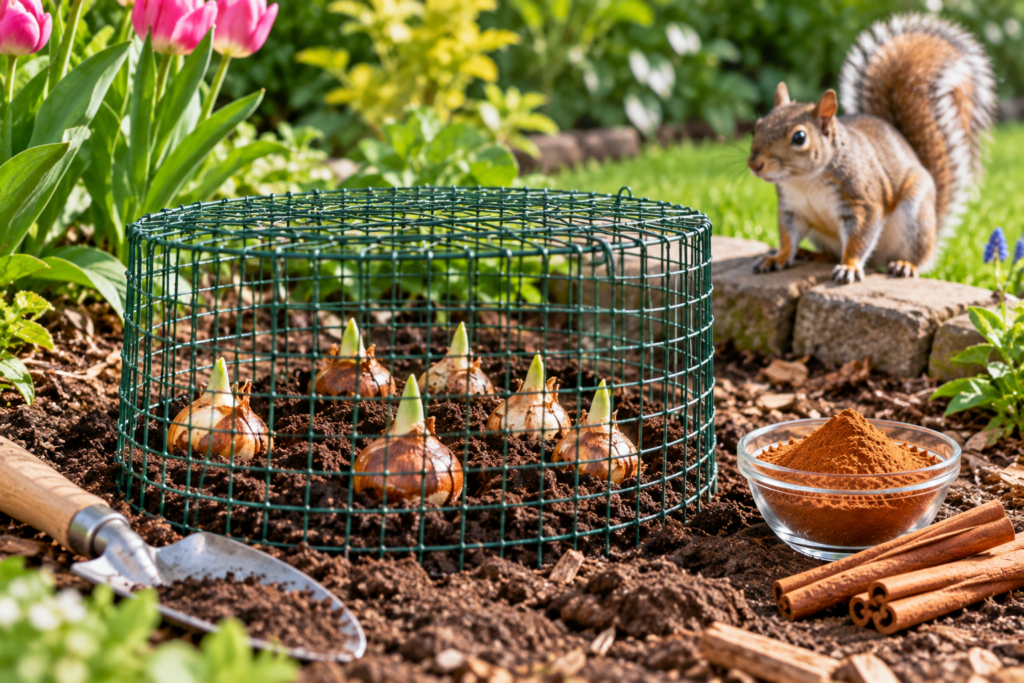
Another attractive Pinterest trick recommends coating flower bulbs with cinnamon before planting.
The claim usually combines two ideas: fungal protection + squirrel repellent.
But evidence that culinary cinnamon reliably prevents squirrels from digging up bulbs is not strong enough to promise that result.
If squirrels repeatedly dig up newly planted bulbs, physical protection is generally a much more straightforward strategy. Depending on the planting situation, gardeners can consider appropriate barriers or cages designed to prevent animals from accessing bulbs.
- Cinnamon? You can experiment with its scent, but don’t depend on it to protect an expensive planting.
🧪 10. The Most Interesting Use of Cinnamon May Be the One Scientists Are Studying
Perhaps the most fascinating cinnamon garden tip isn’t actually a DIY hack at all.
Researchers continue investigating cinnamon-derived essential oils and compounds as potential plant-protection agents. Studies examining Ceylon cinnamon bark essential oil report antibacterial activity against several plant-pathogenic bacteria and antifungal activity against pathogens including Fusarium, Rhizoctonia, and Phytophthora.
Cinnamaldehyde has also attracted attention as a biologically active compound with antifungal properties.
That’s genuinely promising research. But it also teaches us an important lesson about gardening advice: Scientific evidence for a cinnamon-derived compound doesn’t automatically validate every homemade recipe involving supermarket cinnamon.
🚫 4 Cinnamon Garden Hacks I Would Skip
Some viral uses simply don’t offer enough benefit to justify presenting them as gardening solutions.
- ❌ Cinnamon + water as a garden-tool disinfectant: Don’t depend on cinnamon paste to sanitize pruning tools. When sanitation matters—especially after working with diseased plants—use a recognized tool-cleaning or disinfection procedure appropriate for the equipment.
- ❌ Cinnamon as a rooting hormone: Cinnamon isn’t equivalent to IBA rooting hormone. Evidence for cinnamon improving rooting is weak and inconsistent.
- ❌ Cinnamon to acidify soil: Don’t attempt to manage soil pH by randomly sprinkling cinnamon around acid-loving plants.
- ❌ Cinnamon + sand as a lawn fungicide: The fact that cinnamon-derived compounds have demonstrated antifungal properties does not establish cinnamon mixed with sand as a reliable treatment for lawn diseases. Correctly identify the lawn problem before treating it.
🌿 Ground Cinnamon vs. Cinnamon Essential Oil: A Crucial Difference
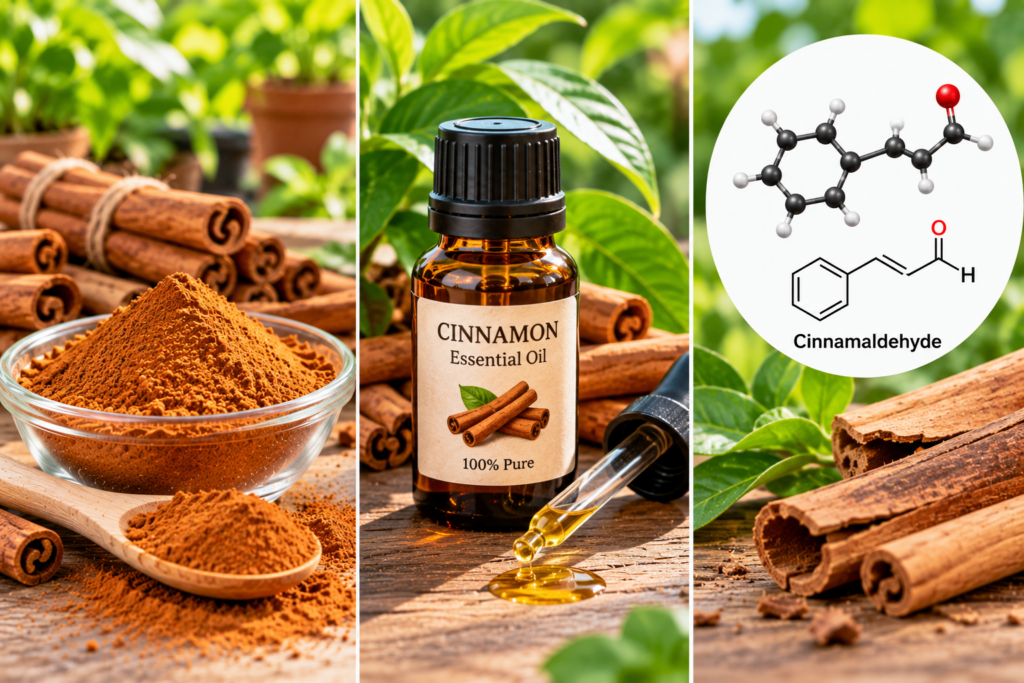
This distinction will make your gardening approach much clearer:
- Ground Cinnamon: This is the culinary powder found in the spice cabinet. Its composition and concentration aren’t standardized as a garden pesticide or fungicide.
- Cinnamon Essential Oil: This is a concentrated product containing volatile compounds. Research has documented biological activity from cinnamon essential oils against various fungi and insects.
- Cinnamaldehyde: This is one of cinnamon’s major bioactive compounds and has been extensively investigated for antimicrobial and antifungal properties.
These three things should not be treated as interchangeable. And don’t assume that because an essential oil is plant-derived it can safely be poured or sprayed directly onto plants. Concentrated essential oils can be biologically active precisely because they are concentrated.
⭐ So, Is Cinnamon Actually Useful in the Garden?
Potentially—but not in the miraculous way social media sometimes suggests.
The strongest evidence concerns cinnamon essential oils, extracts and compounds such as cinnamaldehyde under particular experimental conditions, rather than every popular recipe involving culinary cinnamon.
For an ordinary home gardener, cinnamon powder is better treated as an optional experiment for a few situations rather than an all-purpose pesticide, fungicide, rooting hormone and soil amendment.
The fundamentals still matter much more:
healthy soil + correct watering + good drainage + airflow + appropriate plant nutrition + accurate pest/disease identification.
❓ Frequently Asked Questions
- Does cinnamon kill fungus in soil?Cinnamon-derived compounds have demonstrated antifungal activity, but that doesn’t mean sprinkling culinary cinnamon into soil will reliably eliminate a fungal plant disease. Different fungi, concentrations and formulations can produce very different outcomes.
- Is cinnamon a natural rooting hormone?Not really. Evidence for cinnamon improving rooting is weak and inconsistent. Commercial rooting products containing IBA are more reliable.
- Can I sprinkle cinnamon on seedlings?Some gardeners do, but don’t rely on cinnamon to prevent damping-off. Good sanitation, appropriate moisture, drainage and airflow are much more important.
- Does cinnamon keep ants away?Cinnamon oils and compounds have shown insecticidal activity in research, including against certain ants, but that doesn’t prove that culinary cinnamon powder forms a reliable garden barrier.
- Does cinnamon repel mosquitoes?Cinnamon-derived oils and compounds have demonstrated activity against mosquitoes in experimental research, particularly against larvae, but sprinkling ground cinnamon around plants shouldn’t be presented as a proven mosquito-repellent method.
- Can cinnamon change soil pH?Don’t use cinnamon as a method for managing soil acidity. Test the soil and use amendments appropriate for the plant and soil conditions.
- Can I spray cinnamon essential oil directly on plants?I wouldn’t recommend improvising concentrations. Essential oils are highly concentrated and biological activity doesn’t automatically mean plant safety. Use products specifically formulated and labeled for the intended horticultural purpose.
🌟 Final Thoughts
Cinnamon isn’t useless in the garden—but it isn’t magic either.
The science behind cinnamon is actually more interesting than many of the viral hacks. Cinnamon essential oils and compounds such as cinnamaldehyde have demonstrated meaningful antifungal, antimicrobial and insecticidal activity in research.
What doesn’t follow is that every spoonful of ground cinnamon sprinkled around a garden will reproduce those laboratory effects.
So experiment cautiously if you enjoy trying simple garden ideas, but keep expectations realistic. And when you’re dealing with a genuine plant disease, serious pest infestation or soil problem, identify the cause first and choose a treatment appropriate for that specific problem.
That’s a much better recipe for a healthy garden than relying on any single spice. 🌱✨