
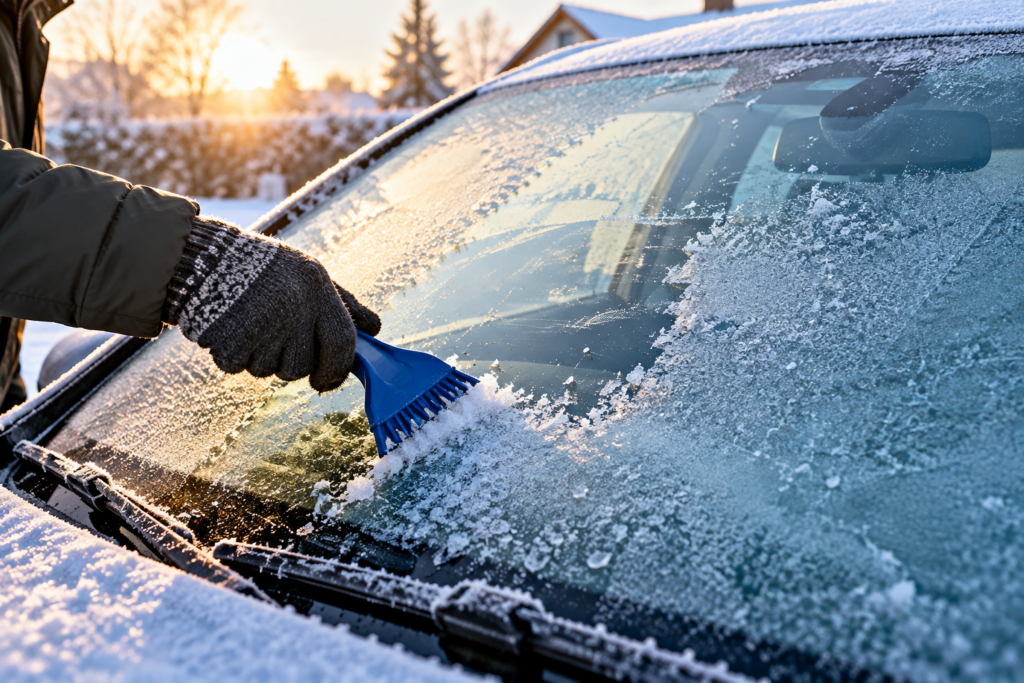
Few winter mornings are more frustrating than walking outside and finding your windshield covered with frost or a stubborn layer of ice. You need to leave, your hands are freezing, and spending several minutes aggressively scraping the glass is probably the last thing you want to do. 🚗🥶
The internet is full of supposed shortcuts involving hot water, salt, vinegar, baking soda, alcohol and other household ingredients. Unfortunately, not every viral winter hack is a good idea for your car.
The better approach is surprisingly simple: prevent frost when possible, warm the windshield gradually, use tools designed for automotive glass, and choose an appropriate de-icing solution when extra help is needed.
Below are 10 practical methods, including a useful DIY option, plus the popular household tricks that deserve more caution.
🌬️ 1. Start With Your Car’s Defroster
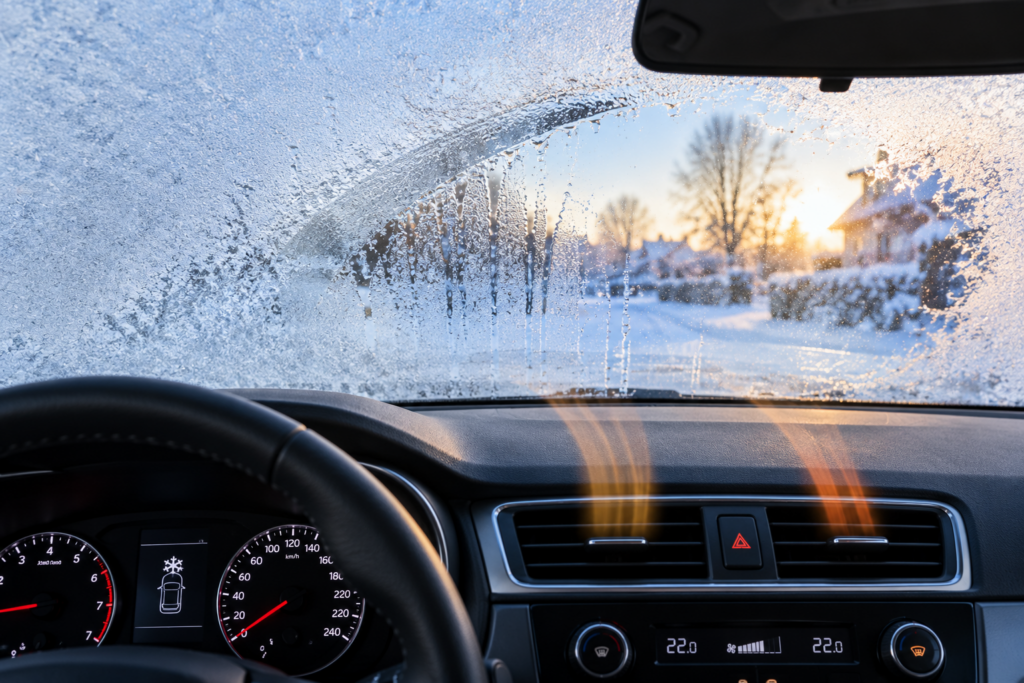
Before reaching for a homemade mixture, let the car help you.
Start the vehicle according to the manufacturer’s instructions and activate the front windshield defroster. Gradually warming the glass helps loosen frost and ice, making them easier to remove.
If your vehicle has an electrically heated windshield or heated windshield area, use it according to the owner’s manual.
AAA recommends using the vehicle’s defrost system as part of the normal ice-removal process.
- 💡 Why this helps: Trying to scrape firmly attached ice immediately requires considerably more effort. Giving the defroster some time to work first can make the next steps easier.
- ⚠️ Important: Never leave a running vehicle unattended where doing so is unsafe or prohibited.
🧹 2. Remove Loose Snow First
If snow is sitting on top of the ice, remove the loose snow before tackling the frozen layer underneath.
Use a soft automotive snow brush and work carefully around the windshield, windows, mirrors and painted surfaces.
This exposes the actual layer of frost or ice so the defroster and scraper can work more effectively.
Before driving, make sure snow and ice aren’t obstructing the glass or other areas needed for safe visibility.
🧊 3. Use a Proper Plastic Ice Scraper
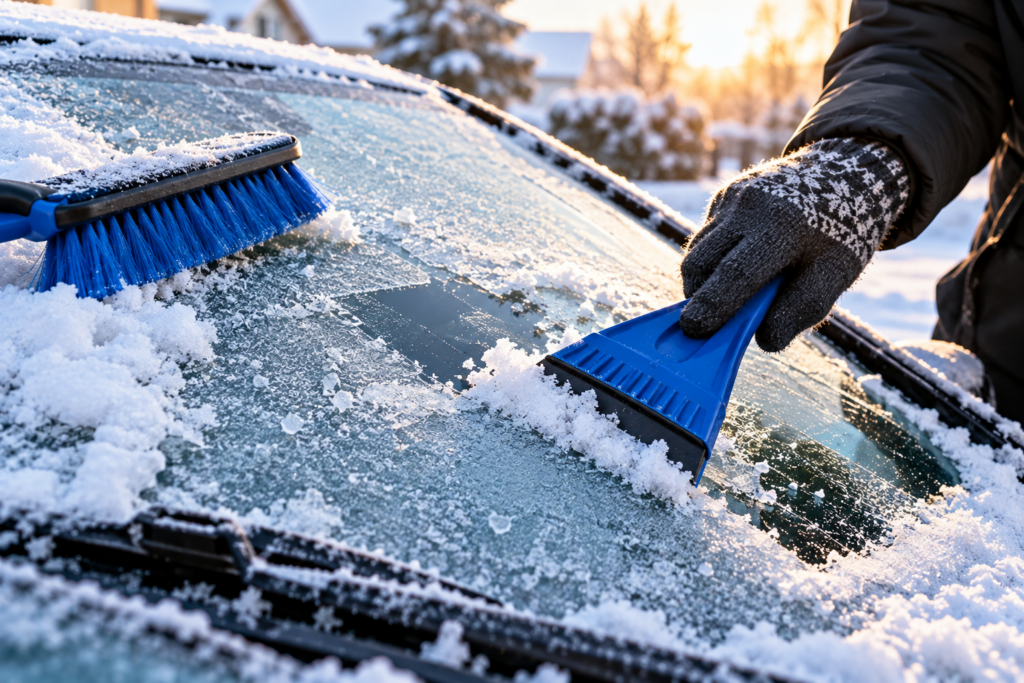
Once the frost begins to loosen, use an automotive plastic ice scraper.
Work gradually across the windshield rather than aggressively attacking one frozen spot.
- 🚫 Don’t improvise with sharp objects: Avoid using knives, keys, screwdrivers, metal spatulas, or metal scrapers. Metal tools can scratch the glass or damage nearby components. AAA specifically recommends plastic scrapers or other non-metallic tools instead.
- And don’t force windshield wipers that are frozen to the glass. Allow the ice holding them in place to loosen first.
🛡️ 4. Prevent Ice With a Windshield Cover
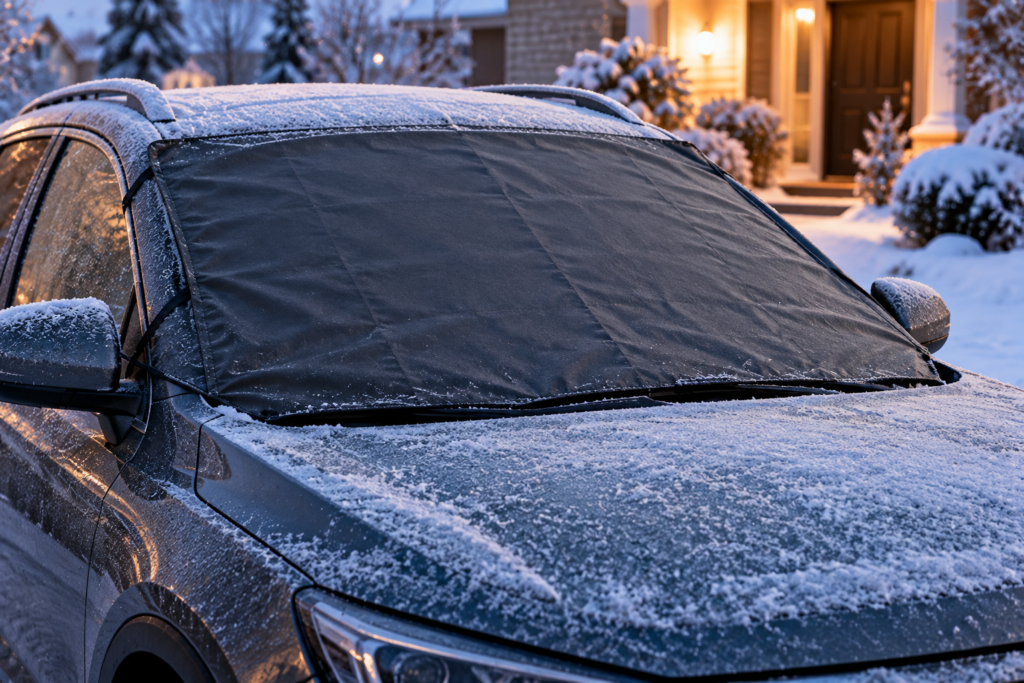
One of the easiest ways to deal with windshield ice is to prevent much of it from forming directly on the glass.
Before a freezing night, install a purpose-made windshield frost cover.
If you don’t have one, AAA also mentions a tarp, large towel or old sheet as possible physical covers, provided they are properly secured. Heavy snowfall, however, can make a cover more difficult to remove.
- 🌿 No cleaning mixture required: This is arguably the simplest low-chemical option in the entire article: No vinegar. No alcohol. No salt sprayed on the windshield. You’re simply creating a physical barrier.
- In the morning, remove the cover and deal with any remaining frost normally.
🪞 5. Protect the Side Mirrors Too
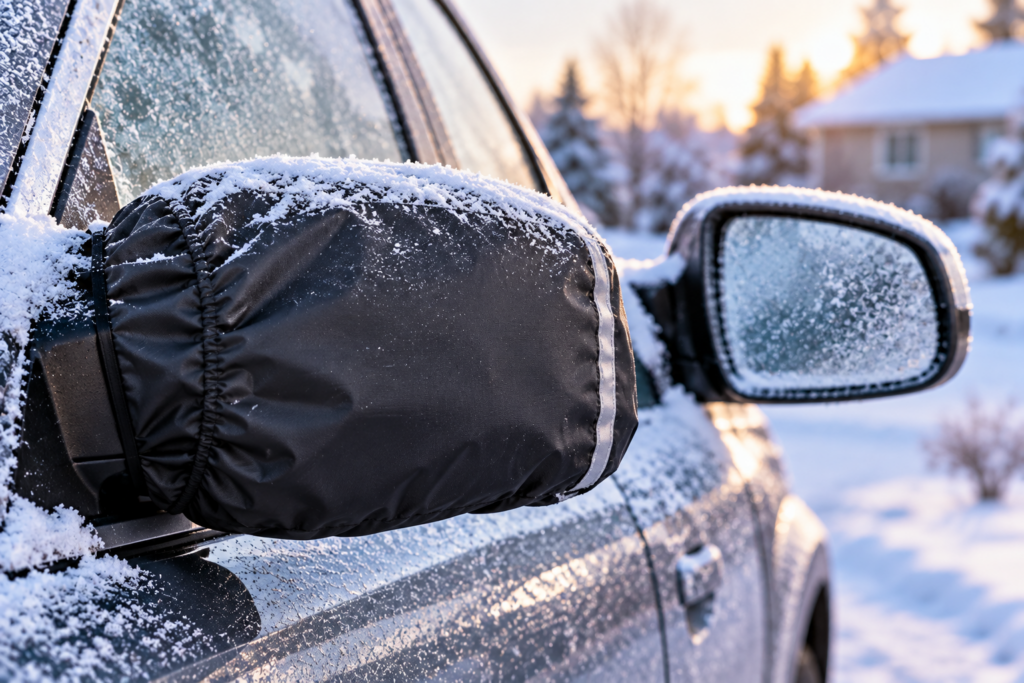
Your windshield isn’t the only glass surface that can freeze.
Purpose-made side-mirror frost covers can help keep frost directly off the mirror glass overnight.
Remove the covers before driving and check that both mirrors are completely clear.
If you’re already covering the windshield, protecting the mirrors takes very little additional effort.
🏠 6. Prevent Frost Before It Becomes a Morning Problem
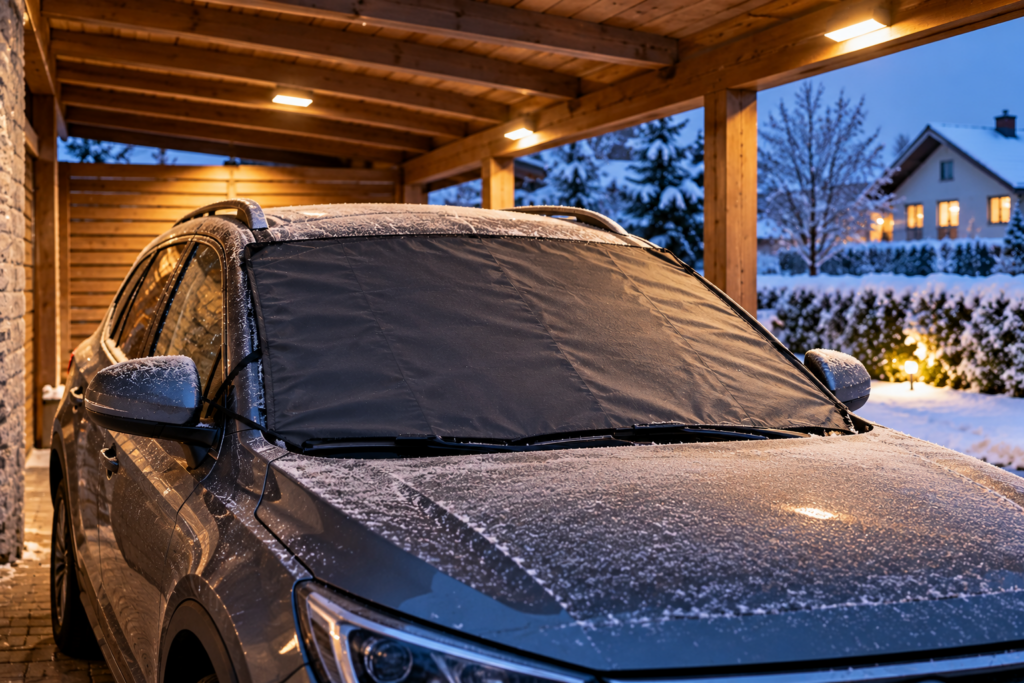
Prevention can save more time than any viral de-icing hack.
When possible:
- park inside a garage;
- use a covered carport;
- cover the windshield before freezing conditions;
- keep your scraper easily accessible;
- use winter-appropriate windshield washer fluid;
- check your vehicle manufacturer’s winter recommendations.
AAA identifies a garage as the most effective option and notes that even a carport can reduce ice formation in some circumstances.
- ☀️ Can morning sunlight help? If you have several safe parking positions available, a spot that receives morning sunlight may sometimes help thin frost begin to soften naturally. Obviously, this isn’t something to depend on—it varies with weather, temperature and parking conditions—but it costs nothing.
- What about lifting the wipers? You’ll often see people raising their windshield wipers before a freezing night. Whether that’s appropriate can depend on the vehicle. Follow the owner’s manual, particularly on vehicles where the wipers need to be placed into a service position.
🧴 7. Try a DIY Rubbing-Alcohol De-Icer Carefully
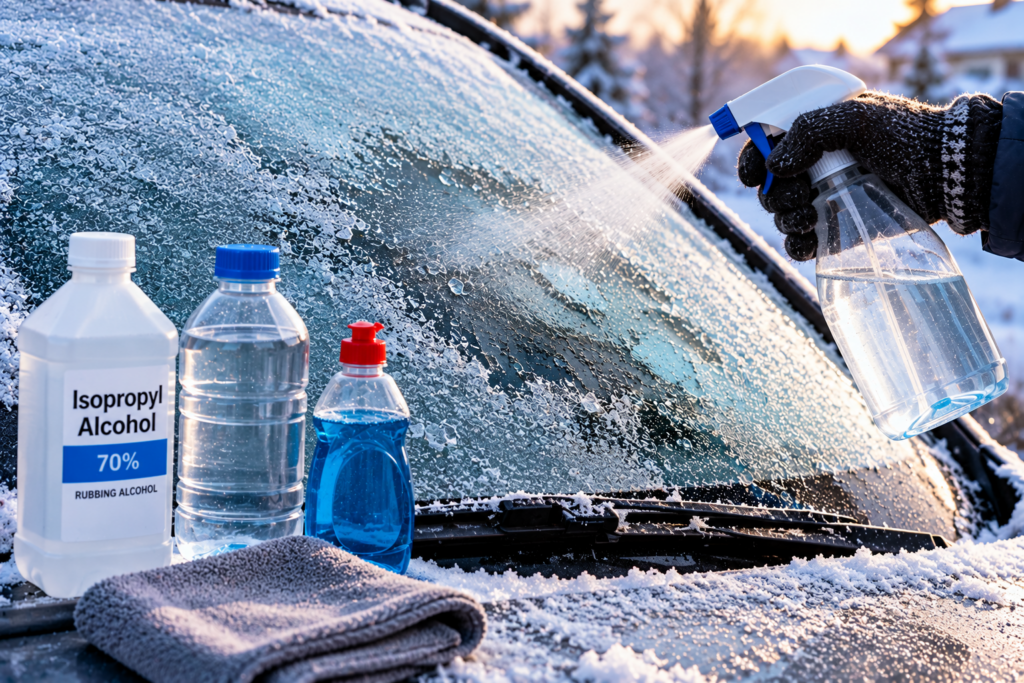
Here’s the household method that deserves considerably more attention than lemon juice or baking soda.
Isopropyl alcohol (rubbing alcohol) has a substantially lower freezing point than water, which is why alcohol-containing solutions can help loosen windshield ice.
AAA publications describe DIY mixtures made from isopropyl/rubbing alcohol, water, and a few drops of dish soap. The dish soap acts as a surfactant, helping the liquid spread across the icy surface.
- 🧪 But what is the exact ratio? This is where online advice needs some nuance. One AAA source recommends: 1 part rubbing alcohol + 2 parts water + a few drops of dish soap. A newer AAA publication gives: 2 parts isopropyl alcohol + 1 part water + a few drops of dish soap. That’s a meaningful difference.
- AAA also notes that rubbing alcohol sold to consumers comes in different concentrations, and that higher alcohol concentration produces a lower freezing point and greater de-icing ability.
- 📝 How to use the principle safely: If you choose a DIY alcohol-based de-icer, know the concentration of the rubbing alcohol you’re using, use a clean spray bottle, apply the solution to the icy glass, give it time to begin loosening the ice, finish carefully with a plastic scraper or other suitable automotive tool, and avoid unnecessarily soaking surrounding painted surfaces.
- ⚠️ One important drawback: AAA notes that alcohol-based de-icing mixtures and dishwashing soap aren’t directly harmful to automotive paint in normal use, but repeated exposure can remove automotive wax over time. If you use such solutions regularly, wash and rewax affected painted areas as appropriate.
🧴 8. Use an Automotive De-Icing Spray When Needed
If you don’t want to experiment with a homemade mixture, an automotive windshield de-icer is the simpler alternative.
Follow the product directions, allow the product time to soften the ice, and remove the loosened material appropriately.
Commercial windshield de-icers typically rely on alcohols to lower the freezing point and help melt ice.
- What about diluting commercial de-icer with water? I wouldn’t recommend turning this into another viral recipe. If a commercial product is already formulated for windshield de-icing, follow its label rather than automatically diluting it. Adding water changes the formulation and can reduce low-temperature performance.
💧 9. Use Winter-Rated Windshield Washer Fluid
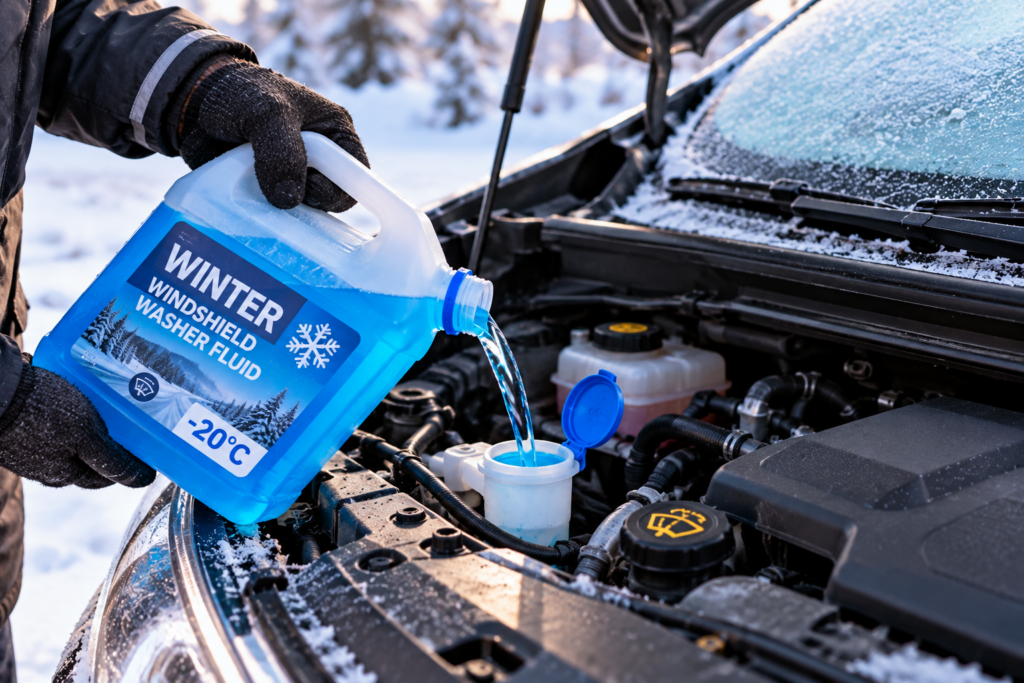
This is an easy winter-preparation step that’s often forgotten.
Before freezing weather arrives, make sure the washer reservoir contains a windshield washer fluid appropriate for winter temperatures.
AAA advises against filling the washer reservoir with plain water because water can freeze in cold conditions; winter formulations are designed to remain usable at lower temperatures and can assist with de-icing.
Always check the product’s temperature rating.
Winter washer fluid isn’t a substitute for manually removing a thick sheet of ice, but it can be very useful for maintaining visibility in winter conditions.
🧤 10. Build a Simple Winter De-Icing Kit
A few inexpensive items kept together can make cold mornings much easier.
Consider having:
- a plastic automotive ice scraper;
- a soft snow brush;
- warm waterproof gloves;
- an appropriate windshield de-icer;
- winter windshield washer fluid;
- a windshield frost cover.
Keep frequently needed items somewhere accessible.
After all, a scraper locked somewhere inconvenient isn’t much help when you’re standing outside beside an iced-over car.
⭐ The Best Strategy: Combine Several Methods
The most effective approach usually isn’t a single “secret trick.”
Think of it as a sequence: Prevent → remove snow → gradually defrost → soften the ice → scrape carefully → use an appropriate de-icer if necessary.
This is much more realistic than expecting one household ingredient to make a heavily frozen windshield instantly crystal clear.
🚫 5 Viral “Natural” De-Icing Tricks to Think Twice About
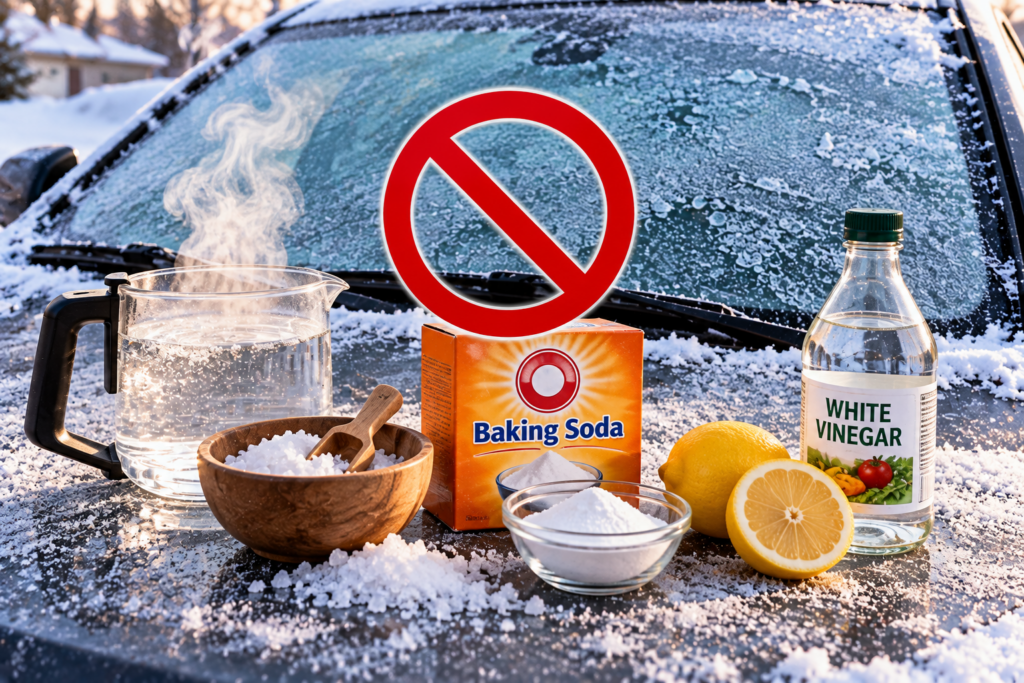
Natural doesn’t automatically mean suitable for automotive glass.
Here are five popular internet recommendations I wouldn’t make the centerpiece of a de-icing routine.
♨️ 1. Hot or Boiling Water — Skip It
This is probably the most important one.
Yes, hot water melts ice.
But pouring hot water onto extremely cold automotive glass can subject the windshield to a rapid temperature change.
AAA explicitly warns against it because thermal shock can crack the glass. Water left on the windshield can also refreeze.
- Better option: Use gradual defrosting, an appropriate scraper and, when necessary, a de-icing solution.
🧂 2. Salt Water — Keep It Away From the Car
Salt can lower water’s freezing point, so the underlying chemistry isn’t imaginary.
That doesn’t make salt water an ideal routine windshield spray.
Salt residue is undesirable around vehicle paint and metal because of corrosion concerns.
Interestingly, AAA has documented an old DIY practice involving soaking a windshield cover in salt water, but it also notes concerns about exposure of vehicle finishes to salts. For an everyday de-icing routine, there are better choices.
🥄 3. Baking Soda — Save It for the House
Baking soda is enormously useful around the home.
Your windshield isn’t where it shines.
It doesn’t offer a compelling advantage over a defroster, plastic scraper or appropriate de-icing solution, and there’s no reason to leave powdery residue across automotive glass.
🍋 4. Lemon Juice — Acidic Doesn’t Mean Better
Lemon is another household ingredient that appears constantly in “natural cleaning” content.
But being acidic doesn’t automatically make something a good automotive de-icer.
There’s little reason to spread lemon juice over your windshield, seals and surrounding finishes when established winter methods are readily available.
🍶 5. Vinegar — There’s More to the Story
Vinegar is more complicated than the previous examples.
AAA describes a DIY frost pretreatment consisting of 3 parts white vinegar to 1 part water, applied the evening before and then wiped off.
But the same AAA guidance provides an important caveat: leaving vinegar solution sitting on the windshield isn’t particularly useful because its freezing point is only slightly below water’s, and it cites warnings from glass professionals about possible micro-pitting from extended exposure.
Therefore, I wouldn’t present vinegar as the star solution. A physical windshield cover is simpler and avoids that uncertainty.
🌿 So, What Is the Most “Natural” De-Icing Method?
If by natural you mean using as few chemical products as possible, the answer isn’t another kitchen mixture.
It’s prevention.
The low-chemical routine:
- Cover the windshield overnight.
- Park under shelter when possible.
- Remove loose snow with a soft brush.
- Use the vehicle’s defroster.
- Finish with a plastic scraper.
No vinegar cocktail, lemon juice, salt solution or baking soda is required.
If the ice needs additional help, the rubbing-alcohol mixture is a plausible DIY option supported in AAA guidance, while a purpose-made automotive de-icer offers a more standardized alternative.
🚗 A Simple Winter-Morning Routine
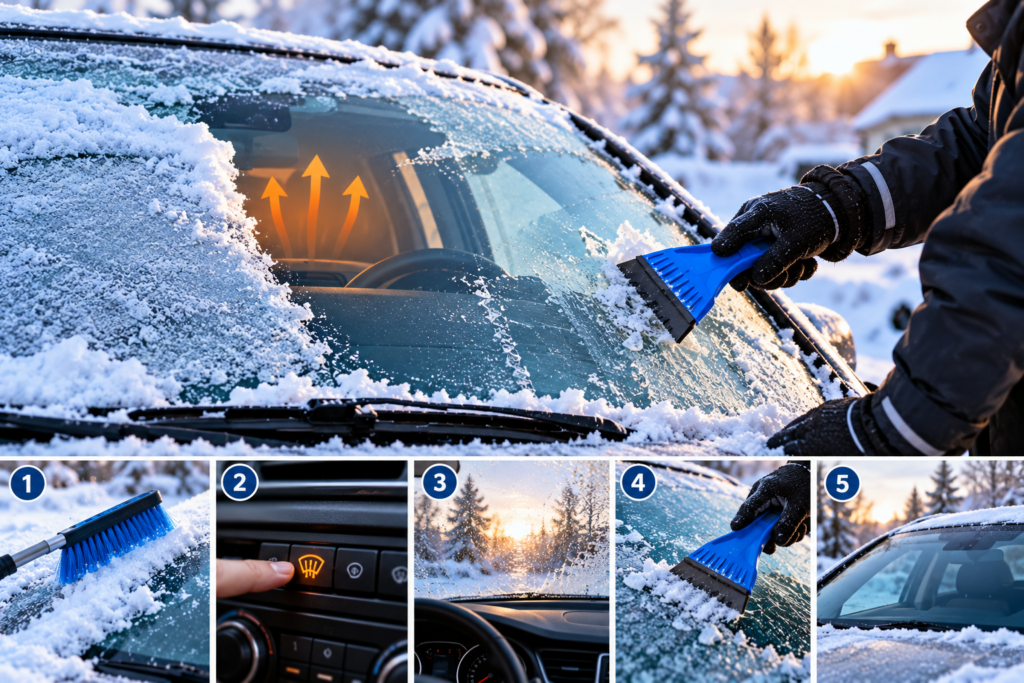
When you discover a frozen windshield, try this order:
- Step 1 — Remove loose snow 🧹: Use your soft automotive snow brush.
- Step 2 — Start gradual defrosting 🌬️: Activate the windshield defroster according to the vehicle instructions.
- Step 3 — Wait for the ice to begin loosening ⏱️: Don’t immediately attack firmly attached ice.
- Step 4 — Use a suitable de-icer if necessary 🧴: Choose either an appropriate automotive product or a carefully prepared DIY alcohol-based solution.
- Step 5 — Scrape gently 🧊: Use a plastic automotive scraper.
- Step 6 — Clear everything before driving 👀: Don’t settle for a tiny clear patch directly in front of the driver’s seat. AAA recommends clearing snow and ice from all vehicle glass so the driver has adequate visibility.
⚠️ Important Winter Safety Tips
Before driving, make sure you can see clearly in every necessary direction.
- Avoid sharp metal objects on the windshield.
- Don’t force wipers that are frozen to the glass.
- Don’t pour hot water over frozen automotive glass.
- Also remember that alcohol-containing de-icers can be flammable and potentially harmful if mishandled. Avoid contact with eyes and unnecessary skin exposure, keep these products away from children and pets, and follow product safety instructions.
❓ Frequently Asked Questions
- Can rubbing alcohol really melt windshield ice?Yes, it can help. Isopropyl alcohol has a lower freezing point than water, and AAA includes alcohol-and-water DIY solutions among its windshield de-icing options. Effectiveness depends partly on alcohol concentration and temperature.
- What is the best alcohol-to-water ratio?There isn’t one ratio that I would present as universally definitive. AAA sources themselves publish different formulations: one gives 1 part alcohol to 2 parts water, while a newer AAA article gives 2 parts alcohol to 1 part water. Alcohol purity also varies.
- Can I pour warm water on my windshield instead?Avoid it. AAA recommends against hot or warm water because rapid temperature change can crack cold glass.
- Does vinegar prevent windshield frost?A vinegar-and-water pretreatment is a commonly reported DIY method, and AAA documents it, but the same guidance notes limitations and concerns about prolonged exposure. A windshield cover is a more straightforward preventive method.
- Can I use my windshield wipers to scrape ice?Don’t force wipers that are frozen to the windshield. Allow the ice to loosen first and use a proper scraper or brush.
- What’s the easiest chemical-free solution?A windshield frost cover, sheltered parking when available, the vehicle’s defroster and a plastic ice scraper provide a strong combination without requiring a homemade chemical spray.
- Can I fill the windshield washer reservoir with plain water?Not during freezing conditions. AAA recommends winter-rated washer fluid because plain water can freeze.
- Is homemade de-icer better than commercial de-icer?Not necessarily. A DIY alcohol solution can work, but a commercial automotive product gives you a formulation and usage instructions designed specifically for the task. Homemade doesn’t automatically mean safer or more effective.
🌟 Final Thoughts
The best windshield de-icing trick turns out to be less dramatic than many viral videos suggest.
Prevention + gradual defrosting + the correct tools should form the foundation of your winter routine.
Cover the windshield before a freezing night when practical. Remove loose snow first. Let the defroster begin loosening the ice. Then use a proper plastic scraper rather than a knife, key or metal tool.
If you want a household alternative, an isopropyl-alcohol-and-water spray is one of the few DIY approaches that has a clear physical basis and appears in AAA guidance—but concentration and formulation matter.
And perhaps most importantly: Skip the boiling water, don’t coat your car in salt, and don’t assume every “natural” kitchen ingredient belongs on your windshield. ❄️🚗
For a genuinely low-chemical solution, preventing the frost in the first place remains hard to beat.