
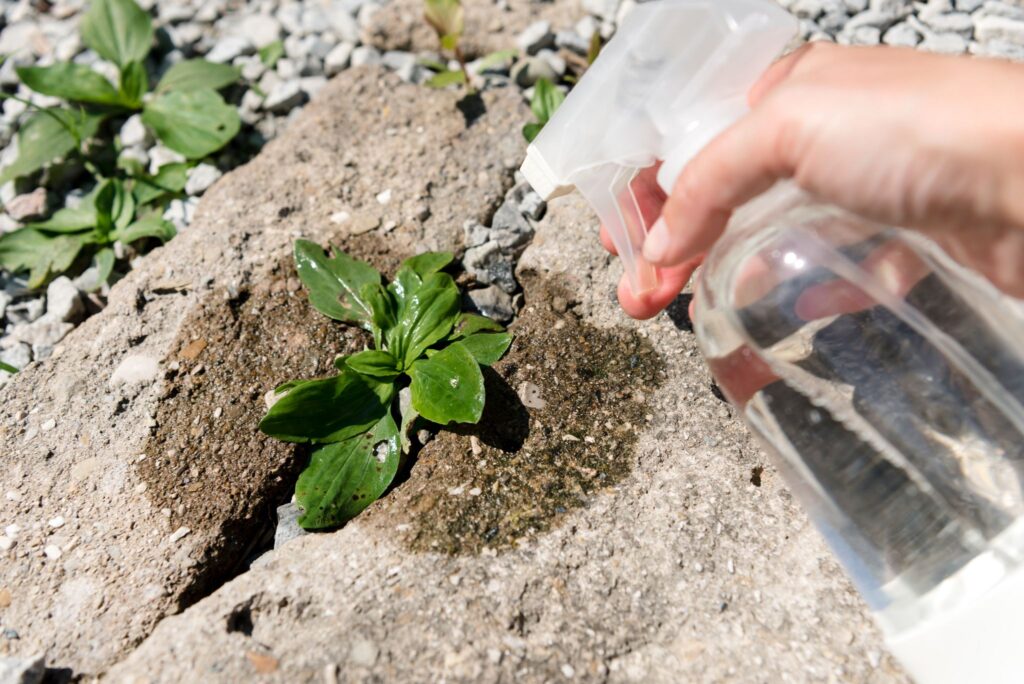
Weeds pushing through sidewalk cracks, driveway joints, and patio gaps can be incredibly frustrating.
That’s why homemade weed-killer recipes made with vinegar, salt, and dish soap have become so popular online. They’re cheap, easy to make, and can make weeds look dead surprisingly quickly.
But there’s an important catch:
A weed that looks dead above ground may still be alive below the surface.
Household vinegar mainly damages the leaves and other green tissues it touches. Young annual weeds may be controlled fairly well, but established perennial weeds can often regrow from their roots.
And adding large amounts of salt can create a second problem by leaving salts behind in the soil or surrounding areas.
So if you want to use vinegar for weeds in sidewalk cracks, it helps to understand where it works, where it doesn’t, and how to avoid the biggest mistakes.
🧪 Why Vinegar Can Damage Weeds
Household white vinegar usually contains around 5% acetic acid.
Acetic acid is a contact herbicidal substance, meaning it damages the plant tissue it directly touches.
When applied to young leaves, it can disrupt cell membranes and cause rapid drying.
That’s why weeds can sometimes appear brown and wilted within hours.
But there’s a limitation
Household vinegar does not reliably travel through the plant and kill deep root systems.
So it is generally more effective on:
✔ young annual weeds
✔ tiny seedlings
✔ weeds growing in pavement cracks
✔ recently emerged growth
And less reliable on:
❌ thistles
❌ dandelions
❌ bindweed
❌ established grasses
❌ other deep-rooted perennial weeds
🌱 A Simpler Vinegar Method for Sidewalk Cracks
If you want to experiment with household vinegar, the best approach is to keep it simple and targeted.
What you need
- household white vinegar
- a clearly labeled spray bottle
- gloves
- a calm, dry day
How to use it
- Choose young weeds growing in a sidewalk, driveway, or patio crack.
- Make sure the leaves are dry.
- Spray the vinegar directly onto the weed foliage.
- Avoid soaking surrounding soil unnecessarily.
- Keep the spray away from grass, flowers, shrubs, and vegetables.
- Recheck the weed after several days.
If regrowth appears, remove the plant manually or repeat only if appropriate.
🫧 Do You Need Dish Soap?
Many recipes add dishwashing liquid because it can act as a surfactant, helping the vinegar spread across waxy leaf surfaces.
However, you do not need large amounts.
Why too much soap is unnecessary
Excess dish soap can:
- increase runoff
- leave residue
- damage non-target plants
- make the mixture more aggressive than necessary
If a surfactant is used, the goal is only to improve leaf coverage—not turn the spray into a heavy detergent solution.
And remember:
Dish soap does not make vinegar systemic.
It may help the liquid stick to leaves, but it does not guarantee that deep roots will die.
🧂 Why I Would Skip the Salt
One of the most common homemade weed-killer recipes contains:
- vinegar
- salt
- dish soap
The salt is the part I would avoid.
Why?
Salt can remain in the soil or migrate with water.
High concentrations can interfere with:
💧 water uptake
🌱 root growth
🦠 soil biology
🌿 future plant establishment
In a sidewalk crack far from anything you ever want to grow, the risk may seem small.
But rain and irrigation can move dissolved salts beyond the exact place where you sprayed them.
What about Epsom salt?
Epsom salt is magnesium sulfate, and it is still a salt.
It is sometimes promoted as a more natural or plant-friendly substitute for table salt, but dumping large amounts into pavement cracks or soil is unnecessary.
So for ordinary home use:
🌿 Vinegar alone is simpler than vinegar + salt.
☀️ When Is the Best Time to Apply Vinegar?
Vinegar generally works best when it remains in contact with dry foliage long enough to damage it.
Choose:
✔ a dry day
✔ little or no wind
✔ no rain expected soon
✔ dry weed leaves
Avoid spraying during windy conditions because drift can injure nearby plants.
What about hot sunshine?
Warm, dry conditions can speed up visible leaf damage, but you do not need to chase extreme heat.
The bigger priority is accurate application.
🌼 Vinegar Is Non-Selective
This is the most important practical rule.
Vinegar does not recognize the difference between a weed and a garden plant.
If the spray lands on:
🌹 roses
🍅 tomatoes
🥬 vegetables
🌱 grass
🌺 flowers
🌿 shrubs
it can injure them too.
That makes vinegar much more appropriate for isolated hardscape cracks than for crowded flower or vegetable beds.
🌿 Does Vinegar Kill Thistles?
It can damage thistle foliage, especially when the plant is young.
But established thistles often have persistent root systems.
That means the leaves may collapse after treatment while the underground parts remain alive.
Better approach for established thistle
Combine strategies:
- Cut or dig out as much of the root as possible.
- Remove new shoots repeatedly.
- Prevent flowering and seed production.
- Continue monitoring for regrowth.
Persistent weeds usually require persistence from the gardener too.
🌱 Does Vinegar Kill Dandelions?
The same limitation applies.
A young dandelion seedling may be severely damaged.
A mature dandelion with a large taproot can simply send up new leaves.
For isolated mature plants, removing as much of the taproot as possible is often more effective than repeatedly burning the foliage.
🌾 Does Vinegar Kill Grass in Sidewalk Cracks?
Young grasses can be damaged by vinegar, but perennial grasses may regrow from crowns, rhizomes, or roots.
If grass repeatedly emerges through the same crack, consider addressing the crack itself once the vegetation is removed.
Repairing the gap can reduce future germination.
🚶 Where Vinegar Makes the Most Sense
If you choose to use household vinegar for weeds, it makes the most sense in places such as:
✔ sidewalk cracks
✔ driveway joints
✔ patio gaps
✔ gravel edges away from desirable vegetation
✔ isolated hardscape areas
It makes much less sense:
❌ inside vegetable beds
❌ between flowers
❌ close to tree roots
❌ on lawns
❌ around seedlings
🔥 What About Boiling Water?
Very hot water is another simple treatment sometimes used for weeds growing in pavement cracks.
Heat can damage above-ground plant tissue and, when enough reaches the crown, may also affect shallow tissues.
Best uses
It is most practical for:
🚶 pavement joints
🧱 cracks
🌿 isolated weeds
Be careful
Boiling water can also damage any plant it touches and can cause severe burns to people.
Never carry large amounts of boiling water around children, pets, or uneven outdoor surfaces.
And avoid pouring it where it could affect desirable roots.
🛠️ Manual Removal Still Works Extremely Well
It isn’t flashy, but pulling weeds is often the best option—especially after rainfall when the soil in a crack is softer.
Helpful tools include
✔ narrow weeding knife
✔ crack weeder
✔ old screwdriver used carefully
✔ hand hoe
✔ long-handled pavement weeder
Try to remove as much of the root as possible.
This is particularly useful for dandelions, thistles, and other weeds that can regrow after foliage-only treatments.
🌧️ Try Removing Weeds After Rain
This simple timing trick can make a big difference.
After rainfall, soil and debris trapped in cracks often soften.
That makes it easier to pull:
🌿 roots
🌱 crowns
🍃 seedlings
rather than snapping off only the leaves.
If the root comes out with the plant, regrowth is much less likely.
🧹 Prevent Weeds Before They Take Over
The easiest weed to remove is the one that never establishes.
After cleaning pavement cracks:
✔ sweep regularly
✔ remove accumulated soil
✔ prevent weeds from flowering
✔ remove seedlings when they are tiny
✔ repair large cracks when practical
Seeds need a place to germinate.
Less soil and organic debris in the crack means fewer opportunities.
🧱 Repair Cracks After Weed Removal
If weeds keep returning in exactly the same location, the real problem may be the gap itself.
Once the vegetation is removed and the area is cleaned, consider repairing suitable cracks or joints using a material designed for that surface.
This can prevent:
🌱 new seeds from settling
💧 water from accumulating
🍂 organic debris from collecting
A physical fix is often more effective than spraying the same weed repeatedly.
🚫 6 Common Homemade Weed-Killer Mistakes
❌ 1. Adding huge amounts of salt
Salt can remain behind and interfere with future growth.
❌ 2. Assuming brown leaves mean dead roots
Perennials can regrow.
❌ 3. Spraying near desirable plants
Vinegar is non-selective.
❌ 4. Using it on windy days
Spray drift can damage nearby vegetation.
❌ 5. Storing an unlabeled spray bottle
Always label homemade mixtures clearly and keep them out of reach of children and pets.
❌ 6. Assuming stronger vinegar is safer because it is “natural”
Higher concentrations of acetic acid are more hazardous to skin, eyes, and plants.
⚠️ Household Vinegar vs. Horticultural Vinegar
This distinction is extremely important.
Ordinary kitchen vinegar is usually around 5% acetic acid.
Products marketed as horticultural vinegar may contain much higher concentrations.
Higher-strength acetic acid can cause:
⚠️ serious eye injury
⚠️ skin burns
⚠️ respiratory irritation
⚠️ severe plant damage
Do not handle concentrated horticultural vinegar as if it were salad vinegar.
Always follow the product label and required safety instructions.
🐝 What About Nearby Wildlife?
Avoid spraying any homemade herbicidal mixture onto:
🐝 flowering plants
🦋 pollinator plants
🐦 wildlife water sources
🌱 desirable vegetation
Target only the weed.
More precise application means less unnecessary exposure in the surrounding environment.
🌿 A Better Strategy for Persistent Weeds
For stubborn sidewalk weeds, combine methods instead of relying on a single spray.
Step 1
Remove mature weeds manually.
Step 2
Treat small new seedlings early.
Step 3
Sweep soil and debris from cracks.
Step 4
Prevent flowering and seed production.
Step 5
Repair the crack when practical.
This is far more sustainable than repeatedly saturating the same area with a strong salt mixture.
❓ FAQ – Vinegar Weed Killer for Sidewalk Cracks
Does vinegar really kill weeds?
It can severely damage young weed foliage. Small annual weeds may die, while established perennial weeds can regrow from surviving roots.
What percentage vinegar works on weeds?
Ordinary household vinegar is typically around 5% acetic acid and can damage tender young weeds. Higher concentrations are more hazardous and should only be used according to their labels.
Should I add salt to vinegar weed killer?
I would avoid adding salt, especially anywhere near soil where desirable plants may eventually grow.
Does Epsom salt kill weeds?
Large amounts of Epsom salt are not necessary for controlling weeds, and adding salts indiscriminately is not a good soil-management practice.
Why do recipes add dish soap?
Dish soap may help a liquid spread over and stick to leaf surfaces. It does not make vinegar a systemic herbicide.
How fast does vinegar work?
Visible wilting or browning may occur within hours or by the following day under favorable conditions. That does not necessarily mean the entire root system is dead.
Will vinegar kill thistles permanently?
Not reliably. Mature thistles may regrow from roots even after the foliage has been damaged.
Will vinegar kill dandelions?
It can burn the leaves, but mature dandelions may regrow from their taproots.
Can I spray vinegar in my flower bed?
It is risky because vinegar is non-selective and may damage nearby flowers and other desirable plants.
Is vinegar safe around trees?
Avoid spraying near exposed roots, suckers, or tree foliage. For weeds around trees, mulching and manual removal are usually better options.
Is boiling water better than vinegar?
Both are contact treatments best suited to isolated hardscape weeds. Neither should touch desirable plants.
When should I spray weeds?
Choose a calm, dry period when the foliage is dry and rain is not expected soon.
🏁 Final Thoughts
The famous vinegar + salt + dish soap weed killer works partly because it aggressively damages plant tissue—but that does not make every ingredient necessary or ideal.
For weeds growing in sidewalk cracks, household vinegar can sometimes be useful as a targeted treatment for young growth.
But keep expectations realistic:
🌿 Vinegar mainly damages foliage.
🌱 Deep-rooted weeds can return.
🧂 Salt is unnecessary and can create longer-lasting problems.
🫧 Large amounts of dish soap are not needed.
🌸 Nearby plants can be injured by overspray.
For the best long-term results, combine targeted treatment with manual root removal, regular sweeping, early weed control, and crack repair.
Sometimes the most effective weed-control strategy is not a stronger recipe—it is preventing the weed from getting established again. 🌱