
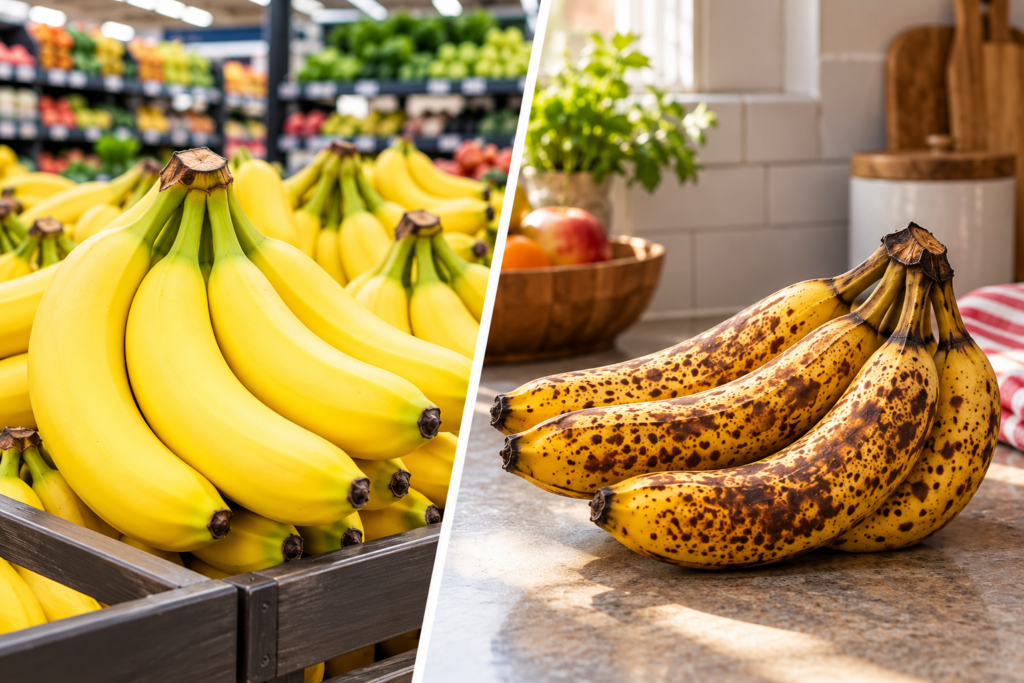
You buy a beautiful bunch of bananas at the supermarket. They’re bright yellow, firm, and look as though they have plenty of life left in them.
Then you bring them home.
Before long, brown spots begin appearing. Sometimes it feels as though bananas can sit looking perfect at the store for days, yet the moment they reach your kitchen, the countdown begins.
So what is actually happening?
The supermarket isn’t using a mysterious trick to “freeze” bananas in time. The real explanation involves when bananas are harvested, controlled ripening, ethylene gas, temperature, and the conditions inside your home.
And once you understand those factors, keeping bananas at the stage you like becomes much easier.
🛒 Why Do Bananas Seem to Last Longer at the Supermarket?
The biggest misconception is that bananas simply arrive at the supermarket yellow and stay that way naturally.
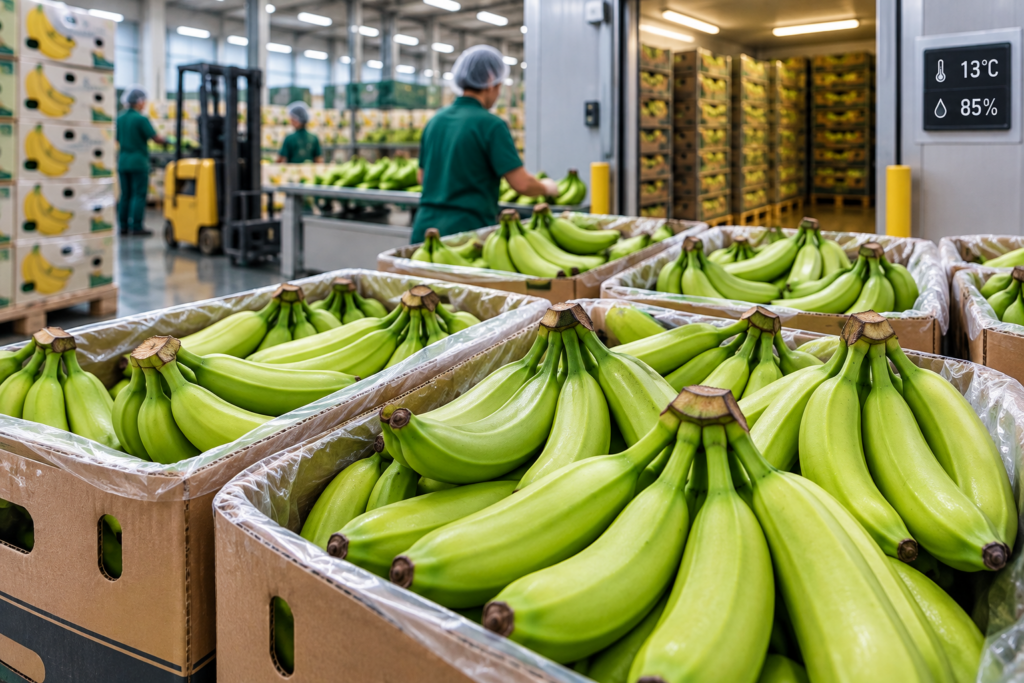
Commercial bananas are generally harvested mature but green rather than allowed to fully ripen on the plant. UC Davis notes that mature-green bananas are then ripened after reaching their destination markets.
That gives producers and distributors much more control over when the fruit becomes ready to sell.
Temperature is particularly important. UC Davis lists approximately 13–14°C (56–58°F) as an optimal range for banana storage and transport, while 15–20°C (59–68°F) is used for ripening.
So before those yellow bananas ever reach your shopping cart, their journey has been much more carefully managed than what usually happens after you place them on your kitchen counter.
🍌 The Banana Has Already Started Its Ripening Clock
Here’s the important part:
A yellow banana in the supermarket is not waiting to start ripening. It is already ripening.
As bananas mature, starch is converted into sugars, the flesh softens, aromas develop, and the peel gradually changes from green to yellow and eventually becomes spotted and brown.
When you buy a perfectly yellow banana, you may simply be purchasing it during a relatively short attractive stage of that process.
Bring it home, and the process continues.
That can make the change seem surprisingly sudden.
💨 The Ethylene Effect
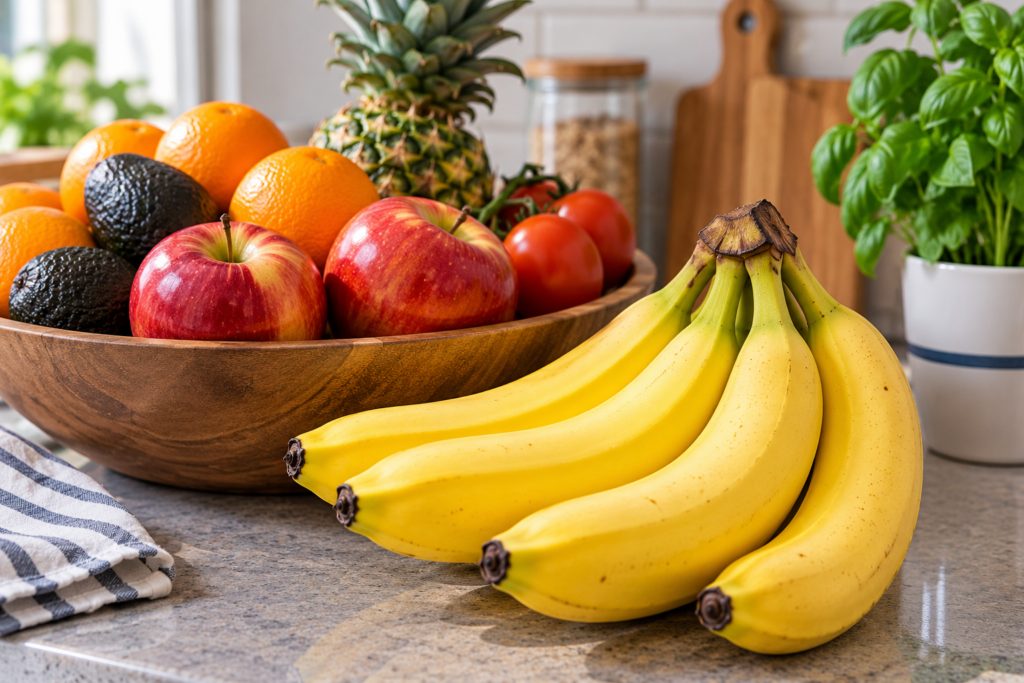
Bananas belong to a group known as climacteric fruits. One of the key players in their ripening process is a natural plant hormone called ethylene.
Commercial handlers actually take advantage of this. According to UC Davis, most commercial banana cultivars can be exposed to approximately 100–150 ppm ethylene for 24–48 hours under controlled temperature and humidity to induce uniform ripening.
The FAO likewise describes controlled banana ripening in purpose-built rooms where temperature, humidity and ethylene exposure can be managed.
Once the process gets going, bananas themselves produce ethylene too.
That means the bunch sitting on your counter is still biologically active.
🌡️ The Biggest Difference at Home May Be Temperature
This is where your kitchen can dramatically change the situation.
A supermarket supply chain can control temperature carefully. Your fruit bowl cannot.
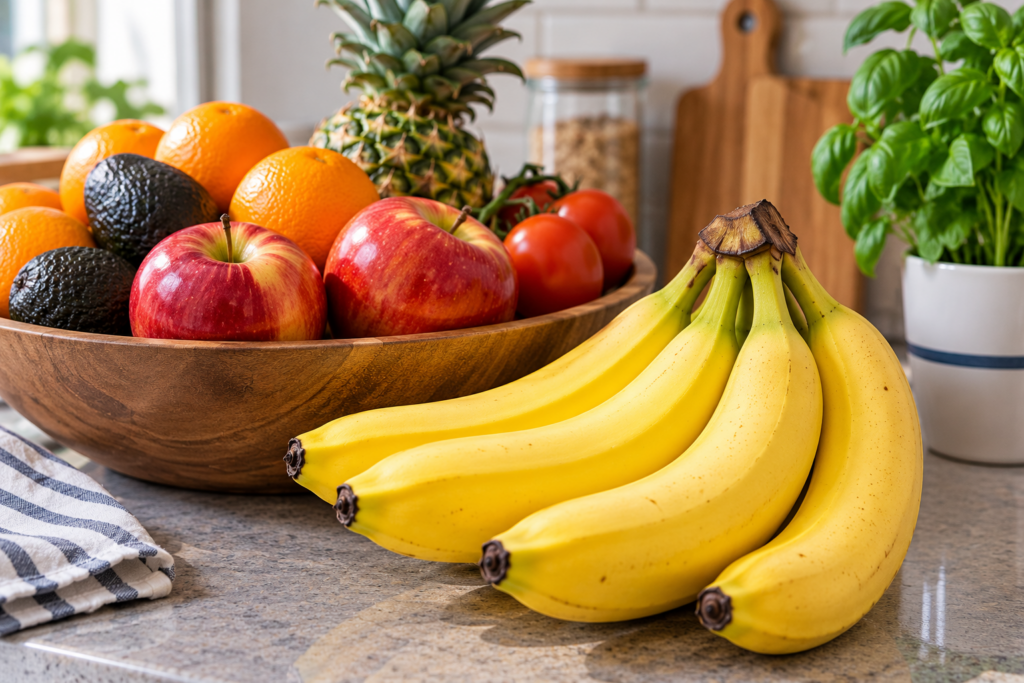
A warm kitchen, a sunny countertop, the top of a refrigerator or another warm location can encourage bananas to move through their ripening stages more quickly.
UC Davis data show that banana respiration and ethylene production generally increase as temperature rises within normal ripening ranges. Their postharvest guidance emphasizes that temperature is a major factor in banana quality and ripening management.
So if your home is considerably warmer than the environment where the bananas were previously held, the difference can become noticeable.
☀️ Avoid this common mistake: Don’t store bananas in direct sunlight or immediately beside a heat source if you’re trying to make them last longer. A comfortable, cooler area away from direct sun is a better choice.
🍎 Your Fruit Bowl Can Speed Things Up Too
That beautiful mixed fruit bowl may not be ideal when you’re trying to slow ripening.
Apples and several other fruits also produce ethylene.
Keeping ripe bananas together with other ethylene-producing fruit can therefore create conditions that favor continued ripening.
Interestingly, the same principle can be useful when you want fruit to ripen faster.
That’s why putting unripe fruit in a paper bag with a ripe banana or apple is such a common ripening technique.
But when your bananas are already exactly as ripe as you want them?
Keeping them away from additional ethylene sources can be sensible.
🟤 Why Does the Peel Suddenly Develop Brown Spots?
Brown spots don’t automatically mean something has gone wrong.
They are a normal part of banana ripening and aging.
As the fruit progresses through ripening, the peel loses its uniform yellow appearance and develops spots. Meanwhile, the flesh generally becomes softer and sweeter as starches are converted into sugars.
This explains another common experience:
A lightly spotted banana may actually taste sweeter than the flawless yellow banana you bought.
The appearance has changed, but that doesn’t automatically mean the fruit should be thrown away.
🤔 But Can Bananas Really Turn Brown in Just a Few Hours?
Sometimes you’ll notice a dramatic change over a relatively short period, especially with bananas that are already very ripe, warm, or bruised.
But “a few hours” isn’t a universal rule.
A banana normally doesn’t go from perfectly fresh to completely overripe simply because you carried it home.
The viral observation is better understood this way:
- The banana may already be well into its ripening process when you buy it, and conditions at home can allow that process to continue quickly.
- The supermarket-to-home difference can therefore feel much more dramatic than it really is.
🧊 Should You Put Bananas in the Refrigerator?
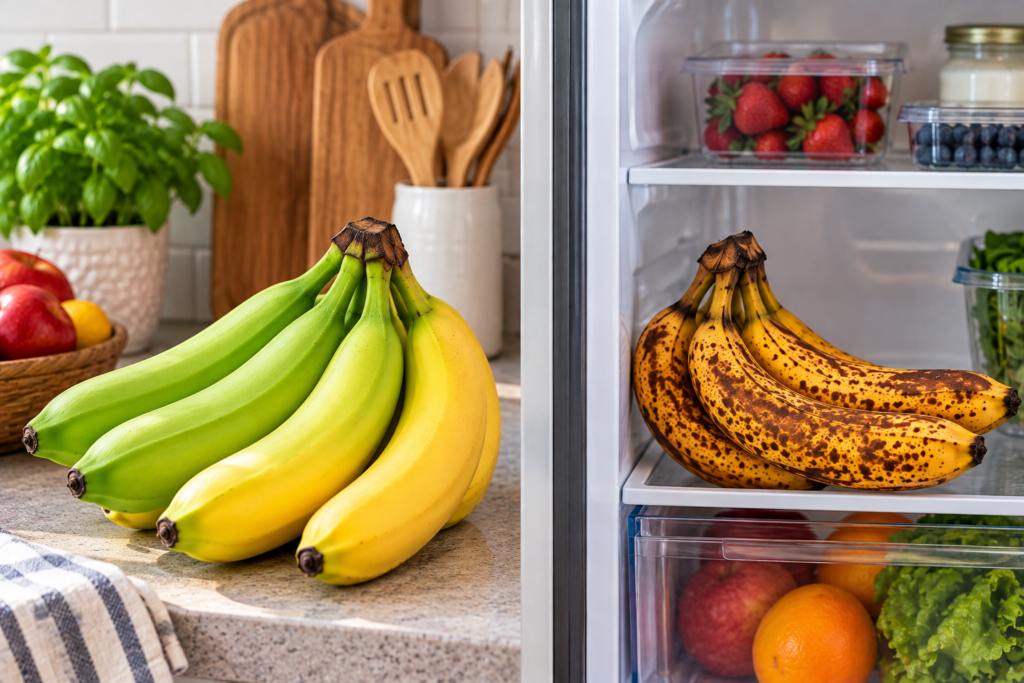
Here’s where timing matters.
Green bananas: generally no
Very cold temperatures can damage unripe bananas. UC Davis reports that Cavendish bananas are susceptible to chilling injury below about 13°C (56°F), depending on temperature, maturity and exposure time. Symptoms can include peel discoloration and abnormal ripening.
So the refrigerator isn’t the place to force a green banana to ripen.
Already ripe bananas: refrigeration can be useful
Once your bananas have reached the ripeness you enjoy, cooling them can help slow further changes.
Don’t panic if the peel becomes darker in the refrigerator. The appearance of the peel isn’t always a perfect indication of the condition of the flesh.
For ripe bananas you aren’t going to eat immediately, refrigeration can therefore be more useful than leaving them in a warm kitchen.
🍌 7 Practical Ways to Keep Bananas Good for Longer
You don’t need an elaborate viral hack. Start with the conditions surrounding the fruit.
- Buy bananas at different stages of ripeness: Instead of buying six perfectly yellow bananas, choose some yellow ones for immediate eating and some greener ones for later in the week.
- Keep them away from direct sunlight: A warm sunny window isn’t ideal if your goal is slower ripening.
- Avoid warm appliances: Don’t leave the bunch next to the oven, stove or another source of heat.
- Separate them from other ripening fruit when appropriate: Especially when the bananas are already ripe enough.
- Handle them gently: Bruising and physical damage can create dark areas and make fruit look old faster.
- Refrigerate them once they’re ripe: The peel may become less attractive, but refrigeration can be useful when your goal shifts from ripening to slowing further ripening.
- Freeze bananas you won’t eat in time: Peel them first, cut them into pieces and freeze them in a suitable container. They’re excellent later for smoothies, baking or frozen desserts.
🧪 What About Viral Banana Storage Hacks?
The internet is full of tricks promising to keep bananas yellow for much longer. Let’s separate plausible ideas from exaggerated claims.
- Wrapping the stems: You’ll often see recommendations to wrap the crown or individual stems with plastic wrap or foil to supposedly “trap the ethylene.” There is a plausible reason people experiment with reducing ethylene exposure, but don’t expect a small piece of wrap to stop the entire ripening process. Temperature, maturity and the fruit’s overall environment still matter enormously.
- Separating every banana: Separating bananas changes how closely the fruit sits together, but it isn’t a magic preservation technique. If your kitchen is warm and the bananas are already ripe, they will continue aging.
- Hanging bananas: A banana hanger can help reduce pressure points and bruising from resting the bunch against a hard surface. That’s useful. But hanging bananas doesn’t switch off ripening.
- Putting foil around the stems: Same idea as plastic wrap: don’t expect miracles. If you want to substantially slow already-ripe bananas, temperature management is much more important than a decorative piece of foil around the crown. UC Davis postharvest guidance specifically emphasizes temperature as a major factor in maintaining banana quality.
🟢🟡🟤 What Banana Color Should You Choose?
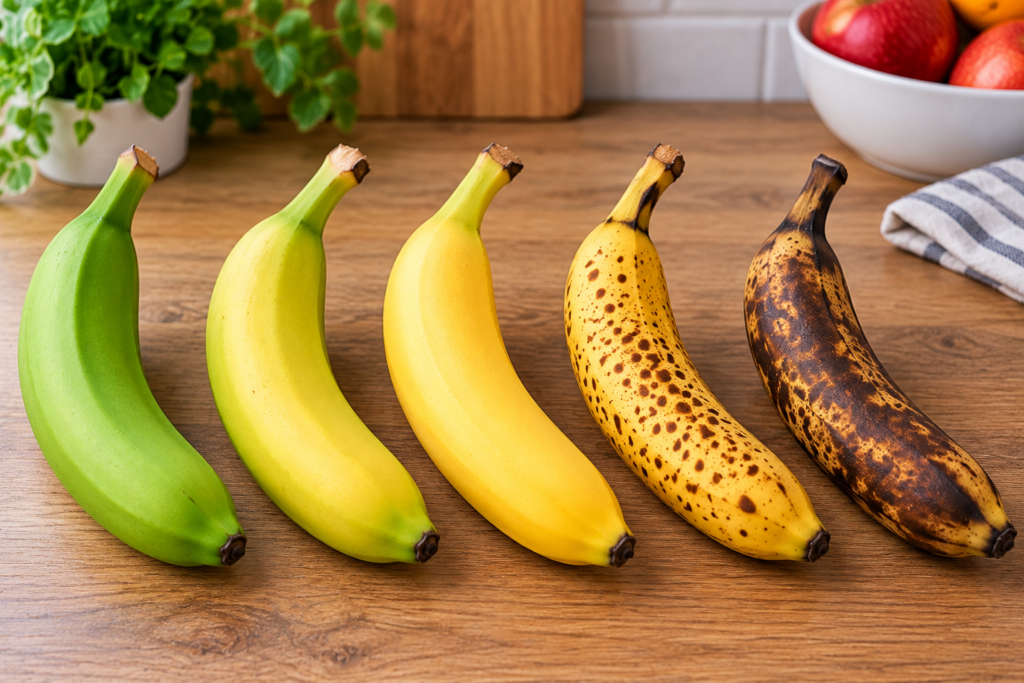
The “best” banana depends on when you want to eat it.
- Green: Still unripe and firm. Give it time at room temperature.
- Green-yellow: Beginning to ripen. Good if you’re buying for later.
- Bright yellow: Ripe and convenient for eating soon.
- Yellow with brown spots: Riper, softer and usually sweeter.
- Very brown: Often excellent for banana bread, pancakes, muffins and smoothies if the flesh is still sound.
This is why buying an entire bunch at exactly the same ripeness can be inconvenient: they tend to become ready at roughly the same time.
🚫 Brown Doesn’t Automatically Mean “Bad”
This is one of the easiest ways to reduce unnecessary food waste.
A heavily spotted or brown peel doesn’t automatically mean the banana inside is spoiled.
Peel it and check the fruit.
A soft, sweet banana with a strong ripe-banana aroma can be ideal for baking.
However, discard fruit showing clear signs of spoilage such as mold, leaking decay, or an obviously unpleasant/off odor.
Use the condition of the fruit, not peel color alone, to make the decision.
🍞 Don’t Throw Away Overripe Bananas
If you’ve missed the perfect yellow stage, you still have plenty of options.
Very ripe bananas are particularly useful for:
- Banana bread
- Banana pancakes
- Muffins
- Smoothies
- Oatmeal
- Frozen banana desserts
- Homemade banana ice cream-style treats
You can also peel and freeze them before they deteriorate further.
So those brown spots can sometimes be the beginning of a recipe rather than the end of the banana.
❓ Frequently Asked Questions
- Why do my bananas turn brown so quickly after I buy them?They may already be well into the ripening process when purchased. Warmer temperatures, continued ethylene production, nearby ripening fruit and physical damage can all contribute to faster visible changes.
- Do supermarkets spray bananas with something to keep them yellow?Commercial bananas are typically harvested mature-green and their ripening can be carefully managed using temperature, humidity and ethylene. Controlled ethylene exposure is a standard way of producing more uniform ripening; it isn’t evidence of a mysterious preservative keeping supermarket bananas permanently yellow.
- Do bananas produce ethylene?Yes. Ethylene plays an important role in banana ripening, and commercial handlers also use controlled ethylene exposure to initiate uniform ripening.
- Do bananas ripen faster in a warm kitchen?Temperature strongly influences banana ripening and quality. Higher temperatures within normal ripening conditions are associated with higher respiration and ethylene-production rates.
- Should I refrigerate bananas?Let green bananas ripen normally rather than placing them immediately in a cold refrigerator. Once bananas are ripe, refrigeration can be useful for slowing further ripening, although the peel may darken.
- Can I eat a banana with brown spots?Usually, yes. Brown spotting is a normal feature of advanced ripening. Check the actual fruit for spoilage rather than judging it only by peel color.
🍌 The Bottom Line
So why can bananas appear perfect at the supermarket and then seemingly turn brown the moment they arrive home?
Because you’re seeing different stages and conditions of the same ripening process.
Commercial bananas are harvested mature-green and can be transported and ripened under carefully managed conditions. By the time you buy a beautiful yellow bunch, the ripening process is already underway. Bring those bananas into a warmer kitchen, perhaps place them beside other ripening fruit, and the visible changes can continue surprisingly quickly.
There isn’t a secret supermarket trick that permanently keeps bananas yellow.
The useful trick is much simpler:
Pay attention to ripeness, temperature, nearby fruit and timing.
And when those brown spots eventually appear?
Don’t throw the bananas away too quickly — they might be perfect for your next batch of banana bread. 🍌