
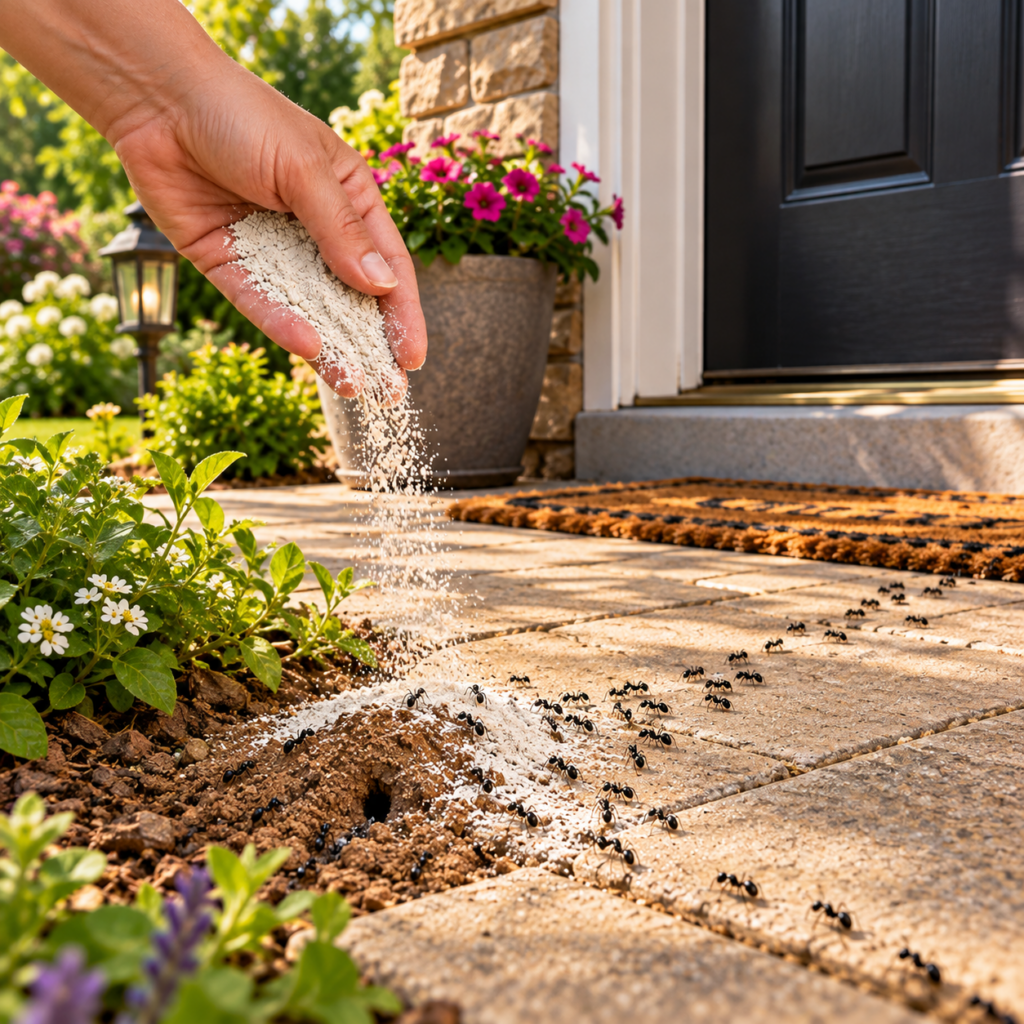
You clean the kitchen counter, come back a few minutes later… and there they are again.
A tiny line of ants marching toward the sink, sugar bowl, fruit basket or pet food.
Or maybe the problem is outside: ants are climbing your plants, appearing around the patio, disappearing into cracks, or building an anthill right beside your vegetable bed.
It’s tempting to grab whatever you have nearby—vinegar, dish soap, baking soda, cinnamon, coffee grounds—and start spraying or sprinkling.
But there’s something important to understand first:
Getting rid of the ants you can see is not the same as getting rid of the colony.
Some simple methods are genuinely useful for removing visible ants, cleaning their trails, eliminating food sources and blocking entry points.
Others may temporarily discourage ants but won’t eliminate an established nest.
And sometimes, particularly outdoors, the ants don’t need to be eliminated at all.
Here’s how to tell the difference—and what to do.
🐜 Why Are Ants Coming Into Your House?
Ants usually enter homes because they have found something useful.
Most commonly:
- 🍯 Food
- 💧 Water
- 🏠 Shelter or a protected route
And they don’t need much.
A few crumbs beneath the toaster, a sticky drop of juice, pet food left overnight or moisture beneath the sink may be enough.
Once a worker finds a useful food source, chemical trails can help other workers locate the same place.
That explains why one ant can seemingly turn into dozens surprisingly quickly.
Look for these common attractions
- sugar and syrup residue
- crumbs
- ripe or damaged fruit
- dirty dishes
- pet food
- cooking grease
- overflowing trash
- sticky recycling containers
- leaking faucets
- damp cabinets
- standing water
Before trying any treatment, remove as many of these attractions as possible.
That simple step is one of the foundations of successful ant control.
🧼 1. Start With Soapy Water
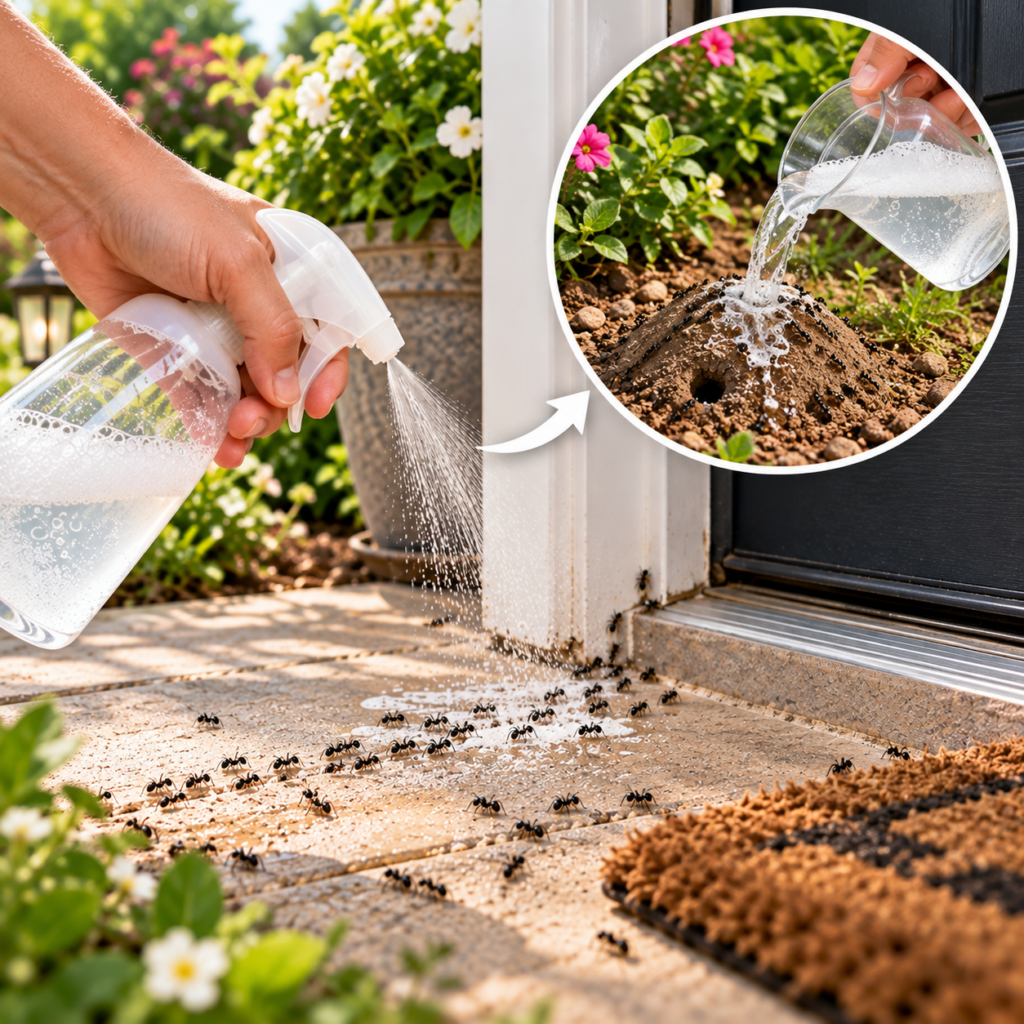
This is one of the simplest methods in this guide, and it’s where I would start when ants appear on a washable surface.
Mild soapy water can help remove exposed ants while also cleaning the surface and disrupting the chemical trail other workers may be following.
Simple soapy-water recipe
Mix:
- 2 cups (about 500 ml) water
- 1 teaspoon mild dish soap
Put the mixture into a spray bottle or apply it with a cloth.
Use it on compatible washable surfaces such as:
- countertops
- floors
- baseboards
- window frames
- door areas
- ant trails
- areas around trash cans
Then wipe the surface clean.
🧠 Why does this help?
Think of an ant trail as a tiny chemical road map.
Workers use chemical signals to help other ants find food and water.
Thoroughly cleaning the route removes food residue and can interfere with that established trail.
🌱 How to use soapy water in the garden
If ants are crossing a patio, paving stone, raised-bed edge or another washable hard surface, mild soapy water can be used to clean visible trails.
But plants require more caution.
If ants are constantly climbing a plant, don’t immediately cover the leaves with ordinary dish detergent.
First look for:
- aphids
- scale insects
- mealybugs
- sticky honeydew
These pests may be the real reason ants are visiting.
For a light aphid infestation on a sturdy plant, a stream of water can knock many aphids from the foliage.
If additional treatment is required, a properly labeled insecticidal soap is preferable to experimenting with concentrated household detergent.
🐜 Can I pour soapy water into an anthill?
I wouldn’t make this a routine recommendation.
Pouring detergent solution into soil may affect plants and other organisms, while reaching the visible entrance doesn’t guarantee that the solution reaches the queen or deeper parts of the colony.
Soapy water is much better for visible ants and washable trails than for flooding an underground nest.
🧽 2. Clean the Entire Ant Trail
Don’t clean only the area where the ants found food.
Watch them first.
Try to determine where they’re coming from.
Follow the trail toward:
- windows
- doors
- baseboards
- cracks
- pipes
- cabinets
- wall openings
Then clean the entire accessible route.
This is much more useful than repeatedly crushing individual workers while leaving the food residue and trail behind.
🌱 Garden tip
The same principle works outdoors.
Follow the trail across the patio or along the foundation.
It may lead you directly to:
- an outdoor food source
- a crack
- an aphid-covered plant
- an anthill
- the route ants are using to enter your house
Finding the destination and the source is more valuable than randomly spraying the entire garden.
🍶 3. White Vinegar Can Help Disrupt Ant Trails
Vinegar is probably one of the best-known homemade ant remedies.
It does have a practical use—but it isn’t the miracle colony killer it’s sometimes made out to be.
Simple vinegar solution
Mix:
- 1 part white vinegar
- 1 part water
Use it to wipe appropriate hard surfaces where ants have been traveling.
What vinegar can help with
It can:
- clean food residue
- clean ant trails
- temporarily disrupt routes
- make a recently used route less attractive
What it won’t reliably do
Wiping a kitchen counter with vinegar should not be expected to eliminate an entire colony hidden inside a wall or underground.
That’s the difference between cleaning/deterrence and colony control.
⚠️ Protect your surfaces
Vinegar is acidic and may be unsuitable for certain:
- natural stones
- wood finishes
- specialty countertops
- delicate surfaces
Always check compatibility.
🌱 How to use vinegar in the garden
Here’s where I would be much more cautious.
If ants are traveling across a vinegar-compatible patio or other hard surface, diluted vinegar can be used to clean the trail.
But I would not pour vinegar into garden soil or directly into an anthill, especially near:
- vegetables
- flowers
- lawns
- shrubs
- tree roots
Acidic vinegar can injure desirable vegetation.
So remember:
Patio trail = potentially useful.
Flower bed or anthill = skip the vinegar.
🚪 4. Find and Seal Their Entry Points
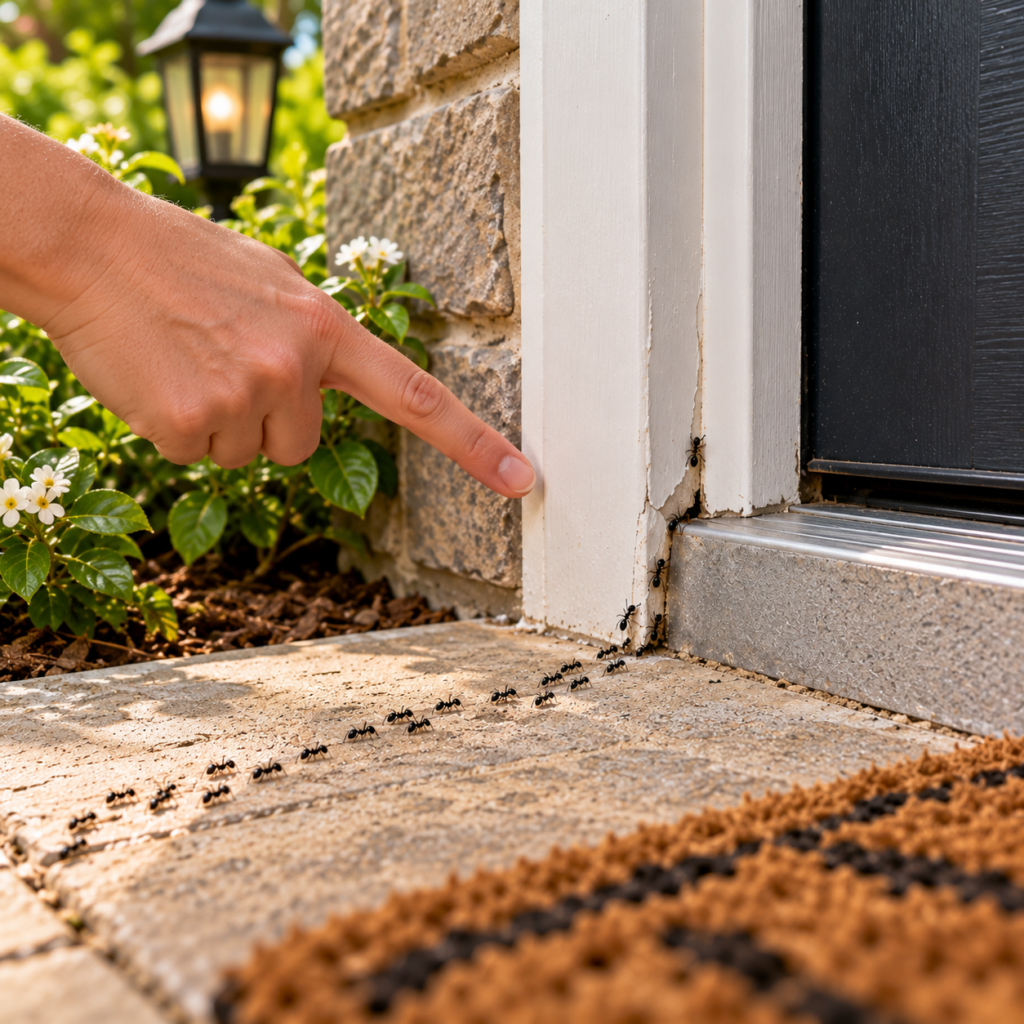
Once the ants disappear, don’t forget about the route they used.
Look for:
- window gaps
- door frames
- baseboards
- pipe penetrations
- cable openings
- cracks
- damaged caulk
Sealing appropriate openings can help prevent another trail from establishing itself.
🌱 How to use this outdoors
Follow the ants outside before sealing their indoor route.
Check:
- foundation cracks
- patio joints
- door thresholds
- outdoor pipes
- window frames
- climbing vegetation
- branches touching the building
Remove unnecessary food sources and trim vegetation where appropriate.
If you discover an anthill, don’t automatically destroy it.
If it isn’t causing a meaningful problem, it may be perfectly reasonable to leave it alone.
If workers from that nest are repeatedly entering the house, however, targeting the colony may make more sense than repeatedly treating your kitchen counter.
💧 5. Remove Water Sources
Everyone thinks about sugar.
Far fewer people think about water.
Ants may repeatedly visit:
- kitchen sinks
- bathrooms
- plumbing areas
- dishwashers
- damp cabinets
Check for:
- dripping faucets
- leaking pipes
- condensation
- standing water
- constantly wet sponges
Repairing unnecessary leaks can make the area less attractive.
🌱 Garden tip
Don’t stop watering your garden.
Instead, look for unnecessary moisture, especially close to the house:
- leaking outdoor faucets
- dripping hoses
- faulty irrigation
- standing water in containers
- constantly wet areas beside foundations
🐜 Should you flood an anthill?
I wouldn’t recommend repeatedly flooding a nest as a standard solution.
An underground colony can contain extensive galleries, and saturating the surrounding soil may damage plants without eliminating the entire colony.
🍯 6. Persistent Ants? Understand How Bait Works
If you’ve cleaned everything and the ants keep returning, the colony itself may need to be addressed.
That’s where a slow-acting ant bait can be much more useful than repeatedly killing workers.
The basic principle is simple.
Workers find attractive food containing an active ingredient and have time to carry it back toward the colony.
This is why effective bait isn’t necessarily supposed to kill workers immediately.
Don’t spray repellent around bait
If you’re trying to attract workers to bait, spraying strong repellents around it can be counterproductive.
Follow the product label and allow ants access to the bait.
🌱 How to use bait around an outdoor colony
When an outdoor nest genuinely needs controlling, choose an ant bait specifically labeled for outdoor use and for the situation you’re treating.
Place it according to its label where active foraging ants can find it.
Don’t randomly scatter pesticide bait throughout the garden.
🐜 What about an anthill?
When label directions permit placement around active trails or nest areas, workers can find the bait and carry it toward the colony.
This can make more sense than immediately destroying the visible mound.
While baiting:
- don’t continually disturb the nest
- don’t block every entrance
- don’t spray repellent around the bait
- remove competing food sources
- give slow-acting bait time to work
And always protect children and pets from access.
🍬 7. Not Every Ant Wants Sugar
Here’s one reason homemade “one recipe kills every ant” tricks often disappoint.
Different ants have different feeding preferences.
Some prefer sugary foods.
Others may be attracted to:
- protein
- fats
- grease
Preferences can also change.
Watch what they’re already eating
Are they surrounding:
🍯 something sweet?
or
🥜 something greasy or protein-rich?
This doesn’t replace species identification, but it can explain why ants completely ignore one bait.
🌱 Garden tip
The same applies outdoors.
Ants feeding on honeydew from aphids may behave very differently from ants searching around an outdoor eating area.
Understanding what they’re seeking can help explain the infestation before you choose a treatment.
🧪 8. What About Borax and Sugar?
Borax deserves more nuance than either “miracle cure” or “complete myth.”
Borax and boric acid are used as active ingredients in some ant baits.
However, that doesn’t mean every homemade borax recipe circulating online is equally effective or safe.
Successful baiting depends on factors such as:
- concentration
- food attractant
- ant species
- placement
- competing food
Too much active ingredient can even undermine the purpose of a slow-acting bait.
⚠️ Safety first
Never leave homemade borax preparations where children or pets can reach them.
Don’t place them on food-preparation surfaces.
For most households, a properly labeled enclosed bait station is simpler and more predictable.
🌱 What about using borax around an anthill?
Don’t scatter borax throughout flower beds, vegetable beds or around plant roots.
Boron can harm plants at excessive concentrations.
If outdoor colony control is necessary, choose a product specifically labeled for outdoor ant control and follow its instructions.
Place bait where the label permits and where active foragers can find it rather than mixing random quantities of borax into the soil.
🌿 9. Diatomaceous Earth: Useful, but Not Magic
Diatomaceous earth has something that coffee grounds and cinnamon don’t: a genuine physical mode of action against crawling insects.
The fine material can damage the protective outer layer of susceptible insects and contribute to dehydration.
But proper use matters.
It needs to remain dry
Moisture reduces its usefulness.
More isn’t necessarily better
Huge piles aren’t required.
When the product label permits, a thin application in targeted dry areas is more sensible.
⚠️ Avoid inhaling the dust
Follow the label and avoid creating airborne clouds of fine powder.
🌱 How to use diatomaceous earth in the garden
If the product is labeled for outdoor ant control, target dry areas where ants actually travel, such as appropriate:
- cracks
- patio edges
- dry entry areas
- ant routes
Rain and irrigation can dramatically limit its usefulness.
🐜 How to use it around an anthill
If permitted by the product label, apply it where active ants are traveling rather than burying the entrance beneath a huge mound of powder.
Ants crossing treated areas may be affected.
But remember:
Killing workers outside the anthill doesn’t guarantee that the queen and entire underground colony have been eliminated.
Avoid unnecessary dusty applications around flowers where pollinators are actively foraging.
♨️ 10. Hot Water on an Anthill: Does It Really Work?
This is one of the oldest natural garden remedies.
Can very hot water kill ants?
Yes—if it actually reaches them.
And that’s the problem.
An anthill visible above ground may represent only a small portion of a much larger underground nest.
Hot water may kill exposed ants and ants in the galleries it reaches while leaving deeper sections of the colony unaffected.
🐜 How people use this method
The traditional method involves carefully applying very hot water directly into the visible nest opening.
But I would reserve this for extremely limited situations.
Why?
Because the same heat that kills ants can also damage:
- grass
- flowers
- vegetables
- roots
- nearby plants
And carrying or pouring boiling water creates a serious burn risk.
🌱 Where I would avoid it completely
Don’t use boiling water around:
- vegetable beds
- valuable flowers
- shrubs
- lawns you want to preserve
- tree roots
If a persistent outdoor colony genuinely requires elimination, identification and appropriately labeled bait are usually more controlled options.
🌱 11. Ants on Your Plants? Check for Aphids First
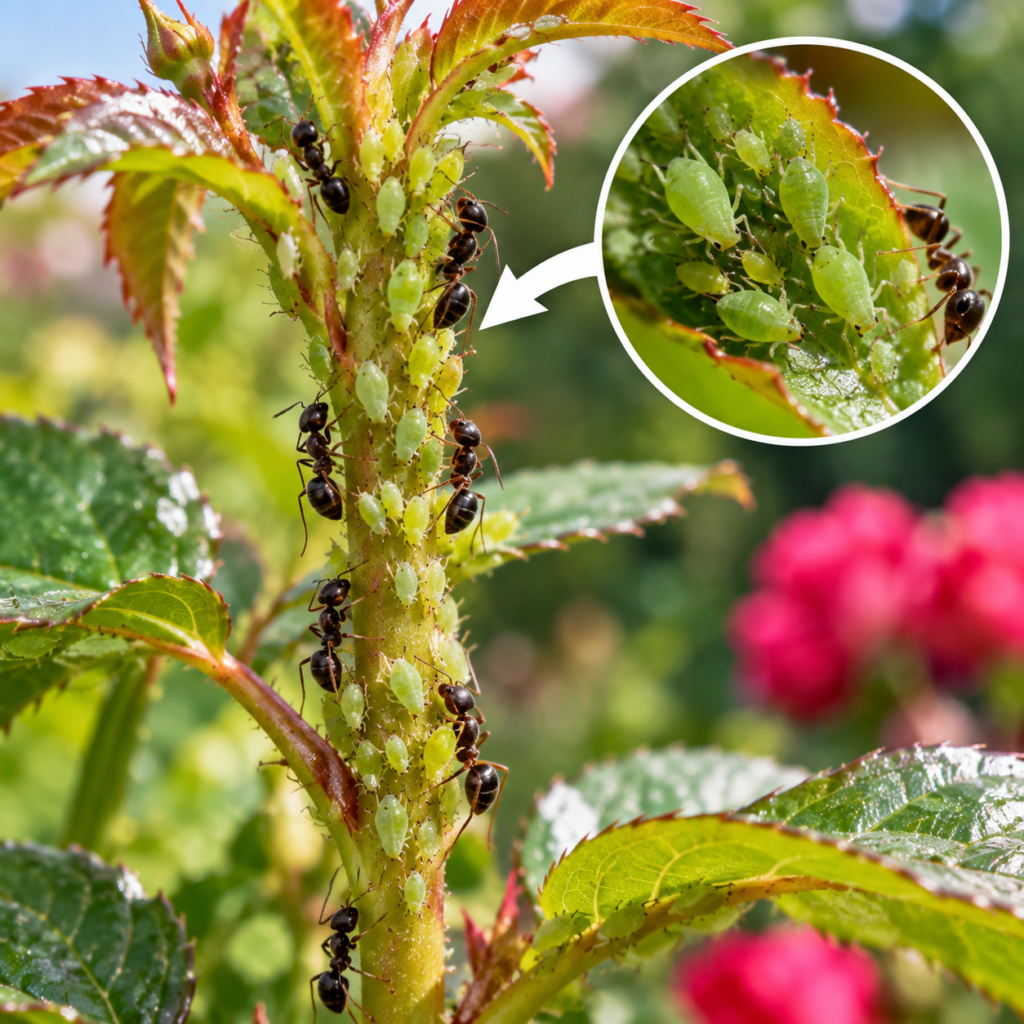
This is one of the most useful garden tips in the entire article.
Suppose dozens of ants are constantly running up and down:
- roses
- tomatoes
- fruit trees
- beans
- ornamental plants
Before treating the ants, inspect the plant.
Look particularly at:
- young shoots
- buds
- stems
- leaf undersides
Search for:
- aphids
- scale insects
- mealybugs
- sticky honeydew
- black sooty mold
Why?
Many sap-feeding insects produce a sugary substance called honeydew.
Ants may feed on it and can even interact with or protect some honeydew-producing insects.
In this situation, the ants may be a clue rather than the original problem.
🌱 What should you do?
For a light aphid infestation on a sturdy plant, use a stream of water to physically knock many aphids off.
Repeat when necessary and monitor the plant.
If additional control is required, consider a treatment specifically labeled for the pest and plant, such as an appropriate insecticidal soap.
🐜 What about the nearby anthill?
Don’t automatically destroy it.
First reduce the honeydew-producing pest.
Once this food source decreases, ant traffic on the plant may also decrease.
You’re addressing why the ants are there, rather than endlessly killing workers.
🌿 12. Peppermint Oil: Strong Smell, Limited Control
Peppermint is one of the most frequently recommended natural ant remedies.
Its strong aroma may temporarily alter where some ants travel.
But that’s very different from proving that peppermint oil can eliminate an established colony.
I would therefore treat peppermint as an optional temporary deterrent, not the foundation of an ant-control strategy.
⚠️ Essential oils aren’t automatically harmless
Concentrated essential oils may pose risks to:
- pets
- children
- sensitive individuals
- certain surfaces
Be especially cautious around pets.
🌱 What about peppermint around an anthill?
I wouldn’t pour peppermint essential oil into garden soil.
Even if ants temporarily avoid the treated entrance, the colony may simply use another exit.
Growing mint because you enjoy it is one thing.
Expecting mint to eliminate a large underground colony is another.
🍋 13. Lemon Juice and Citrus Peels
Another classic Pinterest remedy is lemon.
Strong citrus odors may temporarily change where ants travel, and lemon can be useful for certain household cleaning jobs.
But citrus peels shouldn’t be presented as a dependable colony treatment.
🌱 How people use citrus in the garden
Common methods include putting:
- lemon peels
- orange peels
- citrus-infused water
around ant trails or anthills.
You may notice temporary changes in activity.
🐜 Does it destroy an anthill?
Don’t count on it.
The colony may simply use another entrance or establish another trail.
If you have leftover citrus peels, they’re generally more useful as an appropriate ingredient in a managed compost system than as a supposed ant pesticide.
☕ 14. Coffee Grounds Against Ants: Better in the Compost
This trick appears everywhere.
The usual advice is to sprinkle used coffee grounds:
- around plants
- across ant trails
- around an anthill
The strong smell and physical disturbance may temporarily alter where ants travel.
But that is not the same as eliminating an underground colony.
🌱 How should you use coffee grounds?
If you want to experiment with a small amount around a non-sensitive hard outdoor area, don’t interpret ants changing direction as proof that the nest has died.
For the garden, there’s a much better destination:
your compost pile.
Add reasonable quantities of used grounds to a balanced compost system along with other materials.
🐜 Coffee grounds on an anthill?
I wouldn’t bother.
The colony can often continue using other passages.
Useful compost ingredient ≠ effective ant killer.
🌿 15. Cinnamon, Cloves, Mint and Lavender
These remedies are attractive because they smell pleasant and seem harmless.
Common suggestions include putting:
- cinnamon
- cloves
- mint
- lavender
- aromatic herbs
along ant trails and around entrances.
Strong odors may temporarily influence where ants travel.
But again:
avoidance isn’t colony elimination.
🌱 How to use them in the garden
There’s nothing wrong with growing mint, lavender and other aromatic plants because you enjoy them.
You can also experiment with aromatic materials as a temporary deterrent in appropriate locations.
Just don’t depend on them to control a serious infestation.
🐜 What happens if you put cinnamon around an anthill?
Ants may avoid that particular entrance.
But an underground colony can have more than one route.
Workers may simply emerge somewhere else.
So I wouldn’t keep adding cinnamon, cloves or essential oils to an anthill expecting the queen and colony to disappear.
🥄 What About Baking Soda + Sugar?
This viral recipe deserves its own section because it’s everywhere.
The usual claim is:
Sugar attracts the ants and baking soda kills them.
It sounds simple.
But I wouldn’t recommend it as a dependable colony-control strategy.
Ant feeding preferences vary, and a homemade baking-soda mixture isn’t equivalent to a properly formulated slow-acting ant bait.
🌱 What about sprinkling it around an anthill?
I wouldn’t make this my garden strategy either.
If an outdoor colony truly needs treatment, correctly identifying the problem and using an appropriately labeled treatment is far more predictable than repeatedly sprinkling kitchen ingredients around the mound.
🐜 I Found an Anthill — What Should I Actually Do?
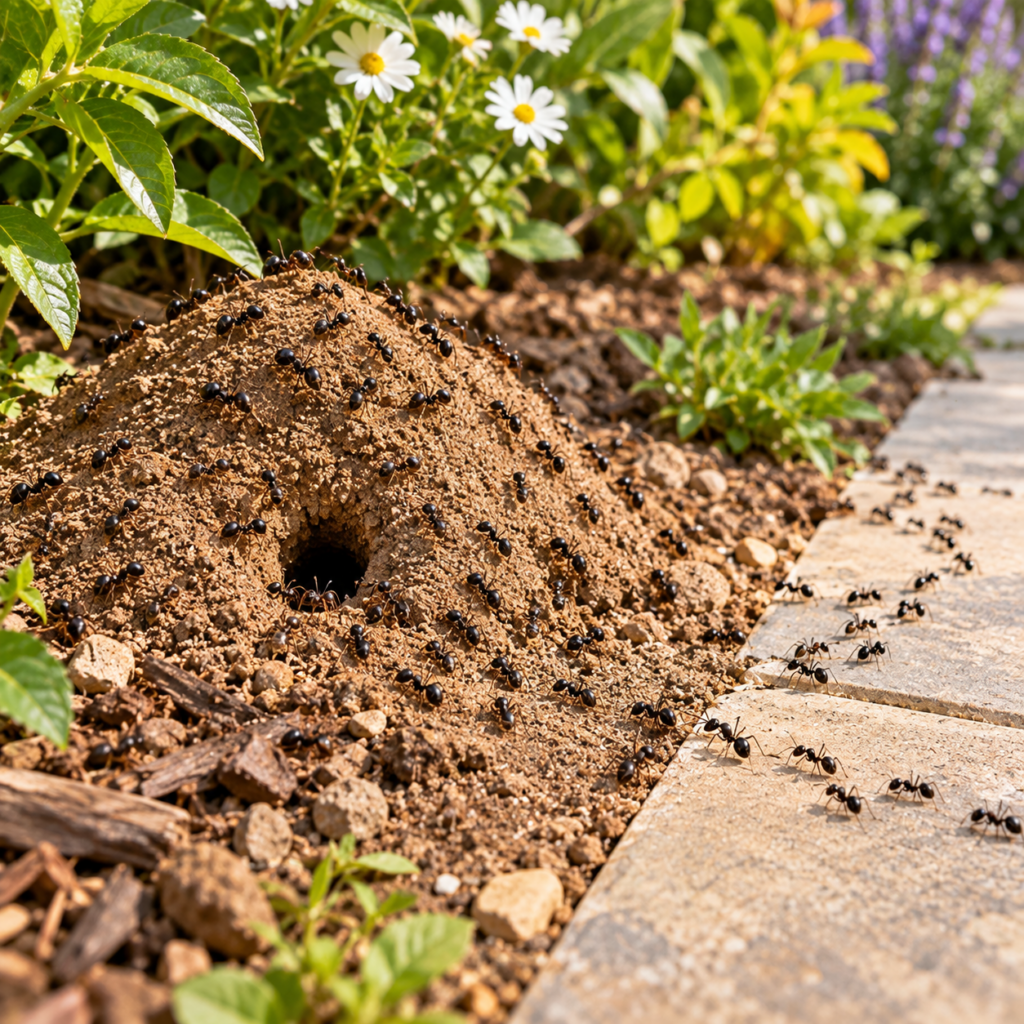
This is probably the question many garden readers really want answered.
First, don’t automatically reach for a treatment.
Ask:
Is this anthill actually causing a problem?
If it’s in an unused corner of the garden and the ants aren’t entering your house, damaging something important or creating another meaningful problem, you may simply leave it alone.
Ants are normal members of outdoor ecosystems.
If the anthill IS causing a problem
Use this order:
1. Follow the trails
Determine where the workers are going.
Are they entering your house?
Feeding around your patio?
Climbing an aphid-covered plant?
2. Remove competing food
Clean:
- outdoor eating areas
- sugary spills
- pet-food residue
- overflowing trash
- dirty recycling
3. Inspect nearby plants
Look for aphids, scale and mealybugs.
Treating the honeydew-producing pest may substantially reduce ant traffic.
4. Don’t immediately destroy the nest entrance if you’re going to bait
You want active workers to continue finding the bait.
5. Choose an appropriate outdoor ant bait when colony control is necessary
Follow its label carefully.
Place it only where instructed and where active foragers can reach it.
6. Don’t spray repellent around the bait
That can discourage ants from reaching what you’re trying to get them to consume.
7. Give it time
Slow-acting colony bait isn’t designed to create an instant pile of dead workers.
8. Prevent the next problem
Once activity has stopped, deal with:
- food sources
- moisture
- cracks
- entry routes into the house
🌿 Quick Garden Guide: What Should I Use?
Ants crossing the patio:
Clean food residue and trails. Mild soapy water can be useful on compatible hard surfaces.
Ants entering the house from outside:
Follow the trail, remove food/water sources, identify entry points and seal appropriate gaps.
Ants constantly climbing a plant:
Check for aphids, scale or mealybugs first.
Small aphid infestation:
Try physically removing aphids with water on suitable sturdy plants.
Anthill in an unused garden corner:
Consider leaving it alone.
Problem anthill repeatedly supplying ants indoors:
Consider an appropriately labeled outdoor colony bait.
Anthill beside valuable plants:
Avoid vinegar, salt and boiling water that could injure the vegetation.
Dry ant routes or cracks:
Properly labeled diatomaceous earth may be an option when conditions and the label allow.
❌ 8 Common Ant-Control Mistakes
1. Killing only the ants you see
Visible workers may represent only a small part of the colony.
2. Leaving food available while baiting
Ants have little reason to choose bait if easier food is everywhere.
3. Spraying repellent around bait
You’re trying to attract ants to the bait, not drive them away from it.
4. Expecting bait to work instantly
Slow action can be part of how colony bait works.
5. Assuming every ant wants sugar
Different ants can have different feeding preferences.
6. Ignoring moisture
Fix unnecessary leaks indoors and outdoors.
7. Treating every outdoor ant as a pest
An anthill in the garden doesn’t automatically require treatment.
8. Assuming “natural” means harmless
Vinegar can damage plants and surfaces.
Boiling water can cause serious burns.
Essential oils can create risks for pets.
Diatomaceous-earth dust shouldn’t be inhaled.
Borax shouldn’t be scattered casually through garden soil.
Natural methods still need to be used intelligently.
🪵 When Ants Could Signal a More Serious Problem
Most household ants are mainly annoying.
But some situations deserve more attention.
One example is carpenter ants.
Carpenter ants don’t eat wood like termites. They excavate galleries in wood for nesting and are often associated with damp or damaged wood.
Possible warning signs include:
- unusually large ants indoors
- repeated activity from a wall or wooden area
- sawdust-like debris
- moisture-damaged wood
- persistent indoor activity
- ants emerging from structural timber
If you suspect carpenter ants—or can’t tell whether you’re seeing ants or termites—professional identification can be worthwhile.
Correcting moisture problems is particularly important.
🏠 My Simple 8-Step Routine for Ants in the Kitchen
If I discovered an ant trail tomorrow morning, here’s what I would actually do.
Step 1: Watch the ants and determine where they’re going.
Step 2: Remove the food or water attracting them.
Step 3: Clean visible ants and the trail with mild soapy water on compatible surfaces.
Step 4: Check for leaks and moisture.
Step 5: Find the likely entry point.
Step 6: Seal appropriate gaps.
Step 7: If ants continue returning, identify the ant and investigate the source.
Step 8: When colony control is necessary, use an appropriately labeled bait and give it time to work.
Simple.
And much more logical than filling the kitchen with coffee grounds, cinnamon, lemon peels and baking soda simultaneously.
🌱 My Simple Routine for Ants in the Garden
Outside, I would do things slightly differently.
Step 1: Determine whether the ants actually need treatment.
Step 2: If they’re climbing plants, check for aphids, scale and mealybugs.
Step 3: Remove unnecessary outdoor food and water sources.
Step 4: Follow trails toward the house and block appropriate entry routes.
Step 5: Leave harmless colonies alone when possible.
Step 6: If an anthill genuinely needs controlling, identify the ants and choose an appropriate treatment rather than automatically pouring household ingredients into the soil.
❓ Frequently Asked Questions
Does soapy water really work against ants?
Soapy water is useful for dealing with exposed ants and, importantly, for cleaning the surfaces and trails they’re using.
It generally won’t eliminate a colony hidden somewhere else.
Is soapy water better than vinegar?
For routine household cleaning, I would start with mild soapy water.
It cleans food residue and trails without requiring another special ingredient.
Diluted vinegar can also be useful on compatible surfaces, but it isn’t necessary for every ant problem.
Can I pour soapy water into an anthill?
I wouldn’t recommend routinely flooding garden soil with household detergent.
It may affect plants and other organisms without reliably reaching the entire colony.
Does vinegar get rid of ants?
Vinegar can be useful for cleaning trails and temporarily disrupting activity on compatible surfaces.
Don’t expect it to eliminate an established hidden colony.
Can I pour vinegar into an anthill?
I wouldn’t, particularly around desirable vegetation.
Vinegar can damage plants, and reaching the visible nest entrance doesn’t guarantee that the entire colony will be affected.
What is the best natural first step?
For indoor ants:
Remove food → clean with mild soapy water → remove water → locate the entry route.
For garden ants:
Determine why they’re there → check plants for aphids → remove unnecessary attractions → decide whether the colony actually needs treatment.
Why do ants keep coming back after I clean?
Because cleaning workers doesn’t necessarily eliminate the colony.
They may also discover another food source, water source or entrance.
Why are ants covering my plants?
Check for honeydew-producing pests such as aphids, scale insects and mealybugs.
The ants may be feeding on their sugary secretions rather than attacking the plant itself.
Should I destroy an anthill in my garden?
Not necessarily.
If it’s away from the house and isn’t creating a meaningful problem, leaving it alone can be reasonable.
Does boiling water kill an anthill?
Very hot water can kill ants it reaches, but a deep colony may survive.
It can also damage vegetation and presents a serious burn hazard, so it isn’t my preferred general garden treatment.
Does diatomaceous earth work on ants?
It can affect ants and other crawling insects through physical action when used correctly and kept dry.
However, killing exposed workers doesn’t automatically eliminate the underground colony.
Follow the product label carefully and avoid inhaling the dust.
Do coffee grounds get rid of an anthill?
I wouldn’t rely on them.
Coffee grounds may disturb ant activity temporarily, but that’s different from eliminating the colony.
They’re generally more useful in a balanced compost pile.
Does cinnamon kill an ant colony?
Don’t count on it.
Strong odors may cause ants to avoid one route, but the colony may simply use another entrance.
Are essential oils safe around pets?
Not automatically.
Some concentrated essential oils can be harmful or irritating to animals and people.
Natural origin doesn’t guarantee safety.
Why aren’t ants eating my bait?
The bait may not match their current food preference, competing food may be available, or it may not be suitable for that species.
Should I kill ants while they’re feeding on bait?
When using a slow-acting bait according to its label, generally leave feeding workers alone so they can return toward the colony.
When should I call a pest-control professional?
Consider professional help when:
- the infestation persists despite appropriate measures
- you can’t locate the source
- the nest appears to be inside a structure
- you suspect carpenter ants
- structural wood may be affected
- you can’t distinguish ants from termites
- the infestation is extensive
🐜 Final Takeaway: Don’t Search for One Miracle Ingredient
If you remember only one thing from this guide, make it this:
Don’t focus only on killing the ants you can see.
Inside the house, start with mild soapy water, thorough cleaning, moisture control and entry-point prevention.
Outside, first determine whether the ants are actually causing a problem.
If they’re climbing your plants, look for aphids and other honeydew-producing pests.
If you find an anthill, don’t automatically pour vinegar, detergent, coffee grounds or boiling water into it. A harmless colony can often be left alone. When a colony genuinely needs controlling, identification and an appropriately selected bait are usually much more sensible than repeatedly experimenting with kitchen ingredients.
Vinegar can help clean trails.
Diatomaceous earth has a legitimate physical mode of action when used correctly.
Coffee grounds, cinnamon, citrus and peppermint may sometimes alter ant activity—but they shouldn’t be presented as guaranteed colony killers.
The internet loves a one-ingredient miracle.
Real ant control works better when you understand why the ants are there first. 🐜🌿