

Every night, millions of people follow the same routine: check the windows, turn off the lights, lock the front door, and head to bed.
But there’s one small detail that many homeowners overlook: what happens to the key after the door is locked?
Some people remove it immediately. Others leave it in the lock, believing that an inserted key makes the door harder to open from outside.
And then there’s a surprising locksmith trick circulating online: leave the key in the lock and turn it slightly before going to sleep.
It sounds almost too simple. Could the position of your key really make a difference to your home’s security?
The answer is more complicated than you might expect.
Depending on the type of lock installed on your door, leaving a key inside may affect how the cylinder operates. In some situations, it could create an additional obstacle to external operation. In others, it may interfere with emergency access or provide no meaningful security benefit at all.
Before trying this popular nighttime security trick, here’s what you should know.
🔑 Why Some People Leave Their Keys in the Door Overnight

Leaving a key in the inside lock is a common habit, especially in homes equipped with traditional double-key cylinder locks.
Homeowners generally do it for three reasons.
1. They believe it prevents unlocking from outside
On certain double-cylinder locks, inserting a key on the inside can prevent another key from operating the cylinder from the opposite side.
However, this behavior depends entirely on the cylinder’s design.
Some modern cylinders include an emergency or double-clutch function that allows the door to be unlocked from outside even when another key remains inserted inside.
Important: An inserted key is not a substitute for a properly secured, high-quality lock.
2. They want their key ready in an emergency
During a nighttime emergency, knowing exactly where your key is located can help you avoid searching for it in the dark.
But accessibility matters more than simply leaving the key inside the cylinder.
If a key becomes difficult to turn, the lock jams, or someone outside needs to provide assistance, leaving it inserted could create additional complications.
3. They have always done it that way
Sometimes, the explanation is simply habit.
Many people grow up seeing family members leave their keys in the front door every night without ever questioning whether the practice is safe.
Yet not every door or lock works the same way.
🔄 The Viral Quarter-Turn Key Trick: Does It Really Work?

One popular security tip suggests leaving the key inserted in the inside lock and rotating it slightly—sometimes described as a quarter-turn.
The theory is that moving the key away from its normal position changes the cylinder’s internal alignment and makes certain forms of external manipulation more difficult.
But there’s an important distinction between a technique demonstrated on a particular lock and a security recommendation suitable for every home.
What actually happens inside a lock?
In a typical pin-tumbler cylinder, the correct key positions internal components so the cylinder can rotate.
As the key turns, the cylinder’s plug and associated mechanisms move according to the lock’s design.
However, the effects of stopping that rotation partway through depend on several factors:
- The cylinder’s internal construction
- Whether the lock supports operation from both sides
- The position of the locking cam
- Whether the door uses a multipoint locking mechanism
- The manufacturer’s intended operating positions
A partially rotated key does not automatically make a lock resistant to burglary.
In some systems, leaving the key between its normal operating positions may even create problems.
Could the quarter-turn trick damage your lock?
Not necessarily, but it should not be assumed safe for every cylinder.
Some locks are designed to operate smoothly through their normal rotation cycle. Others may behave differently when a key is deliberately left in an intermediate position.
If the manufacturer does not recommend this practice, avoid experimenting with it.
The safer approach: Fully lock your door using its intended mechanism, then follow the manufacturer’s instructions regarding whether the key should remain inserted or be removed.
If you’re unsure, ask a qualified locksmith to identify your cylinder and explain its operating features.

🚪 Not All Door Locks Behave the Same Way
Understanding your lock is far more useful than following a viral security trick.
Here are four common lock configurations and what homeowners should consider.
1. Traditional double-key cylinder locks
These locks use a key on both sides of the door.
On some models, a key inserted inside prevents another key from operating the lock from outside.
This can create difficulties when another household member returns home or when emergency assistance is required.
The exact behavior varies between manufacturers.
2. Cylinders with an emergency function
Some European-profile cylinders are designed to operate from outside even when a key remains inserted inside.
This feature is sometimes called an emergency function, priority function, or double-clutch mechanism.
It can be useful in households where residents may accidentally leave keys in the door.
However, this feature alone does not establish the cylinder’s overall burglary resistance.
3. Thumb-turn cylinders
A thumb-turn lock uses a rotating knob on the inside rather than requiring a removable key.
This can make everyday operation and emergency evacuation easier.
For suitable doors, a properly specified thumb-turn cylinder can be a practical option.
However, the inside knob must not be reachable through nearby glazing, letterboxes, or other vulnerable openings.
4. Multipoint locking systems
Multipoint locks secure a door at several locations along the frame.
They are common on modern uPVC, composite, and some wooden doors.
Some systems require the handle to be lifted before the key completes the locking operation.
If you skip that step, the door may not be secured as intended.
Always follow the correct locking sequence for your specific door.
🚨 The Hidden Risk of Leaving a Key in the Lock at Night
The biggest concern isn’t always burglary.
It’s what happens when someone needs to get through the door quickly.
Emergency evacuation
During a fire or other emergency, everyone inside the home should be able to open the main exit quickly.
A lock that requires searching for a missing key can create a dangerous delay.
For this reason, appropriate keyless internal-release hardware is often preferable on designated escape doors, subject to local building and fire-safety requirements.
If your door requires a key to open from inside, seek professional advice about safer options.
Emergency access from outside
Imagine that someone inside becomes seriously ill or cannot reach the front door.
If a key left inside prevents the lock from operating from outside, relatives or emergency responders may face additional obstacles.
This is particularly relevant for homes occupied by older adults, people with limited mobility, or anyone who may need urgent assistance.
Doors with glass panels

A key left within reach of a nearby glass panel may create an additional security risk.
Someone who gains access through a broken or compromised pane might be able to operate the lock from inside.
The appropriate solution depends on the door design, glazing, lock configuration, and emergency-exit requirements.
Avoid relying on a simple rule such as always leaving the key in place or always removing it.
🛡️ 7 Smart Ways to Make Your Front Door More Secure at Night
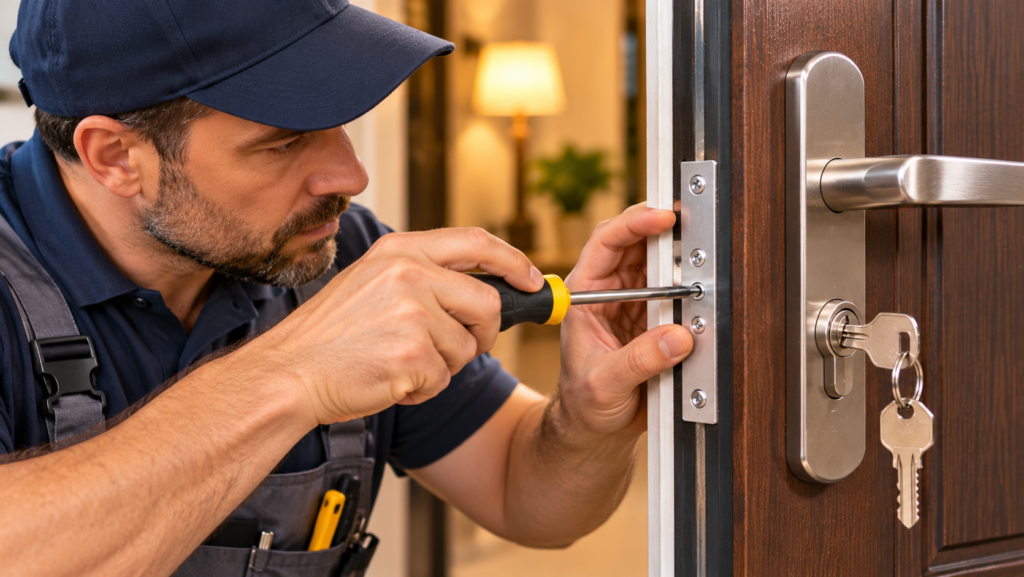
Instead of depending on a single locksmith trick, focus on improvements that address common weaknesses.
1. Make sure your door is fully locked
A closed door is not necessarily a locked door.
Before going to bed, check that the locking mechanism has engaged correctly.
For multipoint locks, follow the manufacturer’s instructions for operating the handle and key.
2. Choose a security-rated cylinder
If your door uses a Euro-profile cylinder, consider a professionally fitted model with appropriate security certification.
In the United Kingdom, examples of relevant standards include TS 007 and Sold Secure SS312.
The right certification depends on the cylinder, accompanying hardware, and local requirements.
A locksmith can help you select compatible components.
3. Reinforce the door and frame
Even a good lock depends on the strength of the surrounding door and frame.
Inspect the hinges, strike plate, frame, and other fittings.
Loose screws, damaged wood, or a poorly aligned door can reduce the effectiveness of the locking system.
Use suitable reinforcement hardware installed according to the door manufacturer’s specifications.
4. Keep entry points well lit
Motion-activated outdoor lighting can improve visibility around entrances.
It may also discourage some opportunistic activity by making movement near the door more noticeable.
Place lighting where it covers entrances and access paths without creating unnecessary glare.
5. Consider a video doorbell or security camera

A video doorbell can help you identify visitors without opening the door.
Some models also provide motion notifications and recorded footage.
Choose devices with appropriate privacy and security settings, including strong account passwords and software updates.
6. Keep windows and secondary doors secure
A strong front door offers limited protection if another entrance is left unsecured.
Check accessible windows, patio doors, garage entrances, and back doors before going to sleep.
Pay particular attention to openings that are hidden from public view.
7. Make emergency escape part of your security plan
A secure home must also be safe to leave.
Make sure household members understand how to unlock and open the main exit.
Keep escape routes clear, maintain smoke alarms, and consider whether any door hardware could delay evacuation.
The best nighttime security routine protects against unauthorized entry without trapping people inside.
❌ 7 Common Front Door Security Mistakes

Even careful homeowners can overlook simple problems.
Mistake 1: Assuming a key left inside guarantees protection
An inserted key may affect certain cylinders, but it does not automatically prevent forced entry or other attacks.
Mistake 2: Leaving the key partially turned without checking compatibility
An intermediate key position is not universally recommended and may interfere with normal lock operation.
Mistake 3: Using a cheap replacement cylinder
A low-quality or unsuitable cylinder may undermine an otherwise sturdy door.
Choose hardware appropriate to the door and the relevant security standards.
Mistake 4: Ignoring the door frame
Locks, hinges, strike plates, and frames work together.
A damaged frame can compromise the entire assembly.
Mistake 5: Leaving keys visible near glass
Keys should not be easily accessible through nearby glazing or other openings.
At the same time, emergency escape must remain straightforward.
Mistake 6: Forgetting to engage multipoint locks correctly
Some doors require a specific sequence to activate all their locking points.
Follow the manufacturer’s instructions rather than assuming that closing the door is sufficient.
Mistake 7: Focusing only on burglary prevention
Security improvements should never make emergency evacuation unnecessarily difficult.
A well-designed door balances resistance to unauthorized entry with safe exit.
🏠 What Should You Actually Do With Your Key Before Bed?
There is no universal answer.
The best practice depends on your door, lock, household needs, and local safety requirements.
| Lock or door type | What to consider |
|---|---|
| Traditional double-key cylinder | Check whether an inside key blocks outside operation and whether safe evacuation is possible |
| Emergency-function cylinder | Confirm its intended operation and follow manufacturer guidance |
| Thumb-turn cylinder | Ensure easy internal operation and assess nearby glazing or openings |
| Multipoint locking door | Follow the complete locking sequence |
| Door with nearby glass | Assess whether internal unlocking hardware can be reached from outside |
For many households, a professionally selected lock that can be opened quickly from inside—without sacrificing appropriate resistance to unauthorized entry—is a better long-term solution than relying on key-position tricks.
If you don’t know which cylinder is installed, a qualified locksmith can usually identify it and explain your options.

❓ Frequently Asked Questions
Should I leave my key in the front door lock overnight?
Not automatically. Some cylinders behave differently when a key remains inserted, and the practice may affect emergency access. Follow the manufacturer’s guidance and ensure that occupants can exit quickly.
Does leaving a key in the lock stop burglars?
Not reliably. It may affect external key operation on certain cylinders, but it does not guarantee protection against burglary or forced entry.
Does turning the key a quarter-turn make the lock safer?
There is no universal evidence that this technique improves security across different lock designs. Its effect depends on the cylinder, and leaving a key partially rotated may be unsuitable for some mechanisms.
Can someone unlock my door from outside if a key is already inside?
On some cylinders, yes. On others, an inserted inside key can interfere with external operation. Cylinders with an emergency or double-clutch function are specifically designed to address this issue.
Is a thumb-turn lock safer than leaving a key in the door?
A suitable thumb-turn lock can make emergency exit easier because no removable key is needed from inside. However, its security depends on the overall door design, installation, and whether the knob can be reached from outside.
What is the most important thing to check before going to bed?
Make sure your door is fully locked according to its manufacturer’s instructions, accessible windows are secured, and everyone in the household can open the exit quickly in an emergency.
How can I tell whether my lock has an emergency function?
Check the cylinder’s model information or ask the manufacturer or a qualified locksmith. Do not assume that all Euro-profile cylinders have the same features.
🌙 Final Thoughts: The Best Security Trick Is Knowing Your Lock
The idea of leaving a key slightly turned in the front door sounds appealing because it promises extra protection without spending money.
But home security is rarely that simple.
A key left inside—or turned to an unusual position—is not a universal burglary-prevention method.
What matters most is using a suitable, properly installed lock, following its intended operating procedure, and making sure the door can be opened quickly in an emergency.
Before copying a viral locksmith trick, take a moment to identify the type of lock protecting your home.
That small step could be more valuable than any supposed secret technique.
What is your nighttime routine? Do you remove your key after locking the door, leave it inside, or use a thumb-turn lock? Share your experience in the comments! 🔐