
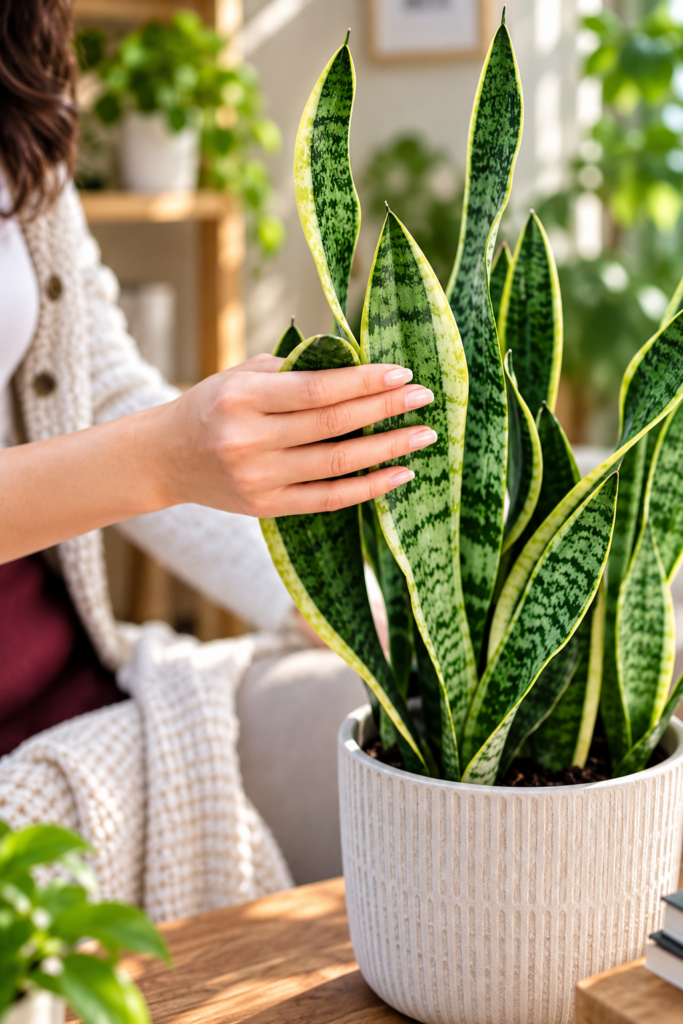
Snake plants are famous for being tough. They tolerate missed waterings, less-than-perfect lighting, and a surprising amount of neglect. So when a viral gardening trick promises that a little lemon juice will make a snake plant “grow like crazy,” it naturally sounds worth trying.
But should you actually pour lemon juice into your snake plant’s pot?
The answer is more nuanced than many viral posts suggest. Lemon juice is acidic and can temporarily lower pH, but it is not a growth booster, fertilizer, or proven miracle treatment for snake plants. In fact, routinely adding acid when your plant doesn’t need it may create a new problem rather than solve one.
The good news? There are much safer—and often more effective—ways to encourage healthy leaves, new shoots, and strong roots. 🌱
Below, we’ll separate what’s true from what’s exaggerated, then look at practical natural alternatives that can genuinely improve snake plant care.
Quick answer: Don’t routinely add lemon juice to a healthy snake plant. Focus first on drainage, correct watering, adequate light, sensible feeding, and pest prevention.
🌿 First: What Is a Snake Plant?
The plant commonly called snake plant or mother-in-law’s tongue is Dracaena trifasciata, formerly classified as Sansevieria trifasciata.
It is a succulent-like perennial with thick, leathery leaves and underground rhizomes. One reason it has become such a popular houseplant is its ability to tolerate relatively dry conditions and a wide range of indoor environments.
But “tolerant” does not mean indestructible.
One of the biggest mistakes is keeping the roots constantly wet. North Carolina Extension specifically emphasizes well-drained soil and allowing the soil to dry between waterings because overwatering can lead to root rot.
And that brings us to the viral lemon trick.
🍋 Does Lemon Juice Really Help Snake Plants Grow Faster?
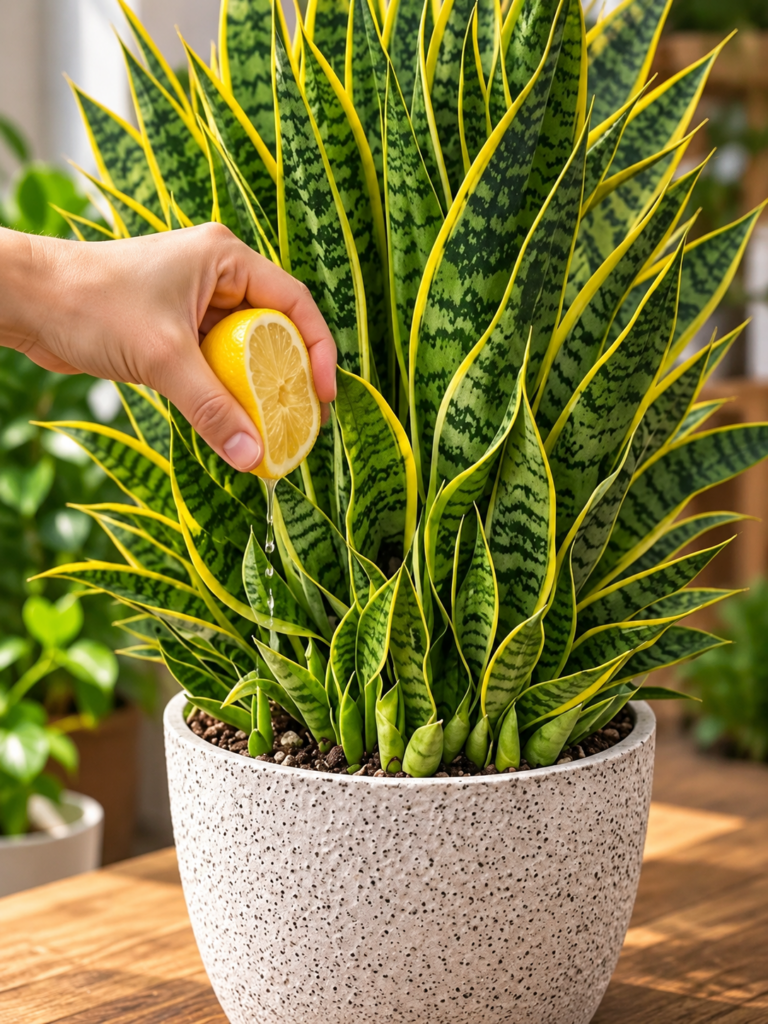
Verdict: 🟡 There is a grain of truth—but the claim is exaggerated.
Lemon juice contains citric acid, so adding it to water can lower the water’s pH.
This is where the internet trick originates.
The argument usually goes like this:
lemon juice → lower pH → better nutrient absorption → faster snake plant growth
Unfortunately, plant care isn’t quite that simple.
North Carolina Extension lists snake plants as tolerating neutral and even alkaline soil conditions, rather than requiring highly acidic soil.
So there is no good reason to routinely acidify the soil of a healthy snake plant.
When could acidification potentially make sense?
If you have unusually alkaline irrigation water or a documented substrate-pH problem, adjusting water chemistry may sometimes be appropriate.
But that should ideally be based on a pH test, not on the assumption that every snake plant needs lemon.
And lemon juice still wouldn’t be my preferred long-term solution because its acidity is difficult to standardize.
🚫 What lemon juice does NOT do
There is no convincing evidence that periodically pouring lemon juice into the pot will automatically:
- produce new shoots faster,
- strengthen roots,
- make leaves dramatically greener,
- act as a complete fertilizer,
- or make a healthy snake plant “grow like crazy.”
Think of pH correction and fertilization as two completely different things.
Lemon juice is not plant food.
⚠️ Should You Rub Lemon Juice on Snake Plant Leaves?
This is another popular version of the hack.
The idea is that diluted lemon juice removes dust and mineral spots while making leaves glossy.
I would skip it.
Snake plant leaves don’t require lemon juice to remain healthy. If they’re dusty, the simplest solution is usually also the best:
💧 A safer leaf-cleaning method
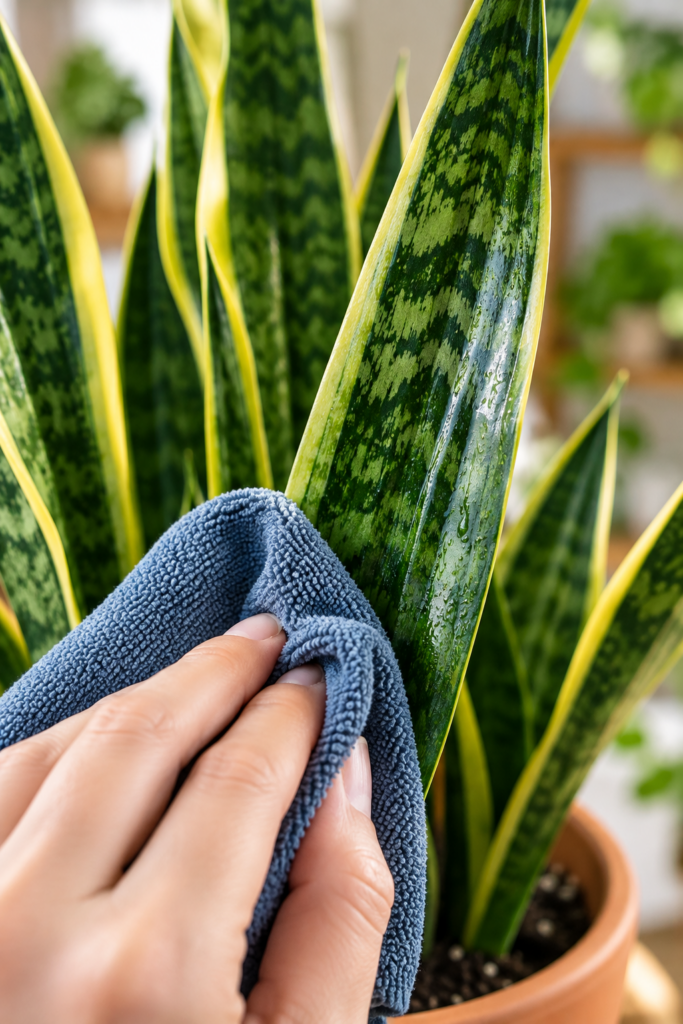
- Dampen a soft microfiber cloth with clean water.
- Support the leaf gently with one hand.
- Wipe from the base toward the tip.
- Wipe both sides if necessary.
- Let the foliage dry naturally away from intense direct sunlight.
That’s it.
You don’t need acidic juice, mayonnaise, milk, commercial leaf-shine mixtures, or other viral ingredients to make a snake plant healthy.
🐛 Does Lemon Juice Kill Aphids or Thrips?
Verdict: 🔴 Don’t rely on it.
Another claim circulating online is that acidic lemon water keeps aphids and thrips away.
There are far better-supported approaches.
UC Integrated Pest Management recommends washing certain houseplant pests from leaves with water, removing badly infested plant material, and, when necessary, using an appropriately labeled insecticidal soap or horticultural oil. These approaches are recommended for pests including aphids and thrips.
So rather than repeatedly coating your snake plant in acidic lemon water, try this approach.
🐜 Natural Pest-Control Routine for Snake Plants
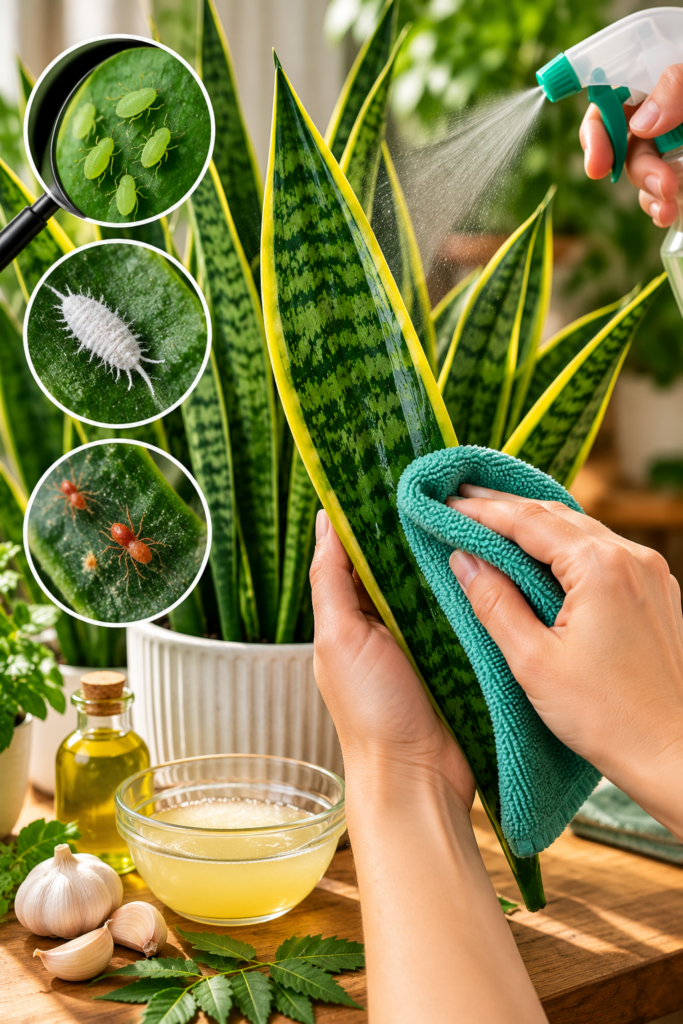
If you notice insects, sticky residue, silvery damage or suspicious specks, don’t immediately reach for a kitchen concoction.
Step 1: Isolate the plant 🚪
Move the affected plant away from your other houseplants.
This reduces the chance of pests spreading.
Step 2: Identify the pest 🔎
Look closely at:
- leaf undersides,
- leaf bases,
- crevices,
- new growth,
- and the surface of the potting mix.
Different pests require different treatment.
Step 3: Start with plain water 💦
For aphids and some other exposed soft-bodied pests, washing or physically removing insects can be surprisingly useful.
UC IPM specifically includes washing among its management strategies for houseplant pests.
Step 4: Use insecticidal soap when necessary 🧴
If washing isn’t enough, consider a commercial insecticidal soap labeled for indoor plants and the pest involved.
This distinction matters.
University of Minnesota Extension cautions against simply mixing homemade household soap products because they can injure plants.
Step 5: Consider horticultural oil or an appropriate neem product 🌿
These can be useful against certain houseplant pests when the product is labeled for the particular plant and pest.
Follow the label carefully and test sensitive plants before widespread application. UC IPM lists soaps and horticultural oils among lower-toxicity choices for several soft-bodied pests.
🌱 9 Tricks That Actually Help a Snake Plant Grow Better
Forget the miracle ingredient. If you want a fuller, healthier snake plant, these fundamentals make a much bigger difference.
☀️ 1. Give It More Light—Without Suddenly Scorching It
Snake plants have a reputation as “low-light plants.”
That’s slightly misleading.
They can survive low-light conditions, but that doesn’t necessarily mean low light produces their best growth.
North Carolina Extension notes that snake plants tolerate low light but can also receive several hours of direct sunlight under appropriate conditions.
For many indoor plants, a bright location can encourage stronger growth than a dark corner.
Try this:
Move a snake plant from a very dark location to a brighter position gradually rather than suddenly exposing it to intense sun.
🌱 Growth tip: If your plant looks healthy but hasn’t produced a new leaf in ages, inadequate light may be more relevant than a missing kitchen ingredient.
💧 2. Let the Soil Dry Between Waterings
This is arguably more important than almost any “secret fertilizer.”
Snake plants store water in their thick leaves and tolerate drought considerably better than permanently wet roots.
North Carolina Extension recommends allowing the soil to dry between waterings and watering very sparingly during winter.
The finger test 👆
Push your finger into the substrate.
If significant moisture remains deeper in the pot, don’t automatically water simply because your calendar says it’s “watering day.”
Check the plant instead of the date.
⚠️ Common mistake
A little water every few days can be worse than a thorough watering followed by a proper drying period.
🪴 3. Improve Drainage Before Adding Fertilizer
If water sits around the roots for too long, no amount of lemon juice, banana peel water or coffee grounds will fix the underlying problem.
Use:
- a container with drainage holes,
- a well-draining potting medium,
- and a pot that isn’t unnecessarily oversized.
Good drainage is explicitly identified as important for snake plants.
If your current soil remains wet for an unusually long time, correcting the substrate may provide a much bigger improvement than adding another ingredient.
🌧️ 4. If Your Tap Water Is a Problem, Change the Water—Not the Plant
Visible mineral buildup around the pot or soil can sometimes occur with hard water.
Instead of automatically adding lemon juice, a simpler approach is to occasionally use suitable rainwater or filtered water, particularly if your local tap water is very mineral-rich.
And if you genuinely suspect a pH issue?
🧪 Test first.
A basic pH test gives you far more useful information than blindly adding an acid.
Measure → diagnose → correct.
Not:
TikTok hack → pour → hope.
🌿 5. Feed Lightly During Active Growth
Here’s another important point that gets lost in viral “natural fertilizer” recipes:
Plants require a range of nutrients.
Lemon juice doesn’t provide a balanced nutrient supply.
Neither does banana-peel water, coffee alone, or one random kitchen ingredient.
If your snake plant genuinely needs feeding, a balanced houseplant fertilizer used conservatively according to its label is generally more predictable than homemade mixtures.
More fertilizer does not mean more growth.
Excess fertilizer can contribute to salt buildup and root stress.
🌱 6. Divide a Mature Plant for an Instant Fuller Look
Want a “bigger” snake plant without waiting months for a miracle ingredient?
Use the plant’s natural growth habit.
Snake plants spread through underground rhizomes and can be propagated by division. North Carolina Extension lists division and cuttings as propagation methods.
When a mature plant develops multiple clusters, carefully dividing and repotting them can give you additional plants.
Or combine suitable divisions to create a fuller-looking arrangement.
That’s a real plant hack. 🌱🌱🌱
🧽 7. Keep the Leaves Clean
Dust doesn’t mean your plant needs lemon juice.
Periodically wiping large leaves with a damp cloth keeps them clean and also gives you a perfect opportunity to inspect for:
- scale,
- mealybugs,
- spider mites,
- thrips,
- discoloration,
- soft areas,
- and physical damage.
This simple habit can help you notice problems before they become severe.
🔄 8. Rotate the Pot Occasionally
If all the useful light comes from one window, growth can become uneven.
Turning the pot occasionally helps expose different sides to the available light.
Don’t obsess over an exact schedule—a small rotation from time to time is enough.
🌡️ 9. Stop “Helping” a Healthy Snake Plant Too Much
This might be the most useful trick in this entire article.
Snake plants are relatively low-maintenance.
Repeatedly adding:
- 🍋 lemon juice
- ☕ coffee
- 🍌 banana water
- 🥚 eggshell tea
- 🧂 Epsom salt
- 🥛 milk
- 🧪 baking soda
can turn a simple plant-care routine into an uncontrolled chemistry experiment.
Unless you know exactly what problem you’re correcting, don’t add an ingredient simply because it’s natural.
Natural doesn’t automatically mean beneficial.
🍌 What About Other Viral Natural Snake Plant Fertilizers?
Let’s quickly separate useful ideas from Pinterest mythology.
☕ Coffee grounds — 🟡 Compost them instead
Coffee grounds aren’t a complete fertilizer and shouldn’t be used to manipulate potting-soil pH blindly.
Adding substantial amounts directly to a small indoor pot can also alter the substrate’s physical properties.
If you compost, that’s usually a more sensible destination for used grounds.
🍌 Banana peel water — 🟡 Not a complete fertilizer
Banana peels contain plant nutrients, but soaking them in water doesn’t magically create a balanced fertilizer.
Your snake plant requires more than potassium.
If you compost banana peels, their nutrients can eventually become part of useful organic matter.
But don’t expect banana water to produce explosive new growth.
🥚 Eggshells — 🟡 Useful in compost, not a quick fix
Eggshells primarily contain calcium carbonate.
Large pieces break down slowly, so putting crushed shells on top of a houseplant pot isn’t a rapid calcium treatment.
And unless your plant actually has a nutrient problem, extra calcium may not be needed anyway.
🧂 Epsom salt — 🔴 Don’t use routinely
Epsom salt provides magnesium sulfate.
That can be useful when magnesium is actually deficient, but adding it routinely to a plant that isn’t deficient doesn’t make it a universal growth booster.
More nutrients aren’t automatically better.
🥤 Baking soda — 🔴 Skip it as a growth booster
Baking soda is another ingredient that frequently appears in plant-hack posts.
It is not fertilizer and shouldn’t be routinely added to snake plant soil to encourage growth.
🧪 A Better Natural “Recipe”: Make the Root Zone Work
If you’d like a genuinely useful DIY approach, focus on the physical environment around the roots rather than mysterious liquids.
🌱 Simple snake plant potting strategy
Use a commercial cactus/succulent potting mix or another loose, well-draining houseplant substrate, and adjust its structure if necessary with an appropriate coarse drainage amendment.
The goal is simple:
water in → excess water drains → substrate gradually dries → roots receive oxygen.
That’s far more valuable to a snake plant than lemon water.
🚨 Why Is My Snake Plant Not Growing?
Before adding anything, work through this checklist.
Very little new growth + dark location
→ Try gradually increasing available light.
Yellow, soft leaves + wet soil
→ Suspect excess moisture/root problems.
Wrinkled or curling leaves + extremely dry substrate
→ Check whether the plant genuinely needs water.
Brown tips
→ Consider inconsistent watering, accumulated salts, environmental stress or physical damage rather than assuming one specific cause.
Silvery scars or tiny black specks
→ Inspect closely for thrips.
Cotton-like white material
→ Check for mealybugs.
Healthy plant but slow growth
→ It may simply be growing slowly, particularly during cooler/darker periods.
Diagnosing the symptom is much more effective than treating every problem with the same homemade recipe.
❌ 7 Snake Plant Mistakes That Matter More Than Lemon Juice
If you want better growth, avoid these:
- Watering on a rigid schedule
- Leaving the pot in standing water
- Using dense soil that stays wet for too long
- Keeping the plant permanently in a very dark corner
- Overfertilizing in an attempt to force growth
- Trying multiple homemade remedies simultaneously
- Ignoring early signs of pests or root rot
Correcting just one of these can make a much bigger difference than most viral “one-ingredient” hacks.
❓ FAQ: Lemon Juice & Snake Plant Care
🍋 Can I put lemon juice directly into snake plant soil?
I wouldn’t recommend it. Concentrated lemon juice is acidic, and there’s no reason to expose healthy roots to it. Even diluted lemon water shouldn’t become a routine treatment without an identified reason to alter pH.
🌱 Does lemon juice make snake plants grow faster?
There isn’t good evidence that lemon juice itself stimulates faster snake plant growth. Light, root health, drainage, appropriate watering and adequate nutrition are much more important.
💚 How can I encourage new snake plant shoots?
Provide adequate light, avoid chronic overwatering, maintain good drainage and keep the plant generally healthy. Mature snake plants naturally spread via rhizomes, so patience is also part of the process.
💦 How often should I water a snake plant?
Don’t use a universal number of days. Check the potting mix and allow it to dry between waterings. Temperature, light, pot size, substrate and season all affect drying speed. North Carolina Extension specifically advises drying between waterings.
☀️ Can a snake plant live in low light?
Yes, snake plants tolerate low light, but brighter appropriate conditions generally give the plant more energy for growth. Avoid abruptly moving a plant accustomed to darkness into harsh direct sunlight.
🐛 Is lemon juice a natural pesticide for snake plants?
I wouldn’t rely on it. For common houseplant pests such as aphids or thrips, extension guidance supports measures such as isolation, physical washing/removal and, when necessary, appropriately labeled insecticidal soaps or horticultural oils.
🧼 Can I make insecticidal soap with dishwashing liquid?
It’s safer to use a product specifically formulated and labeled as insecticidal soap. University of Minnesota Extension warns that homemade soap mixtures can burn plants.
☕ Are coffee grounds good for snake plants?
They’re not a miracle snake plant fertilizer. For most households, composting used coffee grounds is more sensible than repeatedly putting them directly into a small indoor pot.
🍌 Is banana peel water better than fertilizer?
No. Banana peels contain nutrients, but homemade banana water isn’t a balanced or standardized plant fertilizer.
🪴 What is the most important snake plant care rule?
If I had to pick one: don’t keep the roots constantly wet. Well-drained soil and careful watering are fundamental to snake plant health.
🌿 Final Thoughts: Your Snake Plant Doesn’t Need a Miracle Ingredient
The lemon-juice trick has just enough science behind it to sound convincing: lemon juice is acidic, and acids lower pH.
But that doesn’t mean every snake plant needs more acidic soil—and it certainly doesn’t mean lemon juice is a secret growth fertilizer.
A healthy snake plant needs something far less exciting:
☀️ enough light
💧 sensible watering
🪴 excellent drainage
🌱 healthy roots
🍃 appropriate nutrition
🐛 early pest detection
If you suspect excessively alkaline conditions, test first instead of guessing. And if you discover pests, identify them before treating them.
Sometimes the best gardening hack isn’t adding another ingredient.
It’s understanding what your plant is actually asking for. 🌱💚